
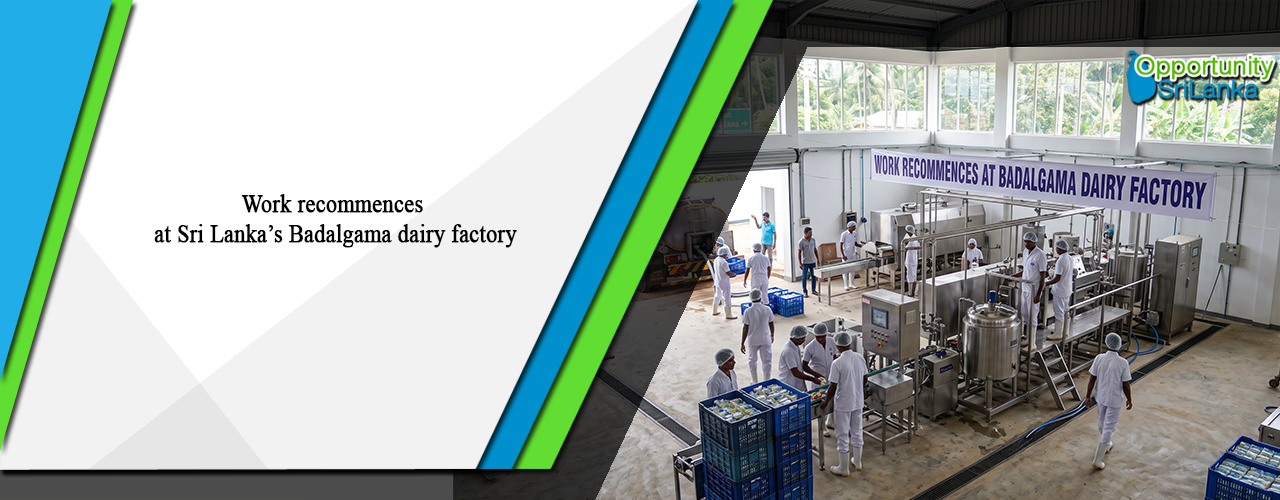
Work recommences at Sri Lanka’s Badalgama dairy factory
The Morning: The Government has recommenced work at the abandoned Badalgama dairy factory, which is scheduled to open next year and is slated to have a daily milk demand of 200,000 litres once operational.
Speaking to The Morning Business, Deputy Minister of Agriculture and Livestock Namal Karunaratne said that the Government had taken the decision to allocate around Rs. 3 billion to recommence work at the dairy factory.
“Once the factory commences operations, if it runs at full capacity, it will need 200,000 litres of milk to operate. This means we will be producing a large quantity of [dairy] products,” he stated.
The Deputy Minister added that this would prove beneficial for dairy farmers as well as for the country as a whole, since the large quantity of dairy products would help reduce reliance on imports and thereby reduce the outflow of foreign exchange, considering the significant foreign exchange expended on imported dairy products.
Responding to queries as to a possible timeline for the completion of the dairy factory, Karunaratne stated that it was scheduled to be opened by next year.
In his 2026 Budget speech, delivered in his capacity as Minister of Finance, President Anura Kumara Dissanayake stressed the importance of resuming construction of Milco Ltd.’s Badalgama dairy factory.
“It is very important to resume the construction work of the Badalgama dairy factory of Milco Ltd. The [construction of the] factory, which was started in 2015, has already been stalled, having already spent about Rs. 18,000 million of public money.
“This project, which has been abandoned since 2022, will be implemented in line with the Government’s policy statement to increase local milk production to process milk to a higher standard in order to contribute effectively to the national economy in the future.
“Accordingly, it is proposed to allocate Rs. 3,000 million for the basic works required to complete the remaining works of the factory, in particular, the rectification of machinery and buildings and the renovation of the factory in order to commence production.”
OSL take:
Sri Lanka’s renewed push to achieve self-sufficiency in fresh milk and dairy products is creating a growing range of business/investment opportunities for foreign businesses/investors across the dairy value chain. The Sri Lankan Government’s decision to allocate around Rs. 3 billion to recommence work at the long-abandoned Badalgama dairy factory is a significant step in this direction. For foreign businesses/investors, the opportunity extends well beyond milk production. Rising domestic demand and the Government’s efforts to reduce costly dairy imports could support investment in modern dairy farms, milk collection networks, cold-chain infrastructure, processing plants, animal feed, breeding and veterinary services, as well as dairy technology and packaging. International companies could also play a role by bringing advanced processing technologies, farm-management systems, genetics, productivity-enhancing technologies and expertise in value-added dairy products such as cheese, yoghurt, butter and milk powder. The expansion of domestic milk production would also create opportunities for partnerships between foreign companies and Sri Lankan farmers, cooperatives and processors. Such investments could improve productivity and quality while creating more reliable supply chains for large-scale processing. With billions of rupees currently spent on imported dairy products, Sri Lanka’s drive towards greater self-sufficiency offers businesses/investors an expanding domestic market, while future improvements in production capacity could eventually create opportunities to develop export-oriented dairy products. The sector is therefore emerging as a potentially attractive area for long-term investment linked to food security, import substitution and agricultural modernisation.
| Article Code : | VBS/AT/20260814Z_4 |