
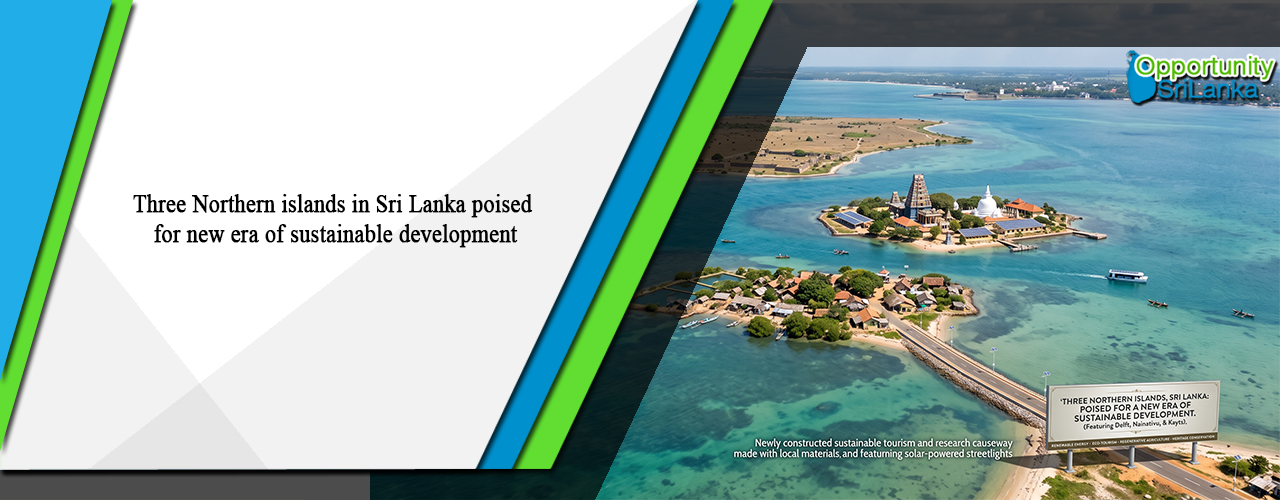
Three Northern islands in Sri Lanka poised for new era of sustainable development
Daily FT: A new chapter is unfolding in the development of Sri Lanka’s Northern Islands, with the commissioning of a Hybrid Renewable Energy Project combining Solar Power, Battery Energy Storage and Generators at Delft Island recently.
The project marks a significant transformation in the way electricity is generated on the island, replacing the cumbersome and costly dependence on diesel-generator-based power generation with a modern, sustainable energy system.
More importantly, the project is expected to create opportunities far beyond electricity generation. Reliable and sustainable power can become the foundation for increased habitation, tourism, small and medium-scale industries, commercial activities and improved livelihoods across the three Northern Islands of Delft, Nainathivu and Analathivu.
The project is part of the Indian Government’s grant assistance to the Government of Sri Lanka for the development of renewable-energy systems in the three islands off the Jaffna Peninsula.
Speaking on the successful completion of the Delft project, U Solar Project Manager Dinesh said the project was completed despite significant logistical and transportation challenges.
The equipment and systems had to be transported through a complex combination of sea, land, sea and inland road transportation, presenting considerable challenges in moving specialised equipment to a remote island location.
Despite these difficulties, the project was successfully completed and commissioned, demonstrating that modern renewable-energy infrastructure can be delivered even in geographically challenging island environments.
According to Dinesh, the Delft system is capable of generating approximately 600 kW of electricity, while the island’s present consumption is only around 300 kW.
This means that the island has significant available capacity to accommodate future increases in electricity demand.
The significance of this surplus extends well beyond households. Reliable electricity creates the basic infrastructure required for new businesses, tourism facilities, cold-storage facilities, workshops, commercial establishments and other productive economic activities.
U Solar is expected to commission the Analathivu project within approximately one week, followed by the Nainativu project within approximately two weeks.
With the completion of all three projects, Delft, Nainathivu and Analathivu will move towards having reliable and sustainable electricity generation capacity with a reserve for future development, rather than merely generating electricity sufficient for their present requirements.
This changes the development equation for the islands.
For decades, limited and costly energy availability has been one of the practical constraints to economic development in remote islands.
The availability of dependable electricity can now provide the platform for a new generation of development.
Tourism operators can consider new accommodation and hospitality ventures. Investors can establish businesses that were previously impractical. Local entrepreneurs can expand commercial activities. Fisheries and agriculture-related enterprises can introduce refrigeration, processing and value addition. Schools, health services and community facilities can operate with greater reliability.
Most importantly, improved energy availability can make the islands more attractive for future habitation, encouraging people to live, work and invest there rather than viewing the islands merely as remote destinations.
OSL take:
Sri Lanka’s growing shift towards renewable energy is creating business/investment opportunities for foreign businesses/investors across power generation, energy storage and supporting infrastructure. The commissioning of the hybrid renewable energy project on Delft Island, combining solar power, battery storage and generators, demonstrates how renewable systems can provide reliable electricity to remote areas while reducing dependence on costly diesel generation. For foreign businesses/investors, opportunities extend beyond large-scale solar and wind projects to battery energy storage, mini-grids, rooftop solar, smart-grid technology, energy-efficiency solutions and operation and maintenance services. The development of renewable systems in the Northern Islands also highlights the potential for private investment in decentralised energy projects serving remote communities and emerging economic zones. Sri Lanka’s broader renewable-energy ambitions could also create opportunities for international companies with expertise in project development, engineering, financing, energy technology and grid integration. As reliable electricity supports tourism, industry and commercial activity, renewable-energy investment can generate opportunities beyond the power sector itself. For foreign businesses, Sri Lanka’s transition towards cleaner energy therefore offers the potential to participate in both the expansion of power generation and the wider economic development that dependable renewable electricity can enable.
| Article Code : | VBS/AT/20260909Z_3 |