
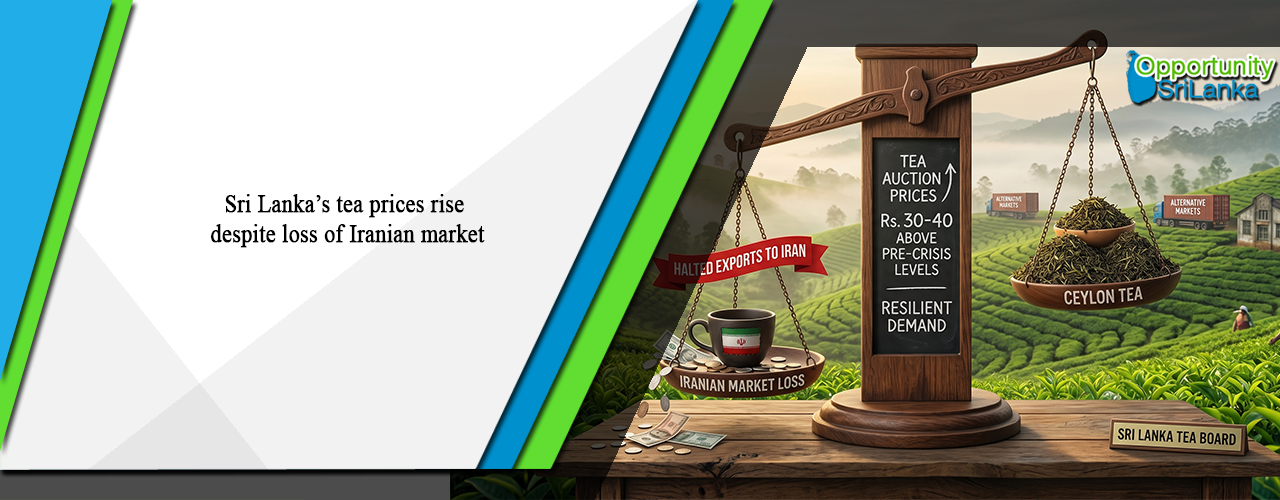
Sri Lanka’s tea prices rise despite loss of Iranian market
The Morning: Tea prices at Sri Lanka’s local auctions have risen above pre-crisis levels despite a significant drop in export volumes and a complete halt in exports to Iran, according to the Sri Lanka Tea Board (SLTB).
Speaking to The Sunday Morning Business, SLTB Chairman Rajpal Obeyesekere said that tea exports to Iran had come to a complete standstill amid the ongoing crisis in the Middle East.
He revealed that despite the loss of the Iranian market, the local tea market had remained resilient, with auction prices increasing by approximately Rs. 30-40 compared to pre-crisis price levels.
The SLTB Chairman added that unsold quantities at auctions were currently averaging around 10-12%, marking an improvement from pre-crisis conditions.
However, Obeyesekere cautioned that the external market remained highly volatile and fluid. He noted that any disruptions in key shipping routes, particularly in the Red Sea or the Gulf of Oman, could adversely impact the local tea industry.
Commenting on the loss of the Iranian market, he revealed that tea varieties traditionally exported to Iran had begun finding demand in alternative markets.
“Although things are not moving in the direction of Iran, there are other markets that are taking up tea strains usually purchased by Iran, and in fact, those teas have been selling well on average. Some tea strains are not being taken up, of course, but that is a small segment in terms of quantity,” he stated.
Nevertheless, Obeyesekere acknowledged that overall tea export volumes had declined by around 20%. He clarified that this decline was not solely due to the loss of the Iranian market but also reflected weaker demand and constraints in other export destinations.
OSL take:
Sri Lanka’s tea sector is showing a notable shift with even lower export volumes and the loss of key markets like Iran; auction prices have climbed to above pre-crisis levels. That combination points to a tightening supply base and resilient global demand with conditions that tend to favour investment, especially in premium segments. For foreign businesses/investors, this creates a strong case to move beyond bulk tea and into value-added products. Branded, origin-certified “Ceylon Tea” already carries global recognition, but there is room to expand into specialty lines such as organic, single-estate, artisanal, and wellness-oriented teas. These categories command higher margins and align with evolving consumer preferences in Europe, North America, and parts of Asia. There are also opportunities to invest in plantation modernization since productivity in many estates remains below potential due to aging bushes and traditional cultivation methods. Capital infusion for replanting, mechanisation, and climate-resilient farming can significantly improve yields while ensuring long-term sustainability. Foreign businesses/investors with expertise in agri-tech and sustainable agriculture are particularly well-positioned in this aspect. Also, processing infrastructure, especially energy-efficient factories and advanced grading, blending, and packaging facilities, can enhance quality consistency and reduce costs. There is also growing scope in ready-to-drink (RTD) teas, tea extracts, and nutraceutical applications, where global demand is expanding rapidly. Therefore, rising tea prices despite constrained supply underline the strength of Sri Lanka’s tea brand. For foreign businesses/investors, this is less a signal of risk and more an indication of untapped business potential, particularly in premiumisation, sustainability, and innovation across the tea value chain.
| Article Code : | VBS/AT/20260504/Z_2 |