
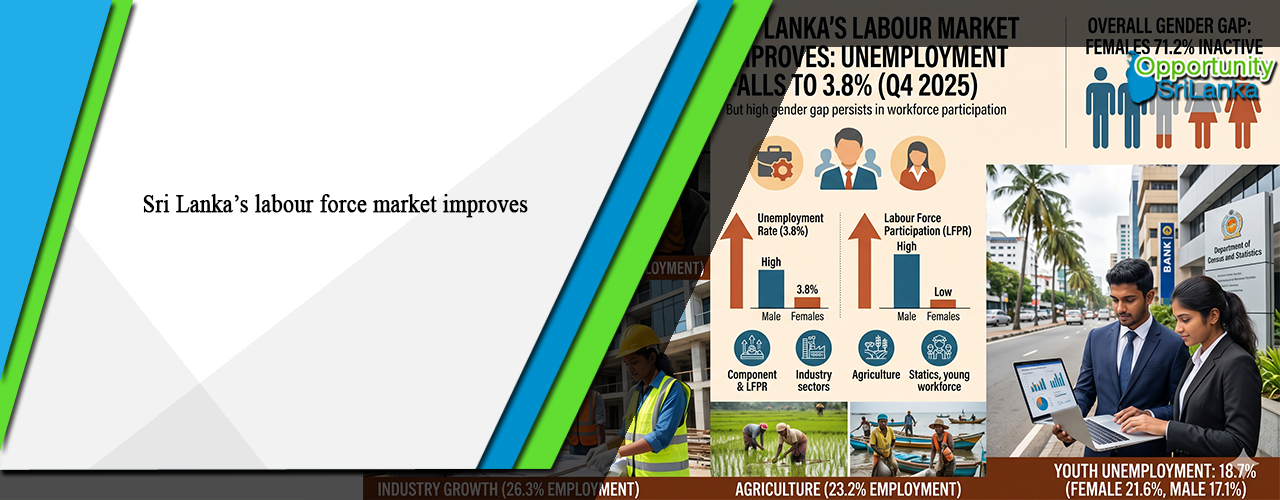
Sri Lanka’s labour force market improves
The Morning: Sri Lanka’s labour market showed signs of recovery in early 2026, with the unemployment rate declining to 3.8% in Q4 2025 from 4.2% in Q4 2024. However, a significant proportion of women remained outside the workforce, accounting for 71.2% of the total population, according to the latest Labour Force Survey report released by the Department of Census and Statistics
According to the report, the economically inactive population is about 9.2 million, of which 28.8% are males and 71.2% are females. The estimated economically active population is about 8.8 million in the fourth quarter, of which 64.4% are males and 35.6% are females.
However, the overall unemployment rate in Q4 2025 was higher among females at 5.7%, compared to 2.7% for males. Youth unemployment (ages 15-24) remained the highest across all age groups at 18.7%. Within this group, male unemployment stood at 17.1%, while female youth unemployment was higher at 21.6%.
The distribution of the Labour Force Participation Rate (LFPR) by age group and gender depicts high male participation compared to female across all age groups. The highest participation rate for males is reported in the age group 35-39 years (94.9%), while for females it is reported in the 50-54 age group (46.7%), the report showed.
Despite the gender gap in economic activity, the employment rate is projected to remain high at around 96% of the total population, according to the report.
In the fourth quarter of 2025, Sri Lanka’s employed population was estimated at 8.5 million, with the highest contribution from the services sector (50.6%), followed by industry (26.3%) and agriculture (23.2%). Compared to the same period in 2024, employment in both the industry and services sectors recorded an increase, according to the report. The non-agricultural sector now accounts for 76.8% of total employment, with private sector employees and own-account workers being the highest contributors to the workforce.
Across both genders, services remained the dominant sector of employment, while agriculture continues to have the smallest share. Female participation in agriculture stood at 23.0%, almost equal to 23.2% recorded for males.
OSL take:
Sri Lanka’s labour market data for late 2025 points to a gradual but steady improvement in economic conditions, offering further evidence of a more stable and business-conducive environment emerging after years of disruption. Employment levels in Sri Lanka remained robust at approximately 8.5 million, with the services sector accounting for just over half of total employment (50.6%), followed by industry (26.3%) and agriculture (23.2%). The dominance of the non-agricultural economy that now represents 76.8% of total employment, reflects an ongoing structural shift towards more diversified and productivity-oriented economic activity. Private sector employment and own-account work continue to be key drivers of this expansion, signalling improving space for entrepreneurship and business growth. These factors are indicative of the expanding business/investment opportunities in all key economic sectors in Sri Lanka. Also, Sri Lanka’s stabilisation, combined with its strategic geographic location in the Indian Ocean and established trade linkages across Asia, Europe, and the Middle East, continues to support its positioning as an accessible hub for regional commerce and services. Sri Lanka’s improving macroeconomic stability and ongoing structural reforms may offer a comparatively attractive alternative for medium- to long-term investment.
| Article Code : | VBS/AT/20260423/Z_1 |