
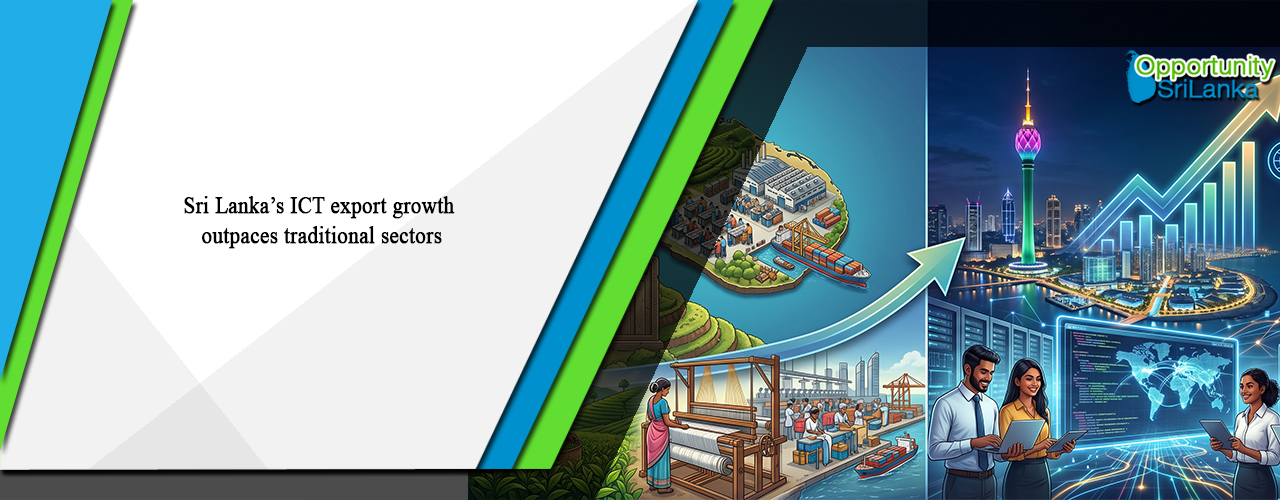
Sri Lanka’s ICT export growth outpaces traditional sectors
The Morning: Sri Lanka’s ICT sector is gaining momentum as a major contributor to service exports, with the sector recording around $ 536 million in earnings during the first four months of 2026 and annual growth of about 20%, according to Export Development Board (EDB) officials.
Speaking on Ada Derana’s ‘Big Focus’ programme recently, EDB Director Indumini Kodikara said ICT has become one of the key sectors supporting Sri Lanka’s efforts to improve export growth and strengthen its position in global value chains.
“The ICT sector is a key segment to look forward to, which strengthens the country’s position in the global value chain. In the previous year to early 2026, contribution for the service exports from the ICT sector was around 1.7%, which is more than tea exports,” Kodikara said.
She said the global services market is expanding, while Sri Lanka is also seeing increased opportunities in the sector due to lower production costs and higher value addition.
“In the global market for service exports, about 27% of goods and services are through the services sector. The growth in services has increased in the world, and it is also increasing in Sri Lanka, due to low cost of production and high value addition,” she said.
EDB Chief Executive Officer Mangala Wijesinghe, as cited by The Daily Morning Business, said the ICT segment has emerged as one of the significant contributors to Sri Lanka’s service exports, recording a 20% increase each year. He said the sector contributed around $ 536 million to Sri Lanka’s service exports during the first four months of 2026.
The EDB is seeking to raise service sector revenue to $ 5 billion by 2030, with plans to support ICT through infrastructure facilities, training, and development initiatives.
Kodikara said the services strategy is not limited to ICT, noting that transport and logistics had also recorded growth of 1.9% from last year to early 2026. She said the EDB is also focusing on electronics and electrical services, as well as marine and offshore services, to capture opportunities in areas that remain underutilised.
“We can further improve the services of this sector. We are also focusing on the Electronics and Electrical Service sector, and Marine and Offshore Service sector to take opportunities. Thus far, this is a sector that Sri Lanka has not utilised. Hence, there is a potential to improve that too.”
Kodikara said Colombo Port remains the country’s largest transit shipment hub, while ongoing terminal upgrades are expected to support future expansion.
“Currently, Colombo Port is the largest transit shipment hub for the country. We handle about 7 billion TEU’s at the hub, while working to increase it to a target of 9 billion TEU’s subsequently. At present, the terminal is being upgraded. Hence, we need to bring foreign investments to the country to improve this further,” she said.
Wijesinghe said Sri Lanka Customs and the Port Authority Administration are playing an important role in supporting foreign investment into service sectors.
“Sri Lanka Customs and the Port Authority Administration, under the patronage of the Sri Lanka President Anura Kumara Dissanayake, is now playing a key role in supporting the growth of foreign investments to further improve the service sectors.”
“Through the Hambantota and Trincomalee hub, we will focus on the vulnerabilities in Sri Lanka and bring investments to the transport and logistics sector. We have already planned to develop the capacity side towards transport and logistics.” he said.
Kodikara said Sri Lanka is also pursuing trade discussions with potential partner countries to strengthen its integration with global value chains and support the National Export Development Plan.
OSL take:
Sri Lanka is emerging as a fast-growing hub in South Asia’s digital economy, with its ICT sector showing strong export momentum and attracting increasing attention from global investors. With reported earnings of around $536 million in the first four months of 2026 and annual growth of approximately 20%, the sector is signaling sustained expansion and rising global competitiveness. For foreign businesses/investors, this growth translates into several clear business/investment opportunities. First, Sri Lanka’s positioning as a cost-effective outsourcing destination continues to strengthen, particularly in software development, business process outsourcing (BPO), and customer support services. A skilled, English-speaking workforce and improving digital infrastructure make it an attractive alternative to more saturated regional markets. Second, the country is gradually evolving beyond traditional outsourcing into higher-value services such as fintech, AI-driven solutions, cybersecurity, and SaaS product development. This shift opens space for foreign venture capital, strategic partnerships, and technology transfer collaborations with local firms and startups. Urban tech ecosystems, especially around Colombo, are also expanding, supported by incubators, accelerators, and increasing private sector participation. Meanwhile, Sri Lankan government-backed initiatives through the EDB and broader national digital transformation strategies are aimed at improving export readiness and easing market entry for foreign businesses/investors. As Sri Lanka continues to position itself as a regional digital services hub, business/investment opportunities are emerging not only in service delivery but also in co-developing products for global markets, investing in early-stage tech companies, and establishing regional innovation centers. For investors seeking high-growth, cost-efficient digital expansion in Asia, Sri Lanka’s ICT sector is increasingly becoming a compelling option.
| Article Code : | VBS/AT/20260707Z_1 |