
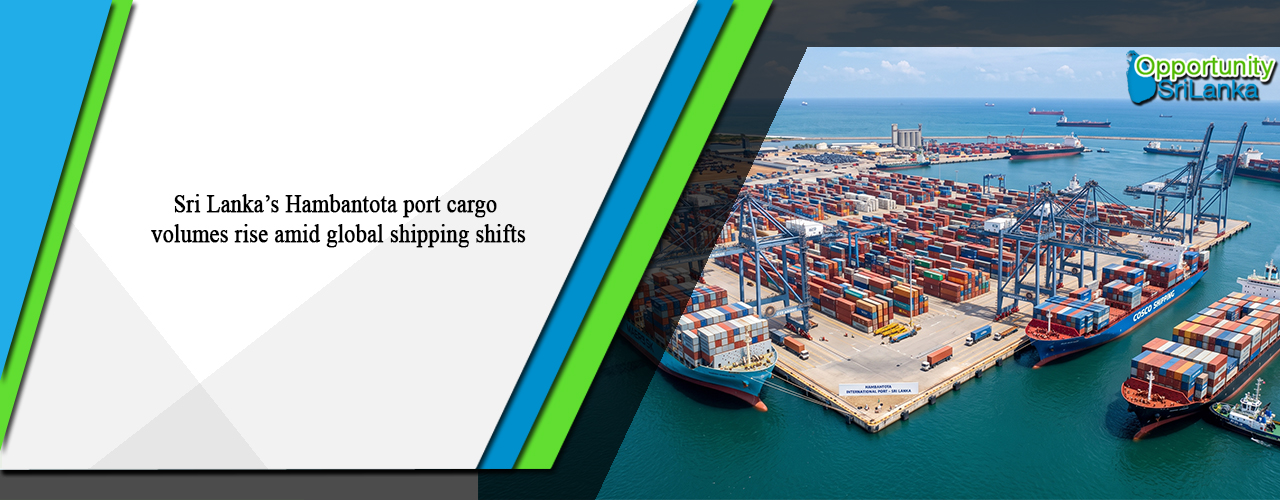
Sri Lanka’s Hambantota port cargo volumes rise amid global shipping shifts
EconomyNext: Sri Lanka’s Hambantota International Port (HIP) has recorded its highest-ever monthly throughput for both roll-on/roll-off (RoRo) and container operations in June 2026, driven by regional shipping disruptions and capacity expansions.
The port handled 90,219 vehicles and 80,325 twenty-foot equivalent units (TEUs) during the month, Hambantota International Port Group said.
“June’s performance demonstrates the importance of anticipating change and being ready when customers need alternatives,” Wilson Qu, Chief Executive, Hambantota International Port Group (HIPG) said.
Officials attributed the volume surge to early operational planning triggered by rising security uncertainties around the Strait of Hormuz in West Asia.
Shipping lines seeking alternative networks shifted cargo to the southern Sri Lankan port, which sits 10 nautical miles off the main East-West sea lane.
The June milestone follows expansion at the facility. In 2025, HIP’s total cargo throughput rose 175 percent year-on-year to 8.24 million metric tonnes.
Container volumes grew to 428,036 TEUs in 2025, up from 53,169 TEUs in 2024.
To accommodate the shifting trade flows, the port recently doubled its RoRo yard capacity and expanded its container yard space by 30 percent. HIPG has also committed 108 million USD for new container handling equipment, aiming to lift its annual container terminal capacity to 2 million TEUs.
The port’s container segment has seen consecutive volume spikes this year. In April 2026, HIP recorded its highest single-vessel container throughput, handling 13,260 TEUs on the MSC Marie Leslie.
Operated as a public-private partnership, HIP manages diversified marine operations including RoRo, containers, bulk cargo, energy, and ancillary marine services.
OSL take:
Sri Lanka’s maritime sector is emerging as an increasingly attractive destination for foreign investment, supported by rising cargo volumes, strategic location, and ongoing infrastructure development. The record performance at Hambantota International Port in June 2026 highlights the country’s growing role as a regional logistics hub, particularly as global shipping lines seek resilient and flexible alternatives amid geopolitical disruptions. Beyond port operations, expanding maritime activity is creating business/investment opportunities across a wide range of related sectors. Foreign businesses/investors can explore prospects in logistics and warehousing, vehicle transshipment services, container freight stations, cold-chain facilities, ship repair and maintenance, bunkering, marine engineering, and digital port technologies. Growth in port throughput is also expected to stimulate demand for industrial parks, export-oriented manufacturing, and value-added processing linked to Sri Lanka’s ports. With its position along one of the world’s busiest east-west shipping routes, Sri Lanka is well placed to benefit from shifting global supply chains and increasing demand for regional distribution hubs. Continued investments in port capacity, connectivity, and trade facilitation are likely to strengthen the country’s competitiveness, offering international businesses opportunities to establish long-term operations serving South Asia, the Middle East, and East Africa.
| Article Code : | VBS/AT/20260715Z_1 |