
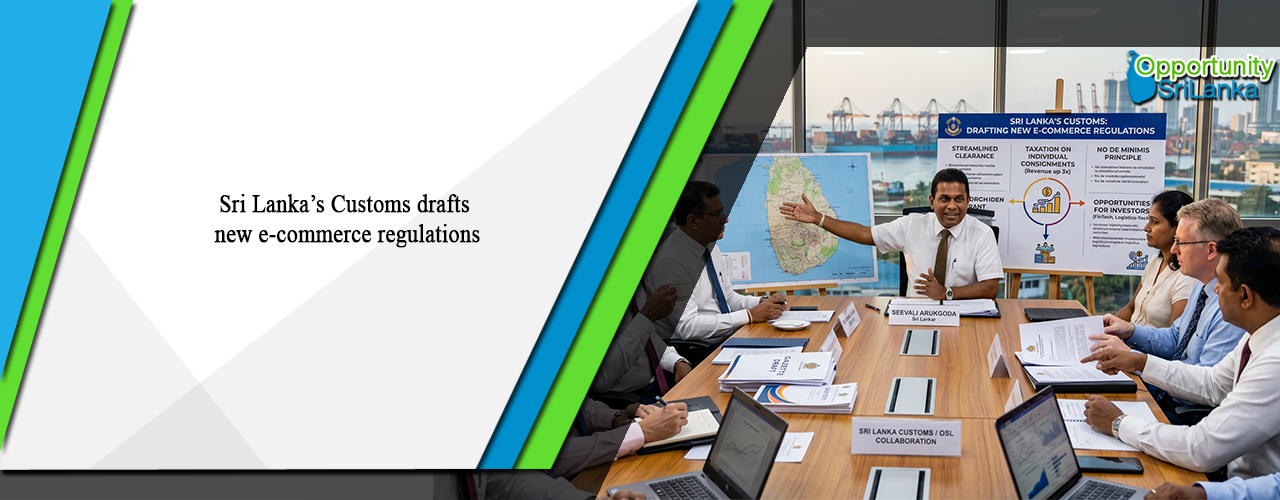
Sri Lanka’s Customs drafts new e-commerce regulations
The Morning: Sri Lanka Customs has commenced drafting new regulations to govern the clearance of e-commerce goods, which will be submitted to the Minister of Finance to be published in the gazette once completed.
Speaking to The Sunday Morning Business, Customs Media Spokesperson Chandana Punchihewa, whilst acknowledging that regulations were being drafted at present to govern e-commerce, further revealed that the proposed regulations would outline how e-commerce goods should be declared and taxed.
“The regulations will address how goods are to be declared, whether it will be done as a normal Customs declaration or through a simplified document, and how applicable taxes will be imposed,” he explained.
He further noted that once the drafting process was completed, the regulations would have to be submitted for publication in the gazette by the Minister of Finance.
Punchihewa also revealed that the drafting process followed discussions held last year with representatives of major e-commerce platforms. “They indicated that they are not opposed to regulations, provided that these are clear and easy to comply with,” he said.
However, Punchihewa was unable to provide a specific timeline for the completion of the draft regulations, noting that he was not directly involved in the drafting process.
Meanwhile, speaking to The Sunday Morning Business, Customs Director General Seevali Arukgoda acknowledged the need to streamline the clearance process for e-commerce imports.
He confirmed that the de minimis principle was no longer being applied to e-commerce goods and stated that there were no plans to reinstate it. He added that since shifting to taxing individual e-commerce consignments, revenue from such imports had increased threefold.
“We have moved away from bulk taxation to taxing individual packages,” he said.
Arukgoda further clarified that Customs did not intend to differentiate between Business-to-Business (B2B) and Business-to-Consumer (B2C) e-commerce imports.
He emphasised that e-commerce channels were not intended for commercial-scale imports, adding that any large-volume imports made through such platforms would be treated as regular commercial imports.
OSL take:
Sri Lanka’s move to formalise regulations for e-commerce clearance marks another step in its broader digital transformation agenda, one that is steadily reshaping the country into an emerging business destination in South Asia. Clearer rules from Sri Lanka Customs will streamline cross-border e-commerce, reduce uncertainty, and improve efficiency in logistics and trade facilitation. For foreign businesses/investors, this creates a more predictable environment to enter Sri Lanka’s fast-growing digital marketplace, particularly in online retail, marketplaces, and cross-border fulfillment services. The wider digitisation programme is opening opportunities across multiple layers of the digital economy. Investments in fintech and digital payments are especially promising, as increasing internet penetration and mobile usage drive demand for secure, scalable transaction platforms. Similarly, logistics-tech solutions such as last-mile delivery optimisation, warehouse automation, and inventory management systems also stand to benefit from the rise in e-commerce activity. Sri Lanka also presents strong potential as a regional IT and business process outsourcing (BPO) hub. With a skilled, English-speaking workforce and competitive operating costs, foreign businesses can explore partnerships or establish delivery centers in software development, AI solutions, and back-office services. The Sri Lankan government’s support for digital infrastructure, including cloud adoption and data management frameworks, further strengthens this value proposition. There also is growing space in digital public infrastructure and GovTech, where foreign expertise can support modernization of customs, taxation, and public service delivery systems. Therefore, Sri Lanka’s digital push, which is anchored by regulatory reforms and infrastructure upgrades, is laying the groundwork for a more connected, efficient economy. For foreign businesses/investors, this translates into timely opportunities to enter a market that is rapidly integrating into global digital trade networks.
| Article Code : | VBS/AT/20260504/Z_4 |