
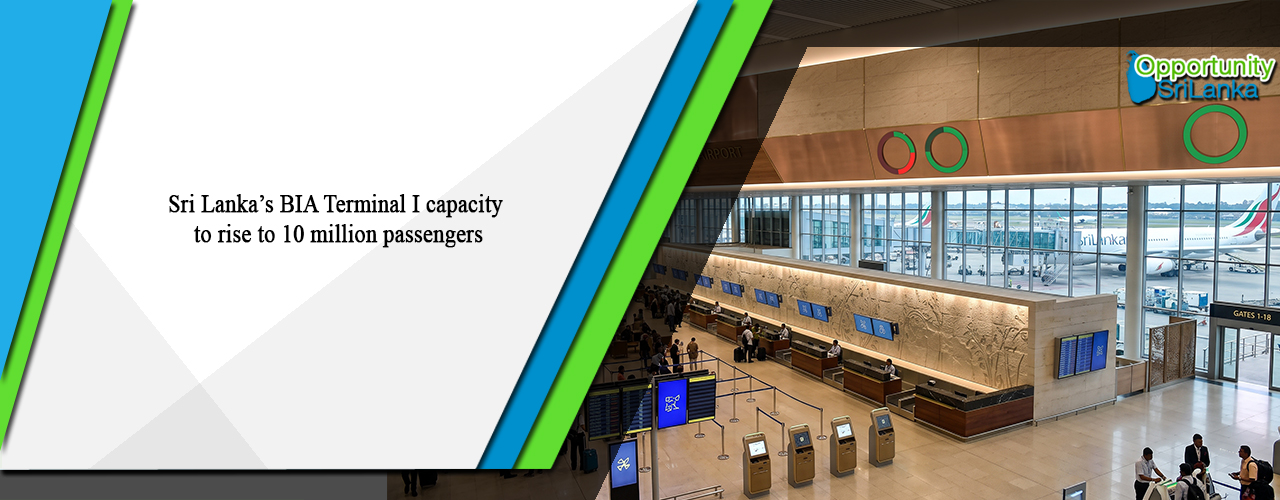
Sri Lanka’s BIA Terminal I capacity to rise to 10 million passengers
The Morning: The Government is looking to expand the capacity of Terminal I of the Bandaranaike International Airport (BIA) to 10 million passengers per annum within the next 12 months, even as it finalises the recommencement of the stalled BIA Terminal II project.
Speaking to The Morning Business, Deputy Minister of Ports and Civil Aviation Janitha Ruwan Kodithuwakku said that the Japan International Cooperation Agency (JICA) had informed the Government that the contractor for the Terminal II project would be selected and appointed by December.
“They informed us that the project could be awarded by December, and we can commence the project thereafter,” he said.
Kodithuwakku further revealed that the necessary gap financing required to complete the project following the escalation of costs would also be finalised by JICA before the contract was awarded to the selected contractor.
Meanwhile, the Government has also taken steps to expand Terminal I to address the congestion issues at the BIA.
Accordingly, as part of the Terminal I expansion project, the Government has granted a one-year project to Maga Engineering Ltd., which involves building 36 check-in counters and a fully equipped lobby area.
“The project has been awarded and Maga has started mobilisation,” Kodithuwakku said.
He said that around four additional projects earmarked to expand the capacity of Terminal I were in the pipeline and that the Government was hopeful of awarding them within the next three months.
“These are all one-year projects and will be completed by next year,” he said.
He added that these measures were expected to increase the capacity of Terminal I to 10 million passengers per annum within a year.
The contract for the construction of the BIA Terminal II project, which involves the construction of a multi-level terminal, was valued at $ 564 million and was initially awarded to the Taisei Corporation in 2020.
However, following the stoppage of construction work in 2020 due to the funding freeze imposed by JICA following Sri Lanka’s default, Taisei Corporation terminated its contract with Sri Lanka.
The construction of this multi-level terminal is part of Package A of the BIA expansion project, which was initially estimated to cost Rs. 133 billion.
The project was to be largely funded by the Special Terms for Economic Partnership (STEP) concessionary Official Development Assistance (ODA) loan granted by JICA, amounting to Rs. 131.5 billion (¥ 74.4 billion) at a 0.1% interest rate per annum.
The remaining Rs. 21.5 billion was to be funded by Airport and Aviation Services (Sri Lanka) Ltd. (AASL).
Under Package A, AASL entered into two agreements with JICA. The first agreement was entered into in March 2012 for ¥ 29 billion, and the second in March 2016 for ¥ 45.4 billion.
OSL take:
Sri Lanka’s renewed infrastructure development drive is creating a widening range of business/investment opportunities for foreign businesses/investors, with the airport and aviation sector emerging as a key area as the country seeks to strengthen connectivity and support its next phase of economic growth. The planned expansion of BIA’s Terminal I to accommodate up to 10 million passengers annually, alongside the expected recommencement of the long-delayed Terminal II project, reflects the Sri Lankan Government’s focus on expanding aviation capacity to meet rising passenger and tourism demand. For international businesses/investors, opportunities extend beyond airport construction. Airport management, ground handling, cargo and logistics, aviation services, duty-free retail, hospitality, digital infrastructure and passenger services are among the areas that could benefit from increased capacity and traffic. Sri Lanka’s strategic position in the Indian Ocean also provides scope to develop Colombo as a stronger regional aviation and logistics gateway, connecting South Asia with the Middle East, Southeast Asia and other international markets. As tourism, trade and business activity recover, investment in aviation infrastructure will become increasingly important to the country’s broader development programme. Improving airport capacity and connectivity could therefore provide foreign businesses/investors with a platform to participate in Sri Lanka’s economic expansion while positioning the country as a more competitive regional hub.
| Article Code : | VBS/AT/20260901Z_1 |