
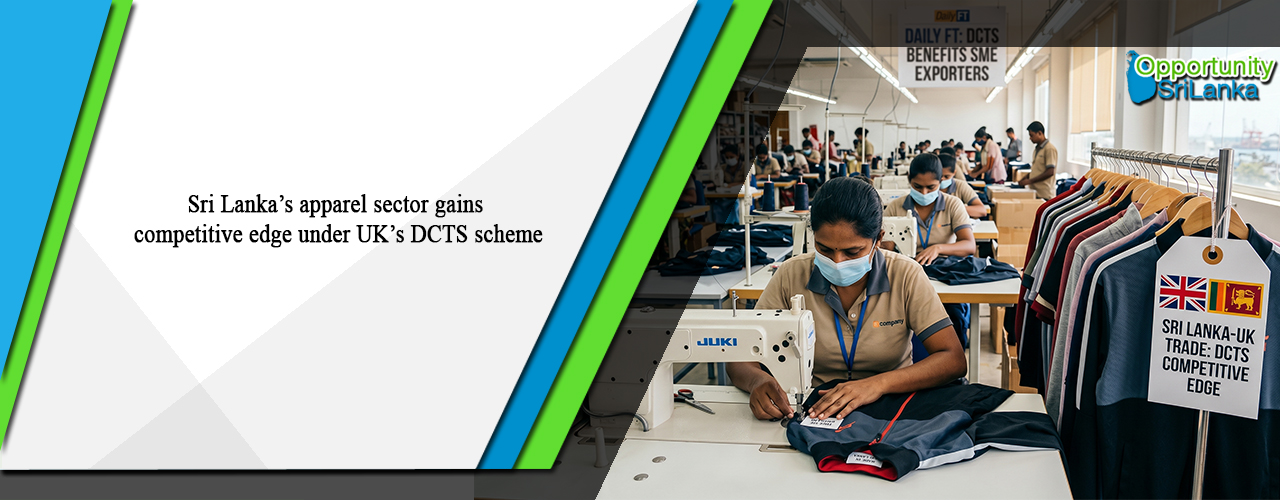
Sri Lanka’s apparel sector gains competitive edge under UK’s DCTS scheme
Daily FT: The United Kingdom’s revised Developing Countries Trading Scheme (DCTS), effective from January 2026, presents a clear opportunity for Sri Lanka’s apparel sector. It is particularly significant for small and medium-sized exporters, offering them a stronger footing in a key market.
The real strength of the revised scheme lies in its practicality. By easing rules of origin and allowing greater flexibility in sourcing inputs, DCTS removes a longstanding constraint that has disproportionately affected smaller exporters. This shift enables Sri Lankan firms to operate with greater agility, improving pricing options, shortening lead times, and responding more effectively to buyer requirements.
For SMEs, this is a meaningful change. The constraint has not been production capacity, but the ability to source competitively, manage costs, and meet the speed and consistency expected by global buyers. Greater flexibility addresses these gaps, allowing smaller exporters to engage more confidently and compete on more equal terms.
From an industry perspective, DCTS should be viewed as a competitiveness enabler. It creates space for Sri Lankan exporters to position themselves more effectively in the UK market, particularly in segments that value flexibility, specialisation, and shorter production cycles. These are areas where SMEs are well placed to contribute and scale.
Joe Jayawardena, an apparel exporter to the UK with experience across sourcing markets, highlighted the practical value of the DCTS. He noted that while the scheme offers duty concessions for developing countries, its real strength lies in how it enhances commercial flexibility. With greater freedom to source inputs without losing preferential access, exporters are better positioned to negotiate on price, lead time, and fabric selection factors that play a decisive role in securing and retaining business in the global apparel market.
The scheme also opens the door to stronger market engagement. With improved access and operational flexibility, exporters are better positioned to build direct relationships with buyers and explore new commercial opportunities.
The DCTS provides a timely platform to expand opportunities across the sector, strengthen export momentum, and support the development of a more competitive and diversified apparel industry in Sri Lanka.
OSL take:
Sri Lanka’s export industry has shown great strength and resilience through the years and is continuing its growth momentum with the apparel sector being one of the key export commodities recording high growth. The many trade agreements and trade concessions enjoyed by Sri Lanka with many foreign countries have helped boost the country’s overall export industry. The continuing growth in the apparel sector also presents business/investment opportunities due to expansion witnessed in many related sectors like the introduction of latest technical and technological advancements, improving to meet the evolving demands of the global market as well as being on par with the latest developments in the global apparel and fashion industry. Given Sri Lanka’s geographical positioning in the Indian Ocean, the expanding opportunities and the improving business conducive environment in the country all serve to attract the attention of foreign businesses/investors. In addition, the growth, profits and expansion of businesses already engaged in the country’s apparel sector and the increasing interest among foreign businesses/investors to enter the sector indicate the increasing business potential in Sri Lanka’s apparel sector and overall export industry.
| Article Code : | VBS/AT/20260420/Z_1 |