
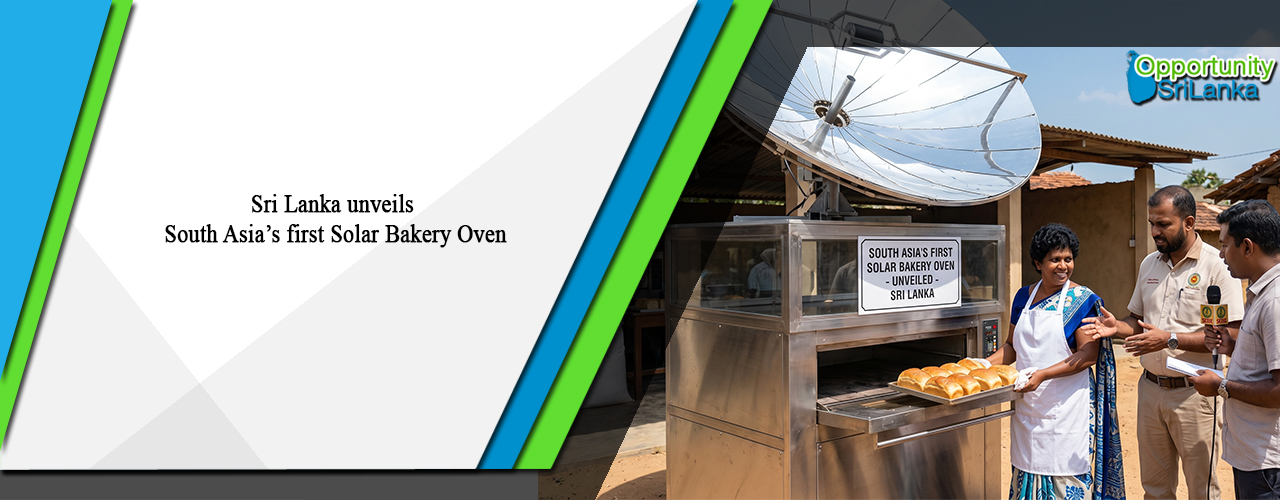
Sri Lanka unveils South Asia’s first Solar Bakery Oven
Daily Mirror: Sri Lanka became the first country in South Asia to unveil a solar hybrid bakery oven, designed with both solar and biogas energy sources to ensure uninterrupted operation despite unpredictable weather conditions.
The event, held on 22 May at Cinnamon Lakeside Colombo, was hosted by Incitare Sri Lanka and the Global Rethinking Finance Collaborative (GRFC), in strategic collaboration with German Tech Kilinochchi, and was graced by Olivier Praz, Deputy Head of Mission at the Embassy of Switzerland to Sri Lanka and Maldives, and Fabio Germano, Representative of GIZ Sri Lanka. The initiative marks South Asia’s first deployment of this European clean technology, replacing fossil-fuel baking with solar and biogas-powered alternatives while supporting sustainable livelihoods and multiple UN Sustainable Development Goals.
Beris Gwynne, Founder and CEO of Incitare International and GRFC said, “We are ready to present a hybrid solar oven that we believe has serious potential not only for communities, bakeries, eco-tourism establishments, but also for training institutions, to be able to reduce the carbon footprint, producing products that reduce imports reliance and potentially establish a new field of export industry.”
Cheryl Arndt, Country Director for Sri Lanka at Incitare International, who has been instrumental in driving the programme on the ground, said, “What we are witnessing today is the result of years of quiet, determined work by communities, partners, and institutions who refused to wait for change and chose to create it. Sri Lanka has not just adopted a new technology. It has demonstrated that sustainable livelihoods and clean energy are not aspirations for tomorrow. They are happening right here, right now.”
The initiative began in March 2025 with a national stakeholder dialogue led by and attended by key government institutions. The discussions led to three major partnerships focused on donating solar ovens, developing a low-cost locally produced solar oven, and expanding sustainable livelihood opportunities for vulnerable communities.
GIZ Sri Lanka Representative Fabio Germano, whose organisation has played a central role in the technology transfer and local innovation dimensions of this work, reflected on the milestone. “It is a pleasure and honour to be part of this partnership with Incitare International, GIZ Sri Lanka, and the Sri Lanka-German Technical Training Institute (SLGTTI) in Kilinochchi.”
OSL take:
Sri Lanka’s introduction of innovative solutions such as the solar hybrid bakery oven, powered by both solar and biogas, reflects a broader shift in its energy landscape toward practical, decentralised, and resilient renewable technologies. This kind of innovation signals a growing openness to clean energy solutions that are adaptable to local conditions while reducing dependence on imported fossil fuels. Within this context, the renewable energy sector has become one of the most promising areas for foreign investment in Sri Lanka. The country’s natural advantages in solar, wind, and biomass resources provide a strong foundation for utility-scale and distributed renewable projects. Solar and wind power developments, in particular, are gaining traction as Sri Lanka works to diversify its energy mix and improve energy security. For foreign businesses/investors, opportunities are emerging across the entire value chain – from project development and independent power production to energy storage, smart grid solutions, and hybrid systems that combine multiple renewable sources. There is also growing demand for technology providers specialising in efficiency optimization, rural electrification, and industrial-scale clean energy integration. At the same time, smaller-scale innovations – such as biogas systems for commercial use and hybrid renewable applications in food processing, agriculture, and SMEs – are creating niche markets for technology transfer and public-private partnerships (PPPs). These segments are especially attractive for companies offering scalable, cost-efficient green technologies suited to emerging economies. Overall, Sri Lanka’s renewable energy transition is evolving from isolated projects into a structured investment ecosystem. As policy support strengthens and demand for reliable clean energy grows, the sector offers long-term business/investment opportunities for foreign businesses/investors seeking entry into a high-potential, sustainability-driven market.
| Article Code : | VBS/AT/20260605Z_4 |