
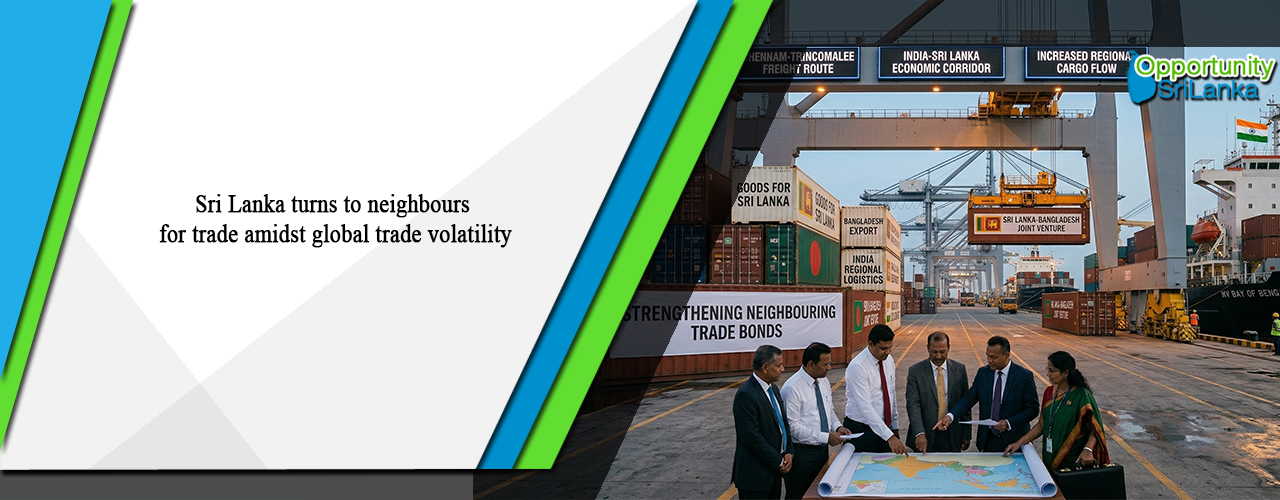
Sri Lanka turns to neighbours for trade amidst global trade volatility
The Morning: Due to global trade volatility in experienced in the recent past – with last year’s Trump tariffs and this year’s war on Iran – Sri Lanka as a small State is pursuing trade with smaller trade partners and strengthening trade with long-time partners, keeping to its non-aligned trade position, Lakshman Kadirgamar Institute (LKI) Executive Director Dr. Nishara Mendis said on Monday (30 March), speaking at a panel discussion.
“Small countries affected by this have to rely back on their traditional trusted partners. If the US is no longer going to be someone we can rely on as a trading partner, whether it’s going to be so disruptive, then we have to look to our long-term partners,” Mendis said, referring to the Liberation Day tariffs leveraged by the United States last year this time, speaking on an Asian Economic Dialogue panel organised by the Government of India Ministry of External Affairs (MEA) and Pune International Centre.
Though Sri Lanka’s initially proposed tariff rate of 44% had only been reduced to 20% after rounds of discussion, atop a 10% universal tariff – Sri Lanka’s apparel exports in 2025 recorded only marginal declines in performance in August (-1.33%) and October (0.05%), with cumulative exports for the year growing by 5.4% in year on year terms, Joint Apparel Association (JAAF) data shows.
However, Sri Lanka’s apparel exports recorded a broad-based cumulative decline in January and February this year, down by 6.91%, compared to the same time period last year. Notably, apparel exports to the US have declined by 3.53% in February, JAAF recently revealed.
“So what do we do as a small State? Some analysts say there’s very little we can do, if at all, how do we respond? Do we have to sort of just be swept away in whatever else is going on in the global scenario because we’re going to lose out somehow? However, others are saying no, we have to now start thinking of something we should have thought about before: greater export diversification, more small trade partners, more focus on the region. And in a way, we are going back to some basics which we should have been considering,” Mendis said.
Among the long-term partners Sri Lanka relies on within the South Asian region, Mendis listed India and Pakistan. In the Asian region, she identified Singapore, Thailand and Japan as partners Sri Lanka has been actively working with to strengthen trade.
She also noted that Sri Lanka’s trade policy operates much like its regional political stance of being non-aligned. “Sri Lanka has been doing in the economy the same thing that it has been doing politically: a non-aligned position amongst our different partners. So we’ve been trying to balance India and China as our two most important investors.”
OSL take:
Sri Lanka’s strong trade ties with many foreign countries and ongoing efforts to further strengthen and expand trade ties to include more foreign countries have placed the country on a strong footing as an emerging trade destination in the South Asian region. Given Sri Lanka’s strategic positioning in the Indian Ocean, strong and vast trade ties as well as the country’s improving business conducive environment have all helped boost Sri Lanka as an emerging business destination in the region. The ongoing conflict in the Middle East and disruptions caused to global supply chains as a result have presented fresh business/investment opportunities in the field of trade and Sri Lanka has already turned to neighbouring countries to further expand trade ties with them. The lookout for new countries to trade with has opened many business/investment opportunities in Sri Lanka’s manufacturing and export industries, which continue to record steady growth. The increasing business potential in Sri Lanka’s manufacturing and export industries therefore presents lucrative business ventures for foreign businesses/investors, who could also look at expanding operations through local collaborations.
| Article Code : | VBS/AT/20260407/Z_1 |