
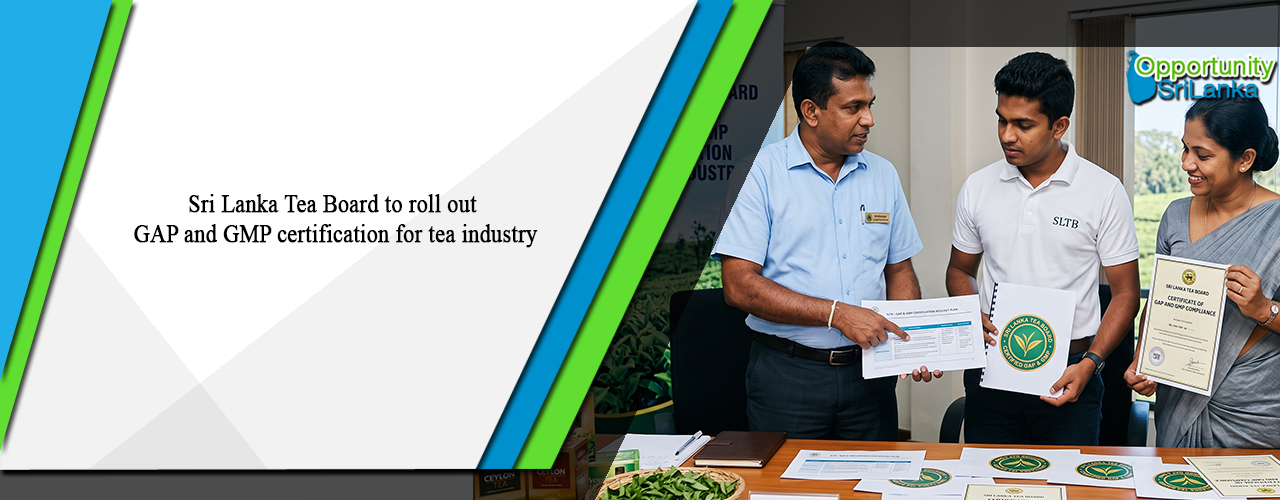
Sri Lanka Tea Board to roll out GAP and GMP certification for tea industry
The Morning: The Sri Lanka Tea Board (SLTB) is set to introduce Good Agricultural Practice (GAP) and Good Manufacturing Practice (GMP) certification for the local tea industry from 2027 as part of its five-year action plan.
Speaking to The Morning Business, SLTB Chairman Rajpal Obeyesekere said that the board had commenced the process to introduce GAP and GMP certification for the local tea industry, adding that it expected to commence the certification process by next year.
“All the formalities have been completed, and we hope to get the certification process started by next year,” he said.
He said that the introduction of the certification process was part of the SLTB’s five-year action plan.
Obeyesekere added that under the five-year action plan, the board had also commenced the Ceylon Tea Village project, with the GAP and GMP certification process to be implemented alongside the project.
He said that GAP and GMP certification would prove beneficial in helping Ceylon Tea fetch a premium price in the world market, as the market would view it as a product with better manufacturing practices.
The Ceylon Tea Village project, which aims to establish 500 tea villages across the country, was launched islandwide on 15 July with the objective of strengthening the economic wellbeing of smallholder tea farmers, enhancing their income levels, and promoting the sustainable development of Sri Lanka’s tea industry.
As part of the Government’s long-term strategy to further strengthen the tea sector, Sri Lanka aims to increase its annual tea production to 400 million kg by 2030, compared to the current production level of approximately 264 million kg.
The Government also expects to increase tea export earnings from the $ 1.5 billion recorded last year to $ 2.5 billion by 2030.
The contribution of smallholder tea farmers is crucial to achieving the Government’s targets, as they account for approximately 75% of the country’s total tea production.
The SLTB’s five-year strategic plan was introduced for the purpose of involving all relevant stakeholders in order to increase tea export revenue to $ 2.5 billion by 2030.
OSL take:
Sri Lanka’s tea industry is seeking to move up the value chain, creating new business/investment opportunities for foreign businesses/investors as the country looks to strengthen the global position of Ceylon Tea. The planned introduction of GAP and GMP certification from 2027 is expected to improve production standards and help Sri Lankan tea secure higher prices in international markets. The initiative, together with the Ceylon Tea Village project, signals a broader shift towards quality, sustainability and value-added production. For foreign businesses/investors, opportunities extend beyond traditional tea cultivation into processing, packaging, branding, logistics, technology and export-oriented value-added products. Investments in sustainable agriculture and modern processing could also help connect smallholder producers with higher-value international markets. The establishment of 500 tea villages under the Ceylon Tea Village project could further expand the supply base for businesses seeking partnerships with smallholder farmers, while creating opportunities for technology providers, agricultural service companies and sustainable supply-chain investors. As Sri Lanka seeks to increase export earnings and position Ceylon Tea as a premium global product, the sector offers foreign businesses/investors an opportunity to participate in an established industry while supporting its transition towards higher-value and more sustainable production.
| Article Code : | VBS/AT/20260831Z_3 |