
Sri Lanka targets doubling maritime sector’s economic contribution to 5-10%
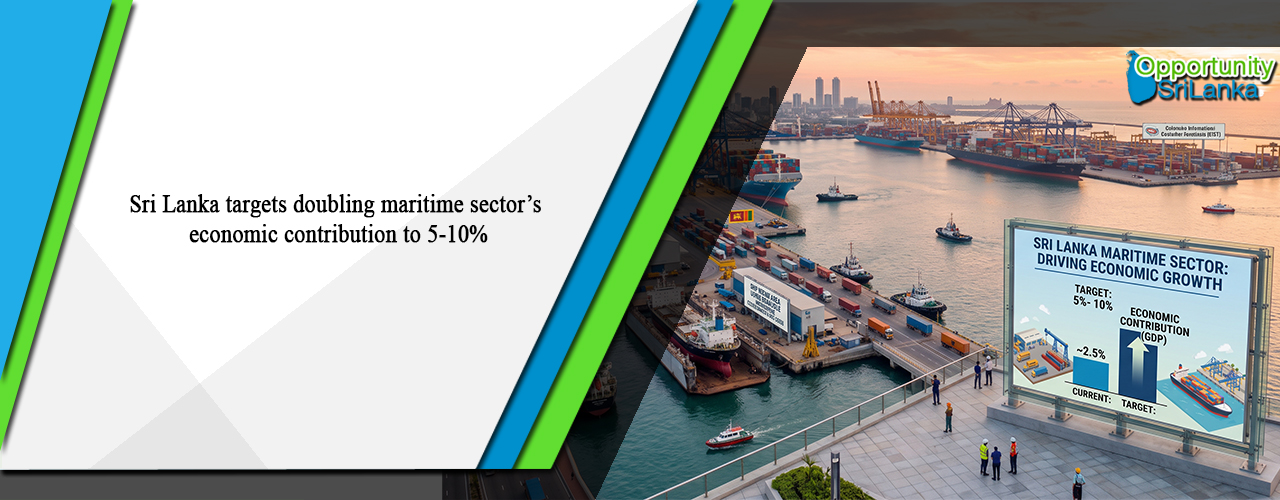
Daily FT: Sri Lanka is targeting a sharp expansion in the economic contribution of its maritime sector, with the Government seeking to increase it from around 2.5% of GDP currently to between 5% and 10%, Ports Minister Anura Karunathilaka said.
Addressing the Colombo International Maritime and Logistics Conference 2026 under the theme ‘Building a World around Us”, held alongside the 15th anniversary of the Shippers’ Academy recently, the Minister said the Government recognised the sector’s significant untapped potential and was determined to develop it more aggressively.
“Historically, data from the Central Bank of Sri Lanka (CBSL) show that the maritime sector has contributed around 2.5% of our national GDP. However, as a new Government, we see the immense untapped potential, and we are determined to aggressively develop this sector, aiming to elevate its economic contribution to a target of 5% to 10% of GDP,” he said.
Karunathilaka said his Ministry, together with international development partners, was working on a comprehensive proposal to be submitted to the Government and President Anura Kumara Dissanayake.
The proposal would set out a broader maritime mission aimed at positioning Sri Lanka as a world-class logistics hub, supported by a robust maritime transportation framework.
“Our vision encompasses the entire ecosystem. It begins with a modernised legal system and stronger regulation. Together, these reforms will enhance our nation’s competitiveness, predictability, and transparency,” he said.
Karunathilaka stressed that developing the maritime and logistics sector would require reforms extending beyond port infrastructure, with the Government seeking to create an environment capable of attracting greater private and foreign investment.
“By building a more competitive landscape, we will attract the vital infrastructure investment needed for our ports and logistics sector,” he said.
The Minister said such investment would also enable Sri Lanka to develop the seamless multimodal connectivity increasingly demanded by global supply chains.
Karunathilaka positioned Colombo as having an important role to play in strengthening supply chain resilience amid disruptions witnessed globally over the past several years.
“Our Government firmly believes that we are capable of being a resilient alternative to global supply chain disruptions we have witnessed over the past decades,” he said.
The Minister also highlighted the significance of Sri Lanka’s growing maritime links with the US. Welcoming representatives from the US Federal Maritime Commission (FMC), he noted that the visit marked the Commission’s first research mission to South Asia.
Karunathilaka said over 500,000 Twenty-Foot Equivalent Units (TEUs) of US-bound and US-origin cargo currently moved through Port of Colombo, underscoring the Port’s importance to international trade flows.
Beyond regulatory and infrastructure reforms, he said the Government is also looking to expand the range of activities within Sri Lanka’s shipping and logistics industry.
“The Government is keen to establish new verticals within the shipping and logistics industry,” he said, adding that these new areas would introduce cutting-edge technology, strengthen security, and develop a more vibrant services sector.
The Minister said the expansion of the industry could also generate higher-quality employment opportunities for young Sri Lankans.
“These new areas will introduce cutting-edge technology, enhance security and, most importantly, nurture a vibrant new services sector. This growth will create meaningful, high-quality employment opportunities for the youth of Sri Lanka,” he said.
OSL take:
Sri Lanka’s ambition to increase the maritime sector’s contribution to GDP from around 2.5% to 5%-10% is creating a growing pipeline of business/investment opportunities for foreign businesses/investors across the maritime and logistics ecosystem. The country’s strategic position along major East-West shipping routes is becoming increasingly valuable as tensions and disruptions in the Middle East encourage global shipping and logistics companies to seek greater supply-chain resilience and alternative connectivity options. Colombo’s established role as a regional transshipment hub, together with Sri Lanka’s wider port infrastructure, provides opportunities in port development, container handling, shipping, ship repair, bunkering, warehousing, freight forwarding and maritime logistics. Business/investment potential also extends into related areas such as multimodal transport, digital logistics, maritime technology, cold-chain facilities and supply-chain services. The Sri Lankan Government’s plans to modernise the legal and regulatory framework and attract greater private and foreign investment could further strengthen the sector’s appeal. As global trade routes continue to adjust to geopolitical risks, Sri Lanka has an opportunity to position itself as a resilient Indian Ocean logistics hub, opening significant space for foreign capital, technology and expertise.
| Article Code : | VBS/AT/20260915Z_4 |