
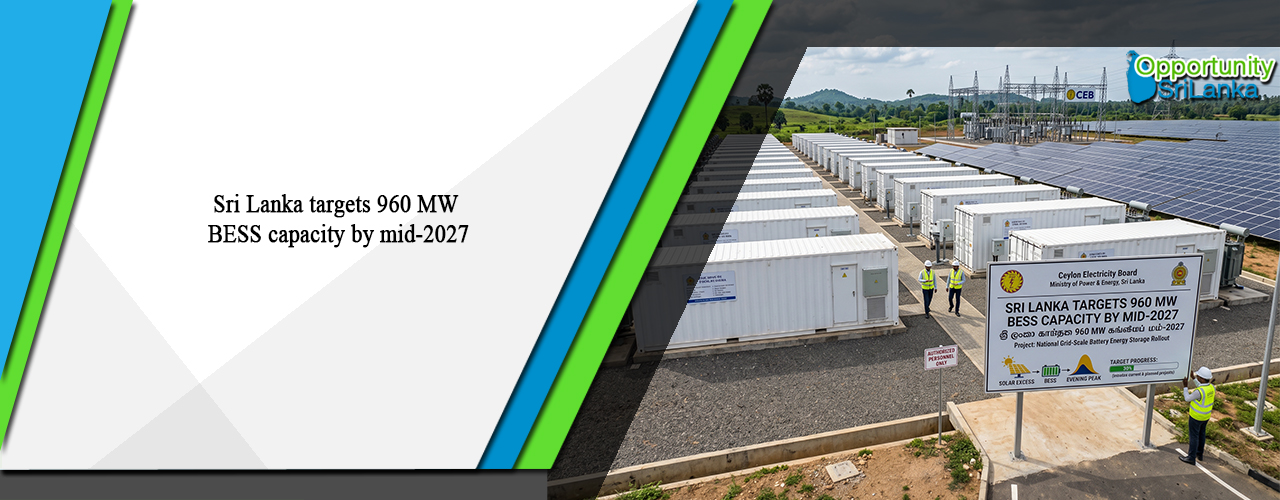
Sri Lanka targets 960 MW BESS capacity by mid-2027
Daily FT: Energy Minister Anura Karunathilake has said the Government will add close to 960 MW of Battery Energy Storage System (BESS) capacity by the end of 2027 as it looks to absorb a growing daytime solar surplus.
He said this at a ceremony to connect a 10 MW/40 MWh system in Anuradhapura, the first of 13 built by Storex Ltd., to the national grid. President Anura Kumara Dissanayake was also at the event. The 13 systems under this project will total 130 MW/520 MWh in combined capacity once complete. Storex expects the remaining 12 systems to be connected within the next two to three months.
Karunathilake said the country currently generates close to 3,000 MW of solar power during the day, against average daytime demand of around 2,800 MW. Night-time demand rises to roughly 3,100 MW, and with El Niño conditions, forecasts indicate this could rise further by February next year, a gap the Minister said battery storage is intended to close by shifting surplus daytime solar generation to the evening peak.
Karunathilake said the Government is implementing projects with a combined capacity of 160 MW targeted for completion before the end of 2026. Bids have also been called for separate battery storage projects of 400 MW, 250 MW and 150 MW, some of which are at the evaluation stage, with the Minister targeting completion within the first six months of 2027.
Karunathilake said the storage build-out is intended to allow greater integration of renewable energy into the grid while reducing the cost of night-time generation from fossil fuels.
OSL take:
Sri Lanka’s accelerating shift towards renewable energy is creating a growing pipeline of business/investment opportunities for foreign businesses/investors, with the Sri Lankan Government increasingly looking to private capital and technology to expand generation capacity and strengthen the reliability of the national grid. The planned addition of nearly 960 MW of BESS capacity by the end of 2027 highlights the scale of investment emerging alongside the country’s expansion of solar power. With daytime solar generation already exceeding average daytime demand, investment in storage, grid infrastructure and related technologies will become increasingly important to move renewable electricity to periods of peak demand. The opportunity extends beyond battery storage. Foreign businesses/investors can potentially participate in utility-scale solar and wind projects, renewable-energy generation, energy storage, grid modernisation and associated engineering and technology services. The Government’s pipeline of battery projects — including tenders for 400 MW, 250 MW and 150 MW systems — also signals a developing market for international companies with expertise in energy storage and grid integration. For foreign investors, Sri Lanka’s renewable-energy transition offers opportunities across the wider energy value chain, while the country’s strategic location and ambitions to develop as a regional hub could provide an additional platform for companies seeking to expand their presence in South Asia.
| Article Code : | VBS/AT/20261001Z_3 |