
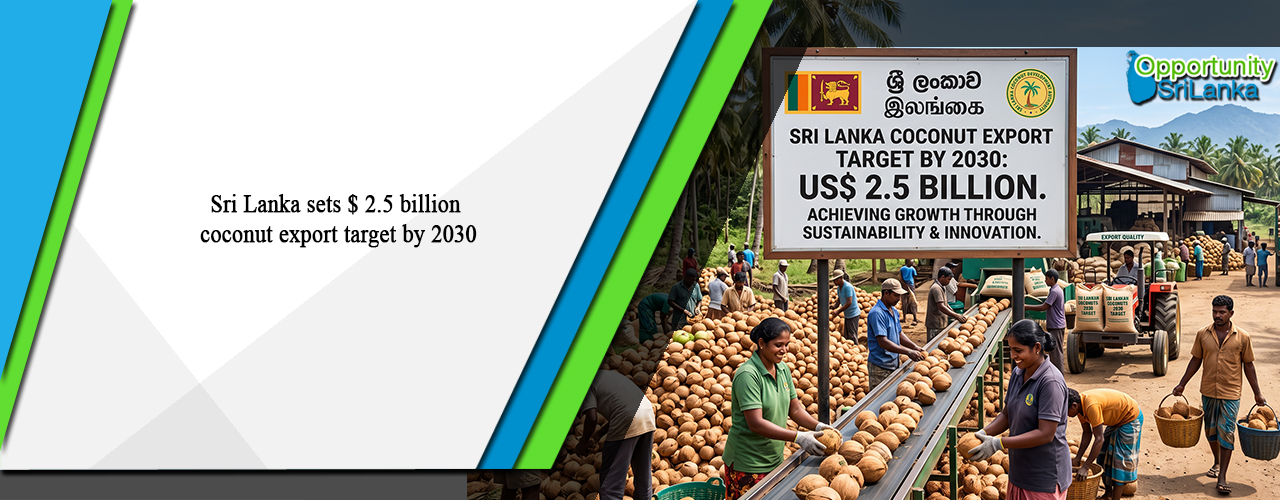
Sri Lanka sets $ 2.5 billion coconut export target by 2030
The Morning: Sri Lanka aims to double its coconut export earnings to $ 2.5 billion by 2030, from around $ 1.22 billion as of mid-2026, with higher production and greater value addition expected strengthen the sector’s contribution to the country’s foreign-exchange earnings, Coconut Development Authority (CDA) Chairperson Shantha Ranathunga said in Ada Derana’s “Big Focus” programme recently.Speaking at the programme, Ranathunga said: “Despite the challenges we face, as a nation, we are on a trajectory to increase coconut production to around 4200 million nuts and boost export earnings to $ 2,500 million by 2030, by providing all necessary facilities to the relevant exporters. We need to aim for the highest level of value addition. While the sector has currently reached an intermediate stage in value addition, our ultimate goal is to have products under our own brands placed on the shelves of foreign markets.”“Sri Lanka’s coconut industry is emerging as a key driver of export growth, and the target comes after a strong performance by the industry, with earnings rising sharply in 2025 and continuing to expand in 2026. Compared to 2024, the coconut sector achieved a significant success and growth in 2025, which was an impressive growth rate of around 44%. Our goal for 2026 is to reach a figure of approximately $ 1,300 million, building upon the current $ 1,222 million,” he said.According to the Export Development Board (EDB) export performance report, Sri Lanka’s coconut export earnings reached approximately $ 1.23 billion for the full year of 2025, reflecting a positive trend of growth, compared to around $ 864.3 million recorded in 2024. “Coconut exports have continued to expand this year, and we have already recorded a 16% growth from the coconut sector, during the first six months of 2026, with the value rising from $ 530 million to $ 614 million,” Ranathunga said.Ranathunga stated: “But however, we have projected challenges ahead, specifically over the next few months, are significant. A major hurdle is maintaining the $ 1,300 million export value, given that coconut harvest forecasts for November and December indicate a 14% decline.”“The expected drop in supply comes as coconut exporters face rising costs, including higher fuel prices linked to the conflict situation. But despite these pressures, our exporters have continued to demonstrate great skill in successfully exporting to foreign markets, while the current government administration is providing the necessary facilities and the support to help the industry maintain its export performance,” he said.Also, this shift could allow the country to generate more export revenue from its coconut industry. For Sri Lanka, which needs to strengthen foreign-exchange earnings and expand exports, the coconut sector offers an opportunity, Ranathunga pointed out.Ranathunga further said: “The strategy is not based solely on producing more coconuts. Sri Lanka also wants to capture more value from its exports by moving further into value-added production, and while we have identified the essential inputs for the coconut palm, specifically fertiliser and water, if these inputs are applied correctly and effectively, we can achieve our production targets, and enable the country to increase export revenue, which has been identified as a key strategic approach.”
OSL take:
Sri Lanka’s ambition to double coconut export earnings by 2030 is opening a wider investment window for foreign businesses/investors seeking opportunities in the country’s growing agricultural and export sectors. With coconut export earnings already reaching around US$1.22 billion by mid-2026, the industry is moving beyond the traditional export of raw and semi-processed products towards higher-value goods, creating business/investment opportunities for international investors in food processing, coconut-based consumer products, ingredients, packaging, technology and export-oriented manufacturing. The Coconut Development Authority’s target of increasing production to around 4.2 billion nuts by 2030 also points to opportunities across the supply chain. Foreign businesses could participate through partnerships in plantation development, modern processing facilities, storage and logistics, agricultural technology and sustainable production. Perhaps the biggest opportunity lies in value addition and branding. Sri Lanka is seeking to move towards internationally recognised own-brand coconut products rather than remaining primarily a supplier of commodities. This creates potential for foreign companies with established distribution networks, technology, product-development capabilities and global brands to partner with Sri Lankan producers. The sector’s strong recent performance adds to its appeal. Coconut export earnings grew by around 44% in 2025, while the industry is targeting approximately US$1.3 billion in earnings in 2026. For foreign businesses/investors, Sri Lanka’s coconut industry therefore represents more than an agricultural opportunity. It offers a platform to build export-oriented businesses linked to global demand for natural, plant-based and sustainable products, while leveraging Sri Lanka’s established coconut-growing base and access to international markets. If Sri Lanka can combine higher production with reliable supply, modern processing and globally competitive branding, the coconut industry could become one of the country’s more attractive avenues for FDI, export growth and long-term international business partnerships.
| Article Code : | VBS/AT/20260904Z_2 |