
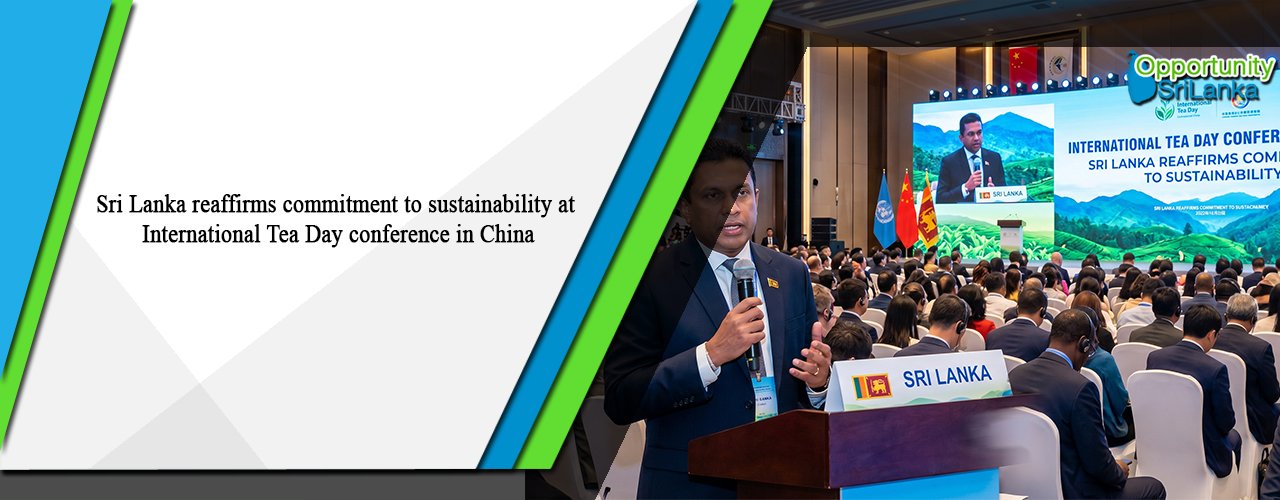
Sri Lanka reaffirms commitment to sustainability at International Tea Day conference in China
Daily FT: Plantations and Community Infrastructure Minister Samantha Vidyaratne recently reaffirmed Sri Lanka’s commitment to building a sustainable and community-focused tea industry, while calling for stronger international cooperation to safeguard the future of global tea production.
Addressing the International Tea Day Conference in Nanning, Guangxi, Vidyaratne said the future of the tea industry must be built not only on economic growth, but also on social responsibility, environmental sustainability and the empowerment of tea-growing communities.
The conference, held under the theme “Safeguarding the Sustainability of the Tea Industry, Empowering Communities,” brought together representatives from major tea-producing countries and international organisations.
He stressed that tea extends beyond being a commercial commodity and remains deeply connected to culture, tradition, and international relations.
“Tea is not just a drink. It is a symbol of culture, friendship, hospitality, and human communication that has connected civilisations for centuries,” he said.
Highlighting the significance of tea to Sri Lanka’s economy and national identity, Vidyaratne said Ceylon Tea continues to represent quality, trust, and reliability globally more than 150 years after the industry was established.
“For over 150 years, Ceylon Tea has carried the name of Sri Lanka around the world, exemplifying quality, reliability and trust,” he said.
The Minister noted that the tea industry remains a critical source of livelihoods for millions of people linked to the sector, including plantation workers, smallholder farmers, producers, exporters, traders, and entrepreneurs across the value chain.
Despite ongoing global economic and environmental pressures, Sri Lanka remains committed to producing premium teas while prioritising ethical production practices and community welfare, he added.
“Today, despite many global economic and environmental challenges, Sri Lanka continues to be committed to producing high-quality premium teas while ensuring the well-being of tea-growing communities, ethical production and sustainability,” Vidyaratne said.
The Minister stressed that the sustainability of the global tea industry is inseparable from the welfare and resilience of the communities supporting it.
“This year’s timely theme reminds us that the future of the tea industry must be built not only on economic growth, but also on social responsibility and environmental management. The sustainability of the tea industry directly depends on the sustainability of the communities behind it,” he said.
Vidyaratne outlined several measures being implemented by the Government to strengthen plantation communities, including welfare initiatives, housing, infrastructure, education, healthcare, and livelihood development programs.
He also highlighted efforts to modernise the sector through innovation, value addition, climate resilience and sustainable agricultural practices.
“In Sri Lanka, the Government continues to empower the people of the plantation sector through various social welfare, infrastructure, housing, education, healthcare and livelihood development programmes,” he said.
The Minister also underscored the importance of international collaboration in strengthening the future of the tea industry and praised the longstanding relationship between Sri Lanka and China.
“Tea can be described as a form of soft diplomacy that brings people together across borders,” he said.
“We believe that it can act as a bridge between nations, promoting cultural understanding, interpersonal communication, and economic partnership.”
OSL take:
Sri Lanka’s tea industry is entering a new phase of transformation as the Sri Lankan government places increasing emphasis on sustainability, community development, and value-added growth. Minister Vidyaratne’s reaffirmation of the country’s commitment to building a socially responsible and environmentally sustainable tea sector signals expanding business/investment opportunities for foreign businesses/investors. Globally recognised for its premium Ceylon Tea brand, Sri Lanka is well-positioned to attract investment in high-value segments of the industry. Growing international demand for ethically sourced, organic, and sustainable tea products is creating business/investment opportunities in specialty tea production, branded exports, eco-certification, and premium packaging. Foreign businesses/investors can also explore partnerships in tea processing, modern plantation management, and agri-technology solutions that improve productivity and climate resilience. The Sri Lankan government’s focus on empowering tea-growing communities further opens opportunities in social-impact investment, rural infrastructure, worker housing, renewable energy, and sustainable water management projects linked to plantation regions. Foreign businesses specialising in ESG-focused investments and sustainable supply chains may find Sri Lanka increasingly attractive as global consumers place greater emphasis on responsible sourcing. There is also rising potential in tea tourism and experiential travel. Foreign businesses/investors can develop boutique plantation resorts, wellness retreats, tea museums, and immersive tourism experiences that combine Sri Lanka’s scenic highlands with its globally recognised tea heritage. In addition, opportunities are also emerging in tea-based wellness products, nutraceuticals, ready-to-drink beverages, and e-commerce-driven global distribution.
| Article Code : | VBS/AT/20260602Z_3 |