
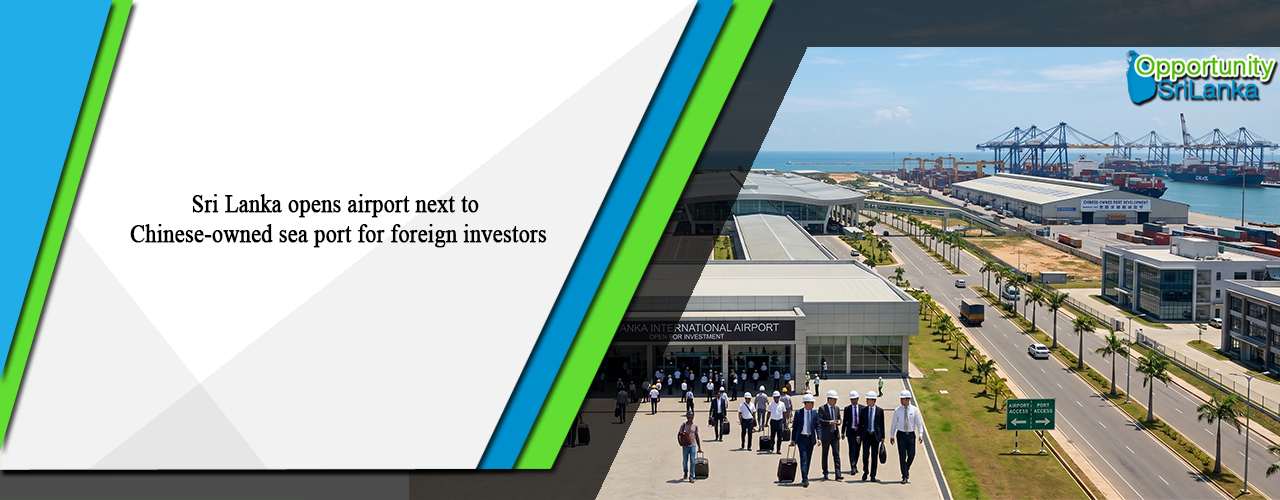
Sri Lanka opens airport next to Chinese-owned sea port for foreign investors
EconomyNext: Sri Lanka has invited foreign investors to operate the Chinese-built airport in the country’s deep southern district of Hambantota, the Board of Investment (BOI) said in a statement.
The loss-making Mattala Airport is located next to the Chinese-owned seaport in Hambantota.
“(The) Ministry of Ports & Civil Aviation has launched a formal drive to attract both local and international investors to Mattala Rajapaksa International Airport (MRIA),” the Ministry said in a statement.
“The Board of Investment of Sri Lanka will work with all stakeholders and prospective investors as a facilitator for this important investment opportunity.”
The Ministry has invited Expressions of Interest (EOIs) for Airside/Aerodrome operations and Landside Operations.
MRIA’s investment proposition spans diverse sectors, including Cargo Services, Logistics, Maintenance, Repair & Overhaul (MRO) Operations, Aircraft Spares Manufacturing, Industrial Parks for manufacturing, packaging, and warehousing, Renewable Energy projects, and Resort Hotels and Hospitality Services.
“Authorities are positioning the airport’s proximity to the Hambantota Port and major international shipping lanes as a key competitive advantage, enabling integrated air-sea connectivity,” the Ministry said.
“The initiative forms part of a broader effort to attract foreign direct investment and elevate Sri Lanka’s profile in the global aviation sector,” the BOI said.
The Airport was inaugurated in March 2013 as the country’s second international gateway.
Constructed with an investment of approximately $209 million, largely funded by loans from the Export-Import Bank of China, it was envisioned as a catalyst for regional development, intended to support a logistics hub, a tourism surge in the southern province, and a sea-air transshipment link with the nearby Magampura Mahinda Rajapaksa Port.
Magampura Mahinda Rajapaksa Port is leased to China under a 99-year tenure.
The Airport facility was designed to handle one million passengers annually and features a 3,500-meter runway capable of accommodating large aircraft like the Airbus A380.
Despite its high-tech infrastructure, MRIA has consistently incurred massive financial losses since its inception, earning the moniker of the world’s emptiest international airport.
In an attempt to mitigate these losses, the Sri Lankan government recently entered into a management agreement with a joint venture between Indian and Russian firms to operationalize the airport through a 30-year lease, aimed at converting it into a profitable entity through transit flights and specialized cargo operations.
However, the deal was cancelled later after both Russian and Indian firms were blacklisted by the U.S. State Department.
The BOI said flexible investment models are on offer, including joint ventures, public-private partnerships, and direct investments, with the aim to lower barriers and appeal to investors with varying risk appetites and capital commitments.
The EOI process is open to both domestic and international entities. The documents can be obtained free of charge from Sri Lanka’s main airport in Katunayake or downloaded from AASL’s website at www.airport.lk.
OSL take:
Sri Lanka’s steadily growing economy and ongoing infrastructure development programme are creating a wide range of business/investment opportunities for foreign businesses/investors. The Sri Lankan government’s move to invite international partners to operate the Chinese-built Mattala Rajapaksa International Airport in Hambantota reflects a broader strategy to attract foreign direct investment into key sectors of the economy. With its strategic location along major Indian Ocean shipping routes, Sri Lanka offers strong potential in logistics, aviation, ports, tourism, renewable energy, manufacturing, and technology. The Hambantota region, which already hosts a Chinese-operated deep-sea port, is emerging as an important industrial and transport hub with opportunities in cargo handling, warehousing, export processing, and aviation-related services. Tourism remains another promising sector as visitor arrivals continue to recover, creating demand for hotels, leisure projects, transport services, and eco-tourism ventures. At the same time, the government is encouraging investment in renewable energy projects, including solar and wind power, as the country seeks to strengthen energy security and reduce costs. Sri Lanka’s relatively skilled workforce, expanding infrastructure network, and access to regional markets through trade links make the country attractive for investors looking to establish a presence in South Asia. The government and the BOI continue to promote public-private partnerships (PPPs) and foreign participation in large-scale development projects aimed at accelerating economic growth and modernisation.
| Article Code : | VBS/AT/20260515Z_1 |