
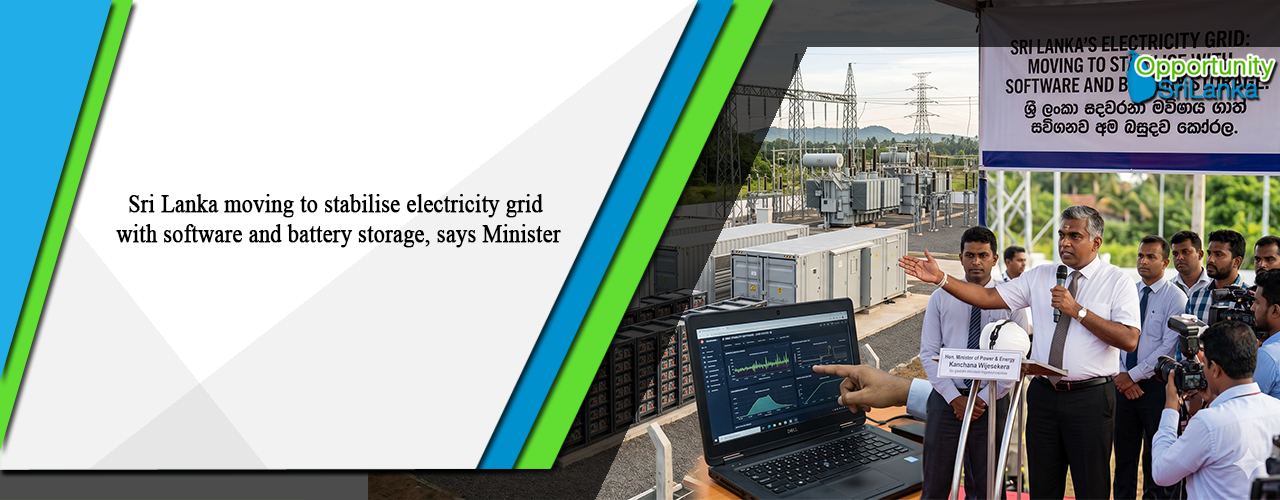
Sri Lanka moving to stabilise electricity grid with software and battery storage, says Minister
EconomyNext: Sri Lanka’s Ministry of Power and Energy is implementing technical reforms, including the procurement of specialised software and battery storage systems, to prevent a recurrence of the countrywide power outage experienced in February 2025, Energy Minister Anura Karunathilaka told Parliament.
Two committees – one from the ministry and another from the Ceylon Electricity Board (CEB) – appointed to investigate the failures of February 9, 2025, made 12 recommendations to secure the national grid against future instability, he said.
“We have instructed the Ceylon Electricity Board to implement the recommendations of the ministry committee immediately to ensure system stability,” Karunathilaka said.
The CEB is procuring “RE-desk” software for its System Control Center, he said, a tool designed to monitor and control the growing number of renewable energy plants connected to the grid.
A new software system for forecasting renewable energy production has already been purchased and is now operational, he said.
To address the physical stability of the system, the government has started setting up battery energy storage systems (BESS), he said, and steps are also being taken to install a synchronous condenser at the New Habarana Grid Substation with funding from the World Bank.
Karunathilaka said the ministry is paying attention to periods of low electricity demand, such as Sundays and public holidays, which can pose risks to grid balance. A special operational policy is now in place to increase the “inertia” of traditional generation systems during these times to keep the frequency stable.
The CEB has also been instructed to update and publish protection parameters and re-evaluate load-shedding settings to better reflect the current energy mix. A four-member monitoring committee has been appointed to oversee the progress of these various interventions.
OSL take:
Sri Lanka’s power sector is entering a new phase of expansion and modernisation as the country moves to stabilise its electricity grid through advanced software systems and large-scale battery energy storage. This shift reflects a broader transformation in the economy, where rising industrial activity, urban demand, and digital adoption are driving the need for a more resilient and flexible energy infrastructure. For foreign businesses/investors, this transition is opening up a range of high-value opportunities across the energy value chain. Grid stabilisation projects require investment in smart grid technologies, energy management software, and real-time monitoring systems, creating space for technology providers and engineering firms with expertise in modern power systems. At the same time, the integration of battery energy storage systems (BESS) is becoming increasingly critical to balance intermittent renewable energy sources such as solar and wind, both of which are expanding rapidly in Sri Lanka. The country’s growing focus on renewable integration and energy security is also creating business opportunities in project financing, equipment supply, and public-private partnerships (PPPs). International developers and institutional investors can participate in utility-scale solar and wind projects, hybrid energy systems, and storage infrastructure designed to support long-term grid stability. As Sri Lanka’s economy continues to expand, electricity demand is expected to rise steadily, reinforcing the need for sustained investment in generation, transmission, and distribution infrastructure. This combination of demand growth and structural reform positions the power sector as one of the most promising frontiers for foreign investment.
| Article Code : | VBS/AT/20260511/Z_4 |