
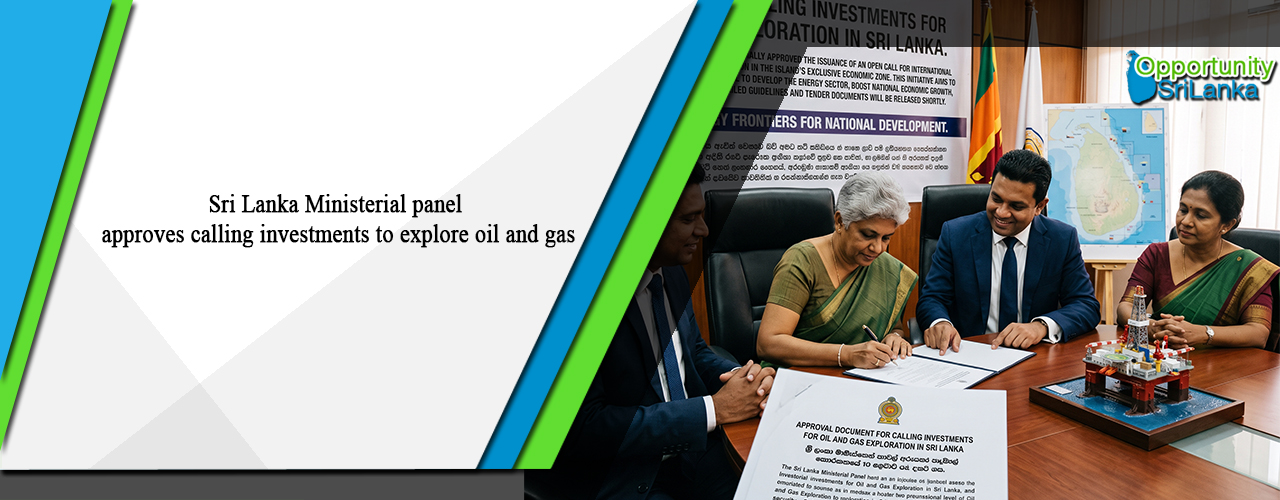
Sri Lanka Ministerial panel approves calling investments to explore oil and gas
EconomyNext: Sri Lanka’s Ministerial Consultative Committee on Energy Affairs has approved the decision to call investment proposals to explore and develop petroleum resources in the country, the island nation’s parliament said recently.
In August, Sri Lanka offered four offshore blocks in the Northwestern Mannar Basin for international investors to explore oil and gas in a fresh attempt to attract investments into the sector after an earlier attempt ended unsuccessfully because production was not commercially viable.
The Mannar Basin, which lies between southern India and northwestern Sri Lanka, may hold around $260 billion worth of oil and gas resources, A Sri Lanka’s former energy minister has told the parliament in 2021.
The latest attempt is the first under President Anura Kumara Dissanayake government to explore oil and gas in the area.
Based on seismic surveys, previous governments estimated that a 30,000 square kilometre area off the country’s north coast holds over one million barrels of oil resources.
The latest approval of the order by the Ministerial Consultative Committee on Energy will help formalize the relevant process.
“Under this order, any person seeking to explore or develop petroleum resources in one or more identified blocks is required to submit an investment proposal together with payment of the administrative fee specified in the relevant invitation for bids,” Parliament said in a statement.
Sri Lanka’s pursuit of offshore oil and gas exploration began in the late 1960s, initially focusing on shallow offshore areas in the Gulf of Mannar and the Cauvery Basin.
Early exploratory drilling yielded limited technical success until 2011, when Cairn Lanka, a subsidiary of Cairn India at that time, made a breakthrough by discovering significant natural gas accumulations in two offshore wells within the deep water Mannar Basin.
These discoveries established the presence of commercially viable natural gas and condensate deposits.
However, due to complex deep water extraction dynamics, a lack of domestic natural gas infrastructure, and global energy market shifts, commercial production failed to materialize, leading Cairn to exit the block in 2015.
Following years of stagnation, Sri Lanka modernized its regulatory setup by enacting the Petroleum Resources Act of 2021 and establishing the Petroleum Development Authority of Sri Lanka (PDASL) to manage exploration rights and update offshore acreage block maps.
To revitalize foreign investment and lower its heavy reliance on coal and oil imports, the country introduced new joint-study regulations and structured new licensing frameworks.
These efforts aim to attract international oil and gas majors to explore and commercialize the estimated hydrocarbon potential across its three major prospective sedimentary basins: the Mannar, Cauvery, and Lanka Basins.
OSL take:
Sri Lanka’s decision to formally advance investment proposals for offshore petroleum exploration adds another dimension to the growing business/investment opportunities emerging in the country’s energy sector, as the Sri Lankan Government seeks to attract foreign capital and develop Sri Lanka as a regional energy and logistics hub. The approval by the Ministerial Consultative Committee on Energy Affairs follows Sri Lanka’s decision in August to offer four offshore blocks in the Northwestern Mannar Basin to international investors for oil and gas exploration. The move marks the latest attempt to unlock the country’s offshore petroleum potential after earlier exploration efforts failed to establish commercially viable production. For international energy companies, the Mannar Basin could represent a longer-term opportunity in a largely underdeveloped offshore petroleum market. Previous seismic surveys have identified significant resource potential, while estimates presented to Parliament have placed the possible value of oil and gas resources in the wider basin at a substantial level. The opportunity, however, extends beyond exploration. As Sri Lanka strengthens its position as a regional maritime and logistics hub, investments could emerge across the broader energy value chain, including offshore services, storage, transportation, petroleum infrastructure, renewable energy, power generation and related technologies. The Sri Lankan Government’s latest move could therefore help create an investment ecosystem around the country’s energy resources rather than focusing solely on oil and gas extraction. Foreign companies with capital, technology and offshore expertise could play a role in developing these areas, while Sri Lankan businesses could benefit through partnerships, services and supply-chain opportunities. With the formal investment-proposal process now being advanced, Sri Lanka’s energy sector is increasingly positioned as an area for international investors to examine as the country seeks to diversify its economy, strengthen energy security and establish itself as a regional commercial hub.
| Article Code : | VBS/AT/20261001Z_2 |