
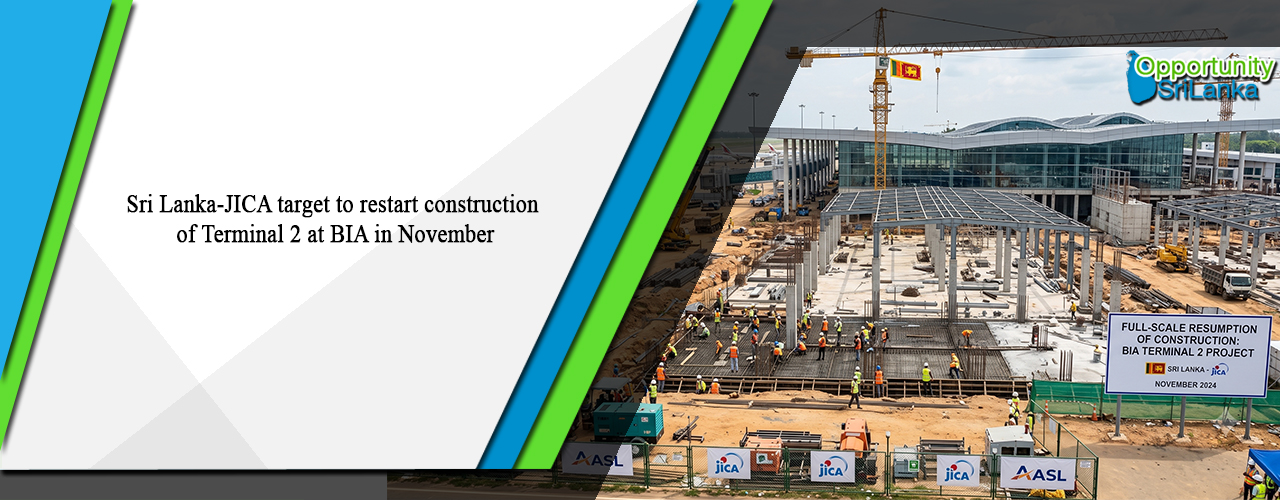
Sri Lanka-JICA target to restart construction of Terminal 2 at BIA in November
Daily FT: The long-delayed second passenger terminal project at Bandaranaike International Airport (BIA) moved a step closer to resumption following high-level discussions held yesterday between Ports, Civil Aviation and Energy Minister Anura Karunathilaka and a delegation from the Japan International Cooperation Agency (JICA) led by Japanese Ambassador to Sri Lanka Isomata Akio.
The meeting focused on accelerating approvals related to the project’s loan allocation and contract value, with both sides expressing their intention to restart construction work by November this year.
Deputy Minister Janitha Ruwan Kodituwakku, Ministry Secretary W.W.S. Mangala, senior officials from the Civil Aviation Authority, and officials from the Ministry also attended the discussions.
During the meeting, Minister Karunathilaka assured the JICA delegation that discussions would be held with the Finance Ministry to secure approval for the necessary loan amount at the earliest opportunity.
It was also revealed that President Anura Kumara Dissanayake has taken a keen interest in the project due to its national importance, with further discussions expected at the highest level of Government in the coming weeks.
JICA representatives proposed a two-stage approach to move the project forward. The first phase would involve securing the required financing and finalising the loan agreements, while the second phase would focus on awarding the construction contract at the negotiated price.
The Japanese delegation also outlined an ambitious timeline, stating that the terminal could be completed within 30 months from the date construction officially resumes.
The Terminal 2 expansion project, considered one of Sri Lanka’s most significant aviation infrastructure developments, commenced in December 2020 with financial assistance from the Japanese Government through a ¥ 75 billion loan facilitated by JICA. However, construction was suspended in April 2022 following the country’s economic crisis.
Although work resumed in 2024, the project faced another setback in March 2025 when construction was halted due to inadequate loan funding. Following several rounds of negotiations between Sri Lanka and Japan, an agreement was eventually reached to provide the additional financing required to complete the project, reflecting renewed international confidence in the Government’s economic management.
The revival of the BIA Terminal 2 project is expected to significantly enhance Sri Lanka’s airport capacity, strengthen its position as a regional aviation hub, and support the country’s growing tourism and economic recovery efforts.
OSL take:
As Sri Lanka accelerates its ambition to position itself as a key aviation, logistics, and trade hub in the South Asian region, the gradual revival of major infrastructure projects signals a renewed phase of investment-led growth. Recent progress on the long-delayed second passenger terminal at BIA, supported through cooperation with JICA, highlights both the government’s commitment to unlocking stalled development and its openness to structured foreign financing and technical partnerships. This renewed momentum reflects a broader national strategy to integrate Sri Lanka more deeply into regional and global value chains. By strengthening aviation capacity, the country aims to expand its role as a transit and connectivity hub linking South Asia, the Middle East, and Southeast Asia. The airport expansion is therefore not an isolated project, but part of a wider ecosystem of infrastructure development that includes ports, highways, and urban logistics corridors. For foreign businesses/investors, this transformation creates multiple entry points. Construction and engineering firms can participate in large-scale transport infrastructure upgrades, while aviation services providers and airport operators can explore long-term operational and management partnerships. The expansion of passenger and cargo capacity also opens downstream opportunities in logistics, warehousing, hospitality, retail, and aviation-linked services. More broadly, Sri Lanka’s development programme is increasingly structured around public–private partnerships (PPPs) and externally financed projects, creating space for multilateral agencies, sovereign-backed institutions, and private investors to engage in predictable, long-term investments. As the country seeks to establish itself as a South Asian hub, improved air connectivity is expected to act as a catalyst for tourism growth, export expansion, and regional trade facilitation. In this context, infrastructure revival, such as the BIA terminal project, serves not only as a symbol of recovery, but as a practical foundation for Sri Lanka’s evolving role as a strategic gateway economy in the region.
| Article Code : | VBS/AT/20260701Z_4 |