
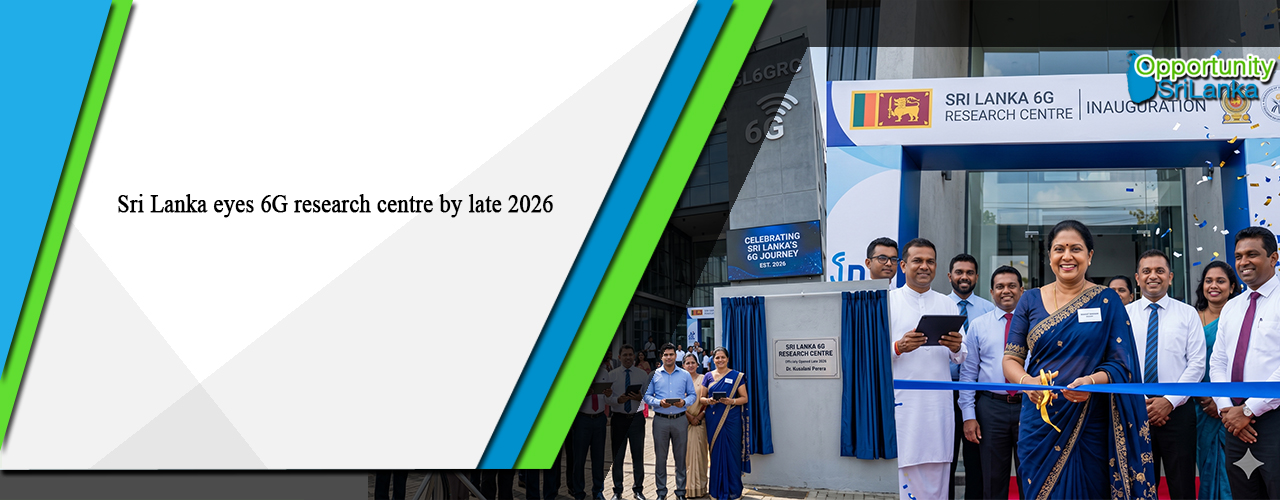
Sri Lanka eyes 6G research centre by late 2026
The Morning: Sri Lanka is planning to establish a dedicated research centre for 6G and next-generation wireless technologies by the third quarter of 2026, in collaboration with foreign partners and the private sector.
Speaking to The Sunday Morning Business, Deputy Minister of Digital Economy Eranga Weeraratne revealed that Sri Lanka was currently engaged in discussions to establish a research centre focused on 6G and other next-generation wireless technologies.
He further explained that the initiative would be undertaken jointly with several international stakeholders as well as private sector participants.
Weeraratne further revealed that discussions were in the final stages and that they expected to establish this research centre within the third quarter of 2026.
He noted that while plans for the research centre were progressing steadily, the rollout of 6G technology locally would take time.
The Deputy Minister pointed out that 5G technology in Sri Lanka still required further maturation, adding that telecommunications operators would need time to recover their existing investments before transitioning to the next generation.
Meanwhile, Dr. (Eng) Samiru Gayan, in his article titled ‘The Road to 6G: Powering the Next Leap in Digital Connectivity’ published in the official e-newsletter of the Institution of Engineers Sri Lanka, highlighted that global efforts towards 6G were already underway.
He noted that unlike previous generations, 6G was not solely focused on faster internet speeds. Instead, it aims to create a smart, immersive, and sustainable network by integrating communication, computing, and sensing into a unified platform.
He emphasised that 6G was being designed to meet the demands of a highly interconnected digital society, marking a significant evolution in global communication systems.
OSL take:
Sri Lanka’s move to establish a dedicated research centre for 6G and next-generation wireless technologies by the third quarter of 2026 marks a significant step in its ambition to become a regional digital hub in South Asia. With ongoing discussions involving foreign partners and the private sector, the initiative signals a shift toward higher-value innovation-driven growth. The development of advanced telecommunications research capacity opens up business/investment opportunities in several high-growth areas, particularly for foreign technology firms, telecom operators, and equipment manufacturers. Companies involved in 5G and emerging 6G ecosystems can leverage Sri Lanka as a testbed for research, pilot deployments, and regional adaptation of next-generation connectivity solutions. For foreign businesses/investors, the project also highlights potential in digital infrastructure development, including data centers, cloud services, and IoT-enabled platforms. As connectivity improves and research capabilities expand, Sri Lanka could attract outsourcing, software development, and R&D operations from global technology firms seeking cost-effective yet strategically located hubs. The initiative further strengthens Sri Lanka’s broader digital economy strategy, which aims to position the country as a gateway for tech innovation in South Asia. This creates opportunities in public–private partnerships (PPPs), university-industry collaborations, and startup ecosystem development, particularly in areas such as artificial intelligence, smart logistics, fintech, and telecommunications software. As Sri Lanka aligns its economic recovery with digital transformation, the planned 6G research centre underscores a long-term vision that is evolving from a service-based economy into a knowledge and innovation hub, offering foreign businesses/investors early access to a rapidly maturing digital market in the Indian Ocean region.
| Article Code : | VBS/AT/20260513/Z_3 |