
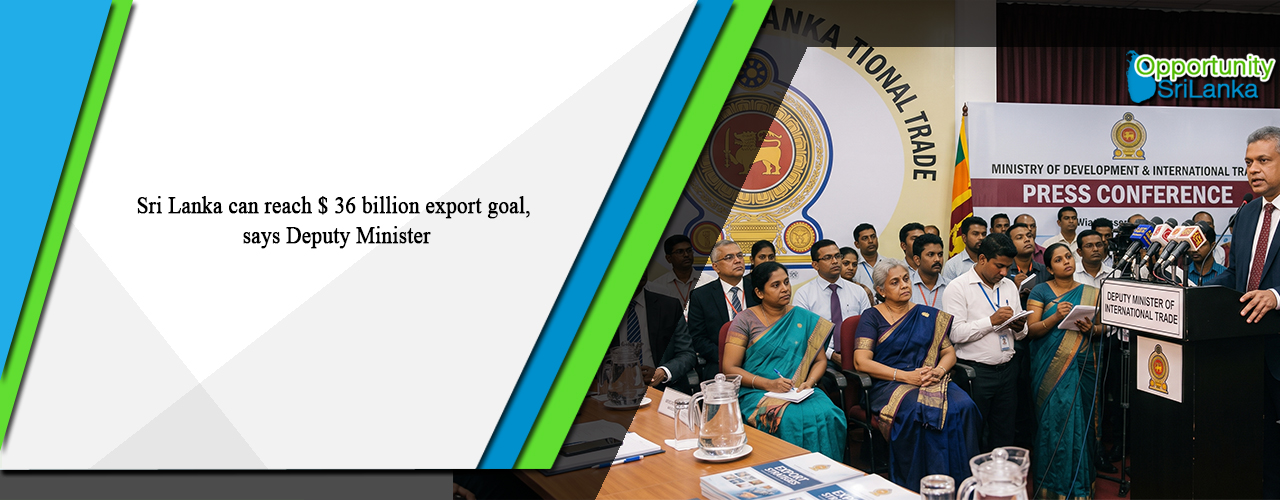
Sri Lanka can reach $ 36 billion export goal, says Deputy Minister
Daily FT: Industry and Entrepreneurship Development Deputy Minister Chathuranga Abeysinghe expressed confidence that Sri Lanka’s ambitious target of increasing exports to $ 36 billion under the National Export Development Plan (NEDP) is achievable, but only if the country urgently delivers long-delayed reforms, attracts strategic foreign investment and tackles high energy costs that are eroding competitiveness.
Speaking at a panel discussion during the launch of the NEDP recently, he argued that the biggest challenge facing Sri Lanka was no longer policy formulation, but implementation, warning that export ambitions would remain on paper unless the country moved quickly to remove structural barriers that have constrained exporters for years.
“The first thing we need to do is focus on implementation,” he said, noting that the plan’s priorities had been shaped directly by exporters and industry stakeholders.
Defending the Government’s goal of lifting exports to $ 36 billion, Abeysinghe said the target was intentionally ambitious and necessary to drive transformation.
“It is important for a Government to have ambitious targets because ambition drives not only policymakers, but also exporters, officials and investors,” he said.
He noted that several export sectors were already recording annual growth rates of between 15% and 20%, which could naturally lift exports to around $ 30 billion. The remaining $ 6 billion, however, would have to come from diversification, value addition and entirely new growth sectors.
The Deputy Minister identified two immediate priorities that could determine whether the target is achieved; improving access to raw materials and supply chains for existing exporters, and attracting export-oriented foreign direct investment (FDI) that integrates Sri Lanka into global production networks.
“Our domestic resource base has limitations, so enabling imports of raw materials and improving supply-chain efficiency are critical. The second game changer is attracting the right FDI that connects Sri Lanka to global markets and value chains,” he said.
He said Sri Lanka seeks to significantly expand exports, while navigating a volatile global trading environment marked by geopolitical tensions, shifting tariffs and slowing growth in several key economies.
Despite those uncertainties, Abeysinghe argued that exporters should focus on long-term market opportunities rather than short-term disruptions.
“Global uncertainties have always existed. The key question is how Sri Lanka connects with growing markets over the long term,” he stressed.
While Europe and the US remain important destinations, he said future export growth would increasingly depend on expanding access to East Asia, India, Africa and the Middle East.
At the same time, the Deputy Minister acknowledged that exporters face mounting challenges, particularly from unpredictable global trade policies and Sri Lanka’s high energy costs.
“The first challenge is the unpredictability of the global economic environment,” he said, stressing that businesses require policy certainty and stable trading relationships to make long-term investments.
“The second challenge is Sri Lanka’s energy costs. Addressing energy affordability and accelerating the transition to renewable energy could provide a significant competitive advantage for our exporters,” he added.
Abeysinghe also highlighted longstanding inefficiencies within the export support ecosystem, saying excessive bureaucracy, delays in approvals and high certification costs continue to discourage investment and expansion.
“Many exporters tell us that certification costs are too high, approvals take too long, and they must engage with multiple agencies to complete a single process. These are practical barriers that we are trying to eliminate,” he added.
The Government is therefore prioritising digitalisation, trade facilitation reforms, single-window systems and logistics improvements under the NEDP, measures he described as essential for building a genuinely export-oriented economy.
The Deputy Minister also identified agriculture and plantation exports as one of Sri Lanka’s biggest untapped opportunities, particularly in sectors such as tea, cinnamon, spices and rubber.
OSL take:
Sri Lanka’s export sector is entering a critical growth phase, supported by expanding global trade linkages, preferential market access, and renewed policy focus under the NEDP. With an ambitious target of reaching $36 billion in exports, the country is increasingly positioning itself as a competitive export hub in South Asia, provided that ongoing structural reforms and cost challenges are effectively addressed. For foreign businesses/investors, this transition is opening up a range of strategic business/investment opportunities. Sri Lanka already benefits from preferential trade arrangements with several key markets, including the European Union’s GSP+ scheme, as well as strong trade relationships across Asia and emerging partnerships with new economies. These concessions significantly enhance the competitiveness of Sri Lankan-made goods in global markets, making the country an attractive base for export-oriented manufacturing and value-added production. Sectors such as apparel and textiles, rubber-based products, ceramics, processed foods, spices, and light engineering continue to offer strong entry points for foreign capital. At the same time, there is growing potential in higher-value segments such as electronics assembly, medical supplies, and branded consumer goods manufacturing, where foreign businesses/investors can leverage local skills and preferential access to international markets. The government’s emphasis on attracting strategic foreign direct investment is also encouraging joint ventures and technology partnerships, particularly in industrial zones and export processing facilities. As Sri Lanka works toward expanding its export base and deepening trade ties with global partners, the country is increasingly being viewed as a platform for export-oriented investment rather than just a domestic market. For foreign businesses/investors, this creates an opportunity to integrate into global supply chains through a cost-competitive, strategically located economy with preferential access to multiple major markets.
| Article Code : | VBS/AT/20260707Z_4 |