
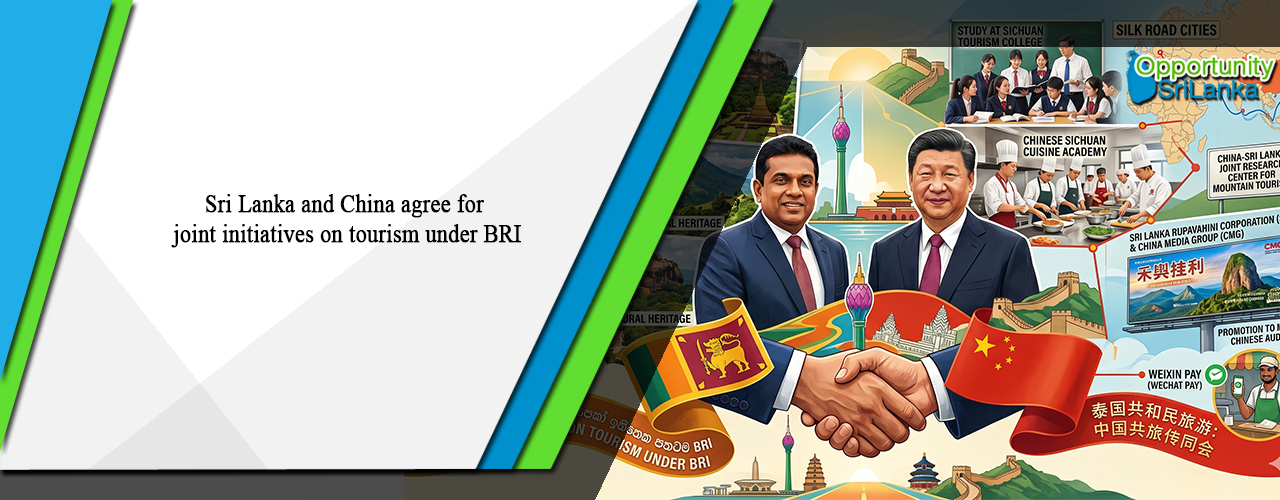
Sri Lanka and China agree for joint initiatives on tourism under BRI
EconomyNext: Sri Lanka and China have agreed on a raft of joint initiatives to boost the tourism industry under the Belt and Road Initiative (BRI), the South Asian island nation’s Foreign Ministry said.
The two countries reached consensus on the initiatives during an official visit by Ruwan Ranasinghe, Deputy Minister of Foreign Affairs, Foreign Employment and Tourism to Sichuan Tourism College in China recently.
The visit concluded with a cooperation symposium, where both sides reached preliminary consensus on several joint initiatives, Sri Lanka’s Foreign Ministry said.
The joint initiatives included establishing a Chinese Sichuan Cuisine Academy, creating a China-Sri Lanka Joint Research Center for Mountain Tourism, launching a China-Sri Lanka Cultural Tourism Cooperation Platform, developing an Innovation Service Research Center for Hospitality, and expanding Sri Lankan student enrollment under the “Study at Sichuan Tourism College” programme.
“Both sides engaged in extensive discussions on strengthening collaboration in tourism talent development, joint research, and vocational training,” the Foreign Ministry said in its statement.
“The dialogue reflected the shared vision of Sri Lanka and China to deepen cultural and educational ties, while also promoting sustainable tourism practices.”
Deputy Minister Ranasinghe who completed his doctoral study at Sichuan University, “emphasized the complementary strengths of Sri Lanka and Sichuan in tourism resources, highlighting opportunities for collaboration in culinary arts, hospitality, and eco-tourism.”
“His remarks underscored the importance of building bridges between academic institutions to foster innovation and mutual growth.”
“He highlighted culture as a core driving force for tourism development and stressed that policy coordination, infrastructure connectivity, digital empowerment, and educational exchanges under the Belt and Road Initiative can transform cultural bonds into sustainable cooperation.”
Sri Lanka and China have fostered a deep bilateral partnership in the tourism sector, which has become a cornerstone of the island’s post-crisis economic recovery strategy.
As of 2026, China has solidified its position as one of Sri Lanka’s top source markets, with the Sri Lanka Tourism Development Authority (SLTDA) setting an ambitious target of attracting 300,000 Chinese visitors annually to buffer downturns in traditional European markets.
This cooperation was significantly elevated following President Anura Kumara Dissanayake’s state visit to Beijing in January 2025, where both nations signed sweeping agreements to enhance aviation connectivity and mutual tourist travel.
These initiatives include joint media content production between the Sri Lanka Rupavahini Corporation (SLRC) and the China Media Group (CMG) to promote Sri Lankan destinations to a massive Chinese audience, as well as the introduction of digital payment platforms like Weixin Pay (WeChat Pay) in Sri Lanka to reduce revenue leakage and empower local small-scale vendors.
By integrating Chinese-supported infrastructure projects like the Colombo Port City into the tourism narrative and aligning with the “International Tourism Alliance of Silk Road Cities,” Sri Lanka aims to position itself as a premier destination for high-yield Chinese travelers seeking wellness, nature-based, and cultural experiences.
Sri Lanka, however, receives its highest number of tourists from India in recent years.
OSL take:
Sri Lanka’s tourism industry is entering a new phase of opportunity, driven by strengthening ties with China under the BRI. Recent agreements on joint tourism initiatives signal not just increased visitor flows, but a deeper level of collaboration in infrastructure, education, and service development. With China being one of the world’s largest outbound tourism markets, even modest gains in arrivals can translate into substantial economic impact for the island. This momentum creates a strong landscape for foreign businesses/investors. Business/investment opportunities are expanding beyond traditional hotel development into areas such as eco-tourism, digital travel services, transport infrastructure, and hospitality training. Strategic partnerships with Chinese institutions like those formed through tourism education and skills exchange can also help raise service standards, making Sri Lanka more competitive globally. Also, ongoing infrastructure improvements linked to BRI projects like ports, highways, and urban development further enhance connectivity and accessibility, both critical for tourism growth. Regions that were previously underdeveloped are becoming viable investment destinations, offering first-mover advantages in boutique resorts, cultural tourism, and adventure travel. For foreign businesses/investors looking for high-growth emerging markets, Sri Lanka presents a compelling mix that includes a resilient tourism rebound, government support, and increasing integration with a major global economic partner.
| Article Code : | VBS/AT/20260505/Z_1 |