
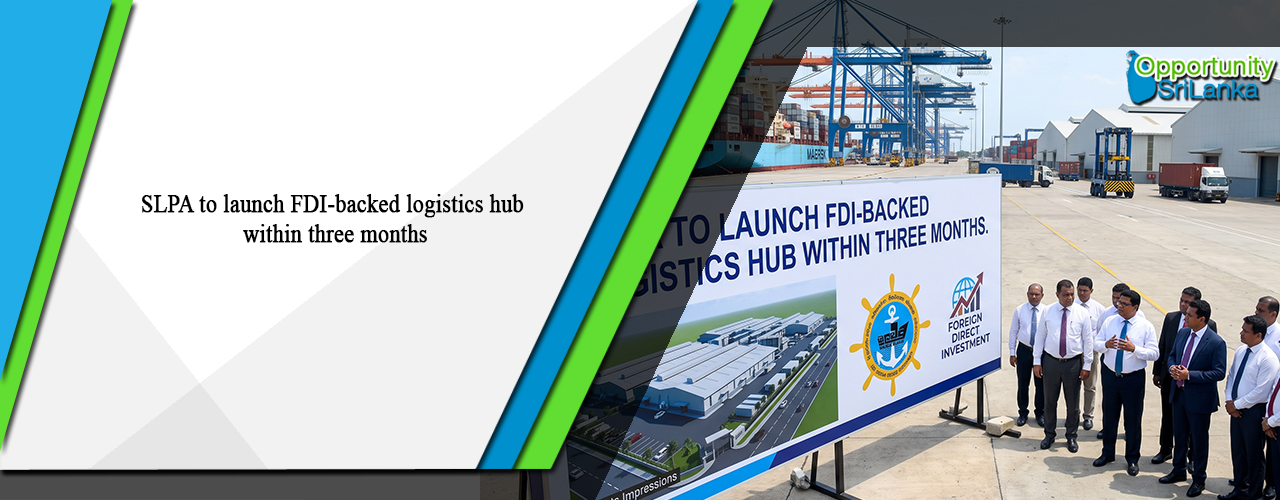
SLPA to launch FDI-backed logistics hub within three months
Daily FT: The Sri Lanka Ports Authority (SLPA) is set to launch a long-awaited logistics hub within the next two to three months, incorporating free-zone and bonded warehousing facilities and opening a new avenue for foreign direct investment, SLPA Chairman Dr. Parakrama Dissanayake said.
Speaking at the 9th Annual General Meeting of the Sri Lanka Association of NVOCC Agents (SLANA) on Thursday, he said the facility could fundamentally alter Colombo’s value proposition by allowing it to move beyond its four-decade role as a transshipment hub and develop a broader logistics ecosystem.
“We have been a transshipment hub for 40 years, but we have never had a proper logistics hub of scale,” Dissanayake said, stressing that the planned facility would create opportunities for investors to establish warehousing and other logistics operations around the Port of Colombo.
The initiative comes as Colombo’s rapid throughput growth begins to put pressure on existing infrastructure. Dissanayake said container volumes had increased by around 12% during the first half of 2026, putting the port on course to handle close to 9 million TEUs for the full year.
At such volumes, he said, utilisation was approaching levels at which operational strain becomes increasingly evident. “The SLPA is therefore targeting an additional 1.5 million TEUs of capacity by end-2027,” he added.
Dissanayake also pointed to the expected opening around October of the expressway connection between the port and the airport, which could reduce the journey to about 25 minutes. Better sea-air connectivity, could strengthen Colombo’s ability to handle cargo, particularly transshipment traffic originating in Bangladesh.
“These would be a game changer,” he stressed.
However, he opined that infrastructure expansion alone will not address the structural changes confronting freight forwarders and NVOCC operators.
Dissanayake said global container ship capacity had reached around 34.6 million TEUs, with the 10 largest shipping lines controlling around 84.5% of capacity. Major alliances collectively account for around two-thirds of global capacity, giving a handful of carriers substantial influence over deployment and freight markets.
“This means freight forwarders and NVOCC agents are increasingly operating at the mercy of five major carriers, who now dictate deployment decisions and continue to add new capacity,” he explained.
With another 13 million TEUs of vessel capacity reportedly on order, he warned that the concentration of power was intensifying.
Compounding this, SLPA Chief noted major shipping lines have themselves evolved from pure vessel operators into full supply chain service providers, giving them a structural advantage through control of the physical infrastructure like terminals, warehousing and end-to-end logistics, which freight forwarders typically lack.
Against this backdrop, Dissanayake called on SLANA to rethink its role, arguing that the association should evolve from representing NVOCC interests into becoming an enabler of Sri Lanka’s next-generation logistics ecosystem.
“It’s all about demand chain management,” he said, stressing that shipping could no longer be treated as an isolated maritime function.
OSL take:
Sri Lanka’s strategic position in the Indian Ocean and its growing role as a regional transshipment hub are creating expanding business/investment opportunities for foreign businesses/investors across the maritime, shipping and logistics sectors. The planned launch of a new logistics hub by SLPA, incorporating free-zone and bonded warehousing facilities, could further strengthen Colombo’s position by allowing the country to move beyond transshipment and develop a broader logistics ecosystem. With Colombo’s container volumes continuing to grow and additional capacity being planned, opportunities are emerging in warehousing, freight forwarding, distribution, supply-chain management, container handling and value-added logistics services. The wider maritime sector also offers investment potential in port infrastructure, shipping services, ship repair, bunkering, maritime technology and multimodal transport. Sri Lanka’s location close to major international shipping lanes gives foreign businesses/investors an opportunity to establish regional operations serving growing trade between Asia, the Middle East, Africa and Europe. As global supply chains increasingly prioritise resilience and efficient connectivity, the country’s maritime and logistics sectors are positioned to become important engines of future investment and economic growth.
| Article Code : | VBS/AT/20260916Z_3 |