
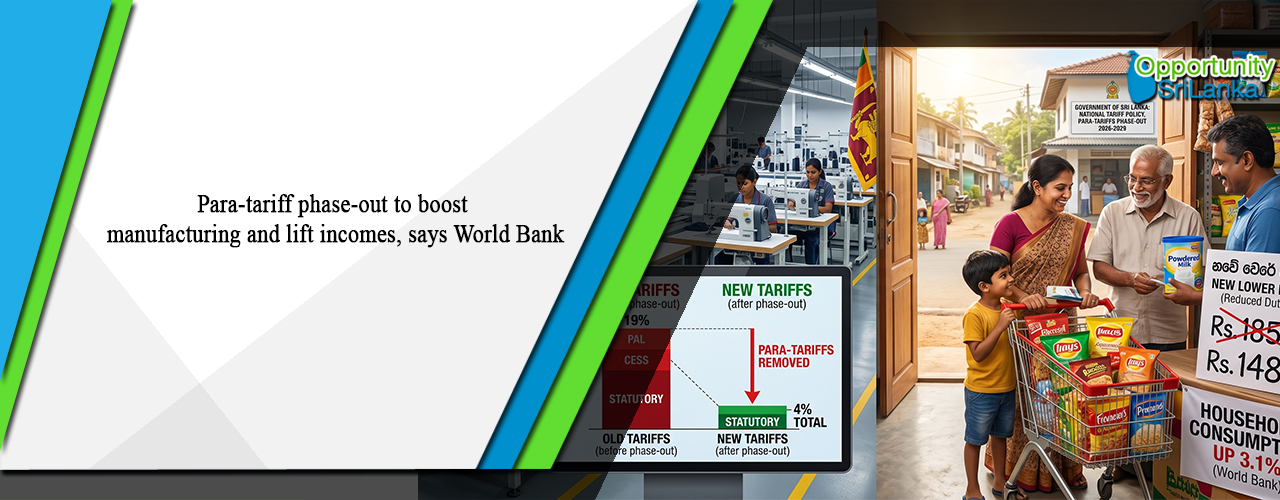
Para-tariff phase-out to boost manufacturing and lift incomes, says World Bank
Daily FT: Sri Lanka’s plan to remove para-tariffs will reduce import duties by around nine percentage points (ppts) and alter cost structures across manufacturing, while raising household consumption and real incomes, according to the World Bank’s South Asia Economic Update April 2026.
The report notes that Sri Lanka’s simple average import duty is 19%, of which 11 ppts come from para-tariffs rather than statutory tariffs. “Less than half of these import duties are statutory tariffs,” the World Bank said, referring to levies such as the Ports and Airport Development Levy (PAL) and the Commodity Export Subsidy Scheme (CESS).
Under the Government’s National Tariff Policy, these para-tariffs are to be phased out over four years to 2029. “This phase-out of Sri Lanka’s two largest para-tariffs would represent a nine-ppt cut in the simple average ad valorem import duties applied,” the report said.
The structure of the tariff regime means the reform will be felt most in manufacturing. Para-tariffs exceed statutory tariffs across all manufacturing sectors, with the largest reductions expected in processed food and beverages, where duties could fall by as much as 28 ppts. In contrast, sectors such as textiles and mining are expected to see cuts of below five ppts.
The changes affect sectors employing about one-third of the workforce, placing weight on labour mobility. Gains depend on how easily workers move between sectors.
Household effects are broad-based. Consumption is projected to increase by around 3.1% in the short term. “The magnitude of these short-run consumption effects is considerably larger,” the World Bank said, noting that the reform applies across all import sources.
The gains are uneven across income groups. Lower-income households, particularly in rural areas, stand to benefit more because of their higher share of spending on food. The poorest rural households allocate about 31% of expenditure to food manufacturing, compared with around 10-12% among richer households.
From a trade perspective, the reform shifts incentives across export sectors. Sri Lanka’s strongest export industries, including textiles and tea, already operate under relatively low tariff regimes. The largest tariff reductions are concentrated in sectors with weaker comparative advantages and higher existing protection, including food and beverage manufacturing and rubber and plastic products.
OSL take:
Sri Lanka’s ongoing tariff reforms, particularly the planned removal of para-tariffs, signal a decisive shift toward a more open and business-friendly economic environment. As highlighted in the latest assessment by the World Bank, the phased reduction of import duties is expected to lower costs, stimulate consumption, and reshape incentives across key sectors, especially in the manufacturing industry. These developments come alongside Sri Lanka’s broader efforts to strengthen its trade integration. Preferential trade agreements and concessions enjoyed by Sri Lanka with regional and global partners have already positioned Sri Lanka as an accessible gateway to key markets, especially given the country’s geographical positioning in the Indian Ocean. For foreign businesses/investors, this means not only improved access to the domestic market but also the potential to leverage Sri Lanka as a base for exports. Also, the evolving policy landscape encourages collaboration between foreign businesses/investors and local enterprises. Sri Lanka therefore is increasingly positioning itself as a competitive destination for foreign investment, offering both market access and opportunities for strategic expansion through local partnerships.
| Article Code : | VBS/AT/20260423/Z_1 |