
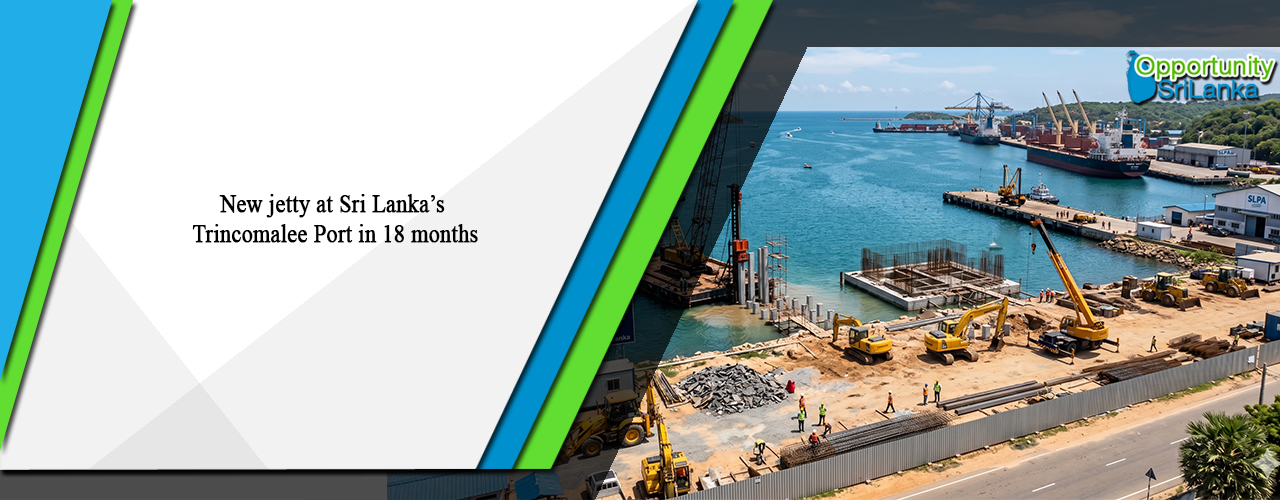
New jetty at Sri Lanka’s Trincomalee Port in 18 months
The Morning: Sri Lanka is reportedly aiming to complete the construction of a new jetty at the Trincomalee Port and associated pipelines within one and a half years.
Speaking to The Sunday Morning Business, Ceylon Petroleum Corporation (CPC) Managing Director Dr. Mayura Neththikumarage revealed that development work on four of the 24 tanks at the Trincomalee Oil Tank Farm allocated to the CPC had already been completed.
However, he noted that the absence of a dedicated jetty and pipeline system had necessitated further infrastructure development to enable fuel transportation to the tanks.
Accordingly, he stated that the CPC was currently in the process of sourcing the required materials for the construction of both the jetty and the connecting pipelines.
“We are currently developing four oil tanks. What remains is the development of the jetty and pipelines. Once the jetty is developed, we can commence using the oil tanks.
“By now, the four oil tanks have been mechanically developed, but the process will be complete only after the jetty is constructed. At present, we are procuring materials for the construction of the jetty and the pipelines,” he said.
He further noted that the construction of the jetty and pipelines was expected to be completed within approximately 18 months.
Dr. Neththikumarage also revealed that redevelopment work on the remaining tanks allocated to the CPC would commence once construction of the jetty got underway.
He further stated that the new jetty at the Trincomalee Port would also be utilised by Trinco Petroleum Terminal Ltd. (TPTL), a joint venture between Lanka IOC (LIOC) and the CPC, established for the joint development of 61 tanks at the Trincomalee Oil Tank Farm.
The Trincomalee Oil Tank Complex Development Project received approval from the Cabinet of Ministers on 4 January 2022. Under the agreed framework, 24 of the 99 tanks are allocated to the CPC, 14 to LIOC, and 61 to TPTL, the latter on a 50-year lease.
The Trincomalee Oil Tank Farm, built by the British as a refuelling station during World War II, is located on 850 acres of land and originally contained 101 tanks, each with the capacity to hold 12,100 MT of oil.
Out of the original 101 tanks, two were destroyed in a kamikaze attack during a Japanese air raid on Trincomalee on 9 April 1942 and when a Royal Ceylon Air Force plane crashed in the early 1960s.
OSL take:
Sri Lanka’s renewed focus on strategic infrastructure development, particularly in energy and maritime logistics, is creating a strong platform for foreign investment, especially as the country positions itself as a South Asian regional hub. A key development is the planned completion of a new jetty at Trincomalee Port along with associated pipeline infrastructure within the next 18 months. This upgrade is closely tied to the expansion of the Trincomalee Oil Tank Farm, where work on four of the 24 tanks already allocated to the CPC has been completed. Once operational, the integrated system will significantly improve fuel handling, storage, and distribution efficiency. These developments open clear business/investment opportunities in energy logistics, port services, and industrial infrastructure. The Trincomalee region, with its deep natural harbour, is particularly well-suited for large-scale petroleum storage, bunkering services, and transshipment operations. For foreign businesses/investors, this presents potential entry points into long-term concessions, public–private partnerships (PPPs), and joint ventures in fuel supply chains and port-related services. Sri Lanka’s ambition to strengthen its maritime positioning enhances its attractiveness as a regional shipping and logistics node linking South Asia, Southeast Asia, and the Middle East. Improved infrastructure at Trincomalee could reduce operational bottlenecks, lower energy import costs over time, and support the development of value-added services such as refining, storage, and re-export. Sri Lanka’s maritime and energy sectors therefore stand out as key engines for growth, offering foreign investors early-mover advantages in a strategically located and increasingly interconnected regional hub.
| Article Code : | VBS/AT/20260513/Z_2 |