
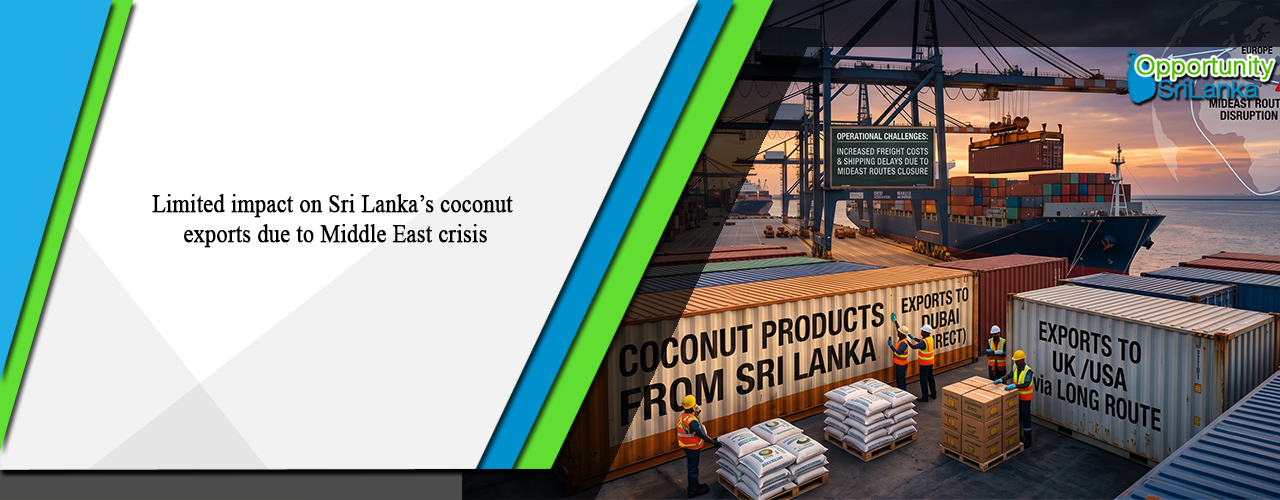
Limited impact on Sri Lanka’s coconut exports due to Middle East crisis
The Morning: The ongoing Middle East crisis has had a limited direct impact on Sri Lanka’s coconut exports, although shipping disruptions and increasing freight costs have created operational challenges for the sector, according to Coconut Development Authority (CDA) Chairman Shantha Ranathunga.
He explained that the direct impact on exports remained relatively low, noting that only a small portion of coconut products were shipped to the Middle East.
According to Ranathunga, approximately 8% of coconut products are exported directly to the Dubai market, especially king coconut and related coconut products. As a result, the overall direct impact on the industry is estimated at around 12–14%.
Ranathunga further stated that while direct impact upon exports remained limited, indirect effects had emerged due to disruptions to shipping routes.
He noted that the closure of certain routes and the inability of vessels to pass through Middle Eastern routes had forced ships to take longer alternative routes before reaching markets such as the UK and the US. As a result, shipping charges have increased notably.
“Freight costs have increased by between $ 1,500 and $ 4,000 per container for exports, and this surge has created additional pressure on exporters. The other challenge is shipment delays, with goods not being collected on time and some buyers slowing down shipments due to higher freight costs. While we can’t predict how the situation will unfold, we hope it will stabilise within the next few weeks,” Ranathunga said.
However, he emphasised that certain exports were continuing despite these disruptions.
Addressing imports related to value addition, the CDA Chairman stated that there was currently no significant impact. He explained that Sri Lanka did not import products for value addition at present, apart from coconut oil.
He further noted that, in certain cases, approvals were granted for specific consumers under the Temporary Import for Export Processing (TIEP) scheme, specifically for products that could not be manufactured locally. These include items such as coconut sugar and concentrated coconut water.
Ranathunga clarified that these products were imported only for value addition and were subsequently re-exported. He added that all products imported under this scheme were processed and exported accordingly, ensuring that imports were tied directly to export-oriented value addition activities.
OSL take:
The limited impact on local commodities exports due to the ongoing conflict in the Middle East indicates the overall strength, resilience and growth of Sri Lanka’s export industry, especially agriculture commodity exports. The many trade agreements and trade concessions enjoyed by Sri Lanka with many foreign countries have helped boost the country’s export industry. Sri Lanka’s export industry is also on a growth path that involves further development with focus on adding more value to Sri Lankan exports while further diversifying the country’s export product portfolio to meet the increasing demands and trends in the global market. All these developments have expanded business/investment opportunities in Sri Lanka’s export industry as well as sectors related to it. The growth, profits and expansions recorded by local businesses engaged in the industry and the increasing interest among foreign businesses/investors indicate the increasing business potential in Sri Lanka’s export industry, especially in the agricultural export sector. Foreign businesses/investors could therefore confidently explore the expanding opportunities in Sri Lanka’s export industry and related sectors.
| Article Code : | VBS/AT/20260421/Z_2 |