
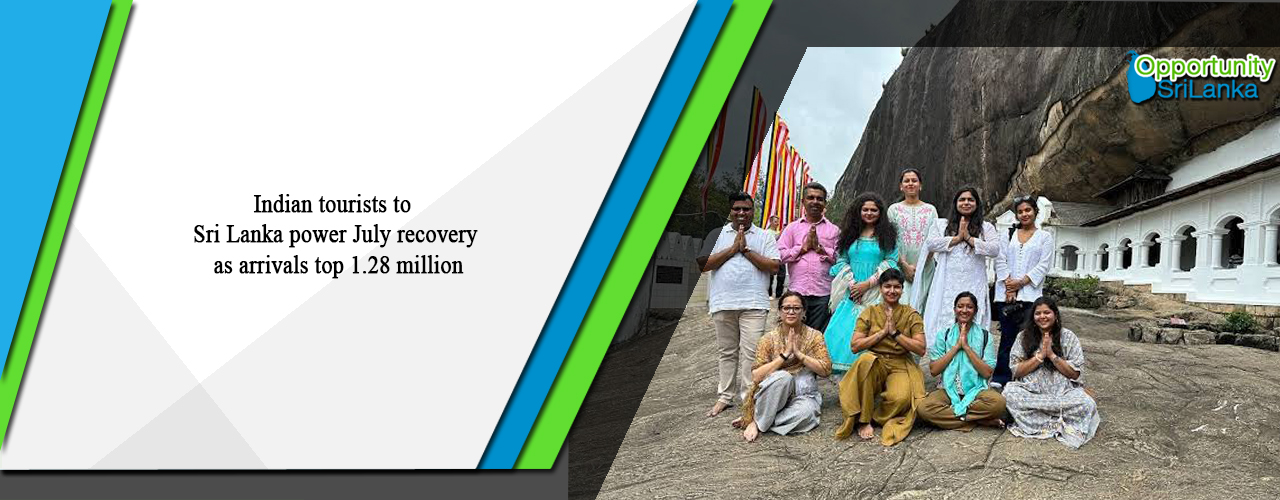
Indian tourists to Sri Lanka power July recovery as arrivals top 1.28 million
Daily FT: Indian tourists have helped Sri Lanka’s tourism industry regain momentum in July, narrowing the year-on-year (YoY) decline in arrivals and pushing cumulative visitor numbers beyond 1.28 million despite continuing disruptions to key Middle Eastern aviation routes.
The latest data released by the Sri Lanka Tourism Development Authority (SLTDA) showed that 138,730 tourists arrived during the first 22 days of July, representing only a 0.4% YoY decline, a marked improvement from earlier in the month as the pace of arrivals gathered momentum.
The recovery also reflects a strong rebound from June’s 124,551 arrivals, with the daily average in July improving to 6,306 visitors.
The narrowing gap has been driven largely by robust demand from India, supported by extensive direct connectivity provided by national carrier SriLankan Airlines and Indian low-cost airline, IndiGo further expanding operations between the two countries.
India remained Sri Lanka’s largest source market during the first 22 days of July, contributing 31,734 visitors, accounting for 23% of total arrivals.
The UK ranked second with 14,959 visitors (11%), followed by China with 8,484 (6%), the Netherlands with 8,415 (6%), and Australia with 7,419 (5%).
On a cumulative basis, Sri Lanka has now welcomed over than 1.28 million tourists so far in 2026, with India maintaining a commanding lead among source markets.
A total of 325,417 Indian travellers have visited Sri Lanka this year, accounting for 25% of all arrivals, followed by the UK with 123,526 visitors (10%) and China with 72,816 tourists (7%).
The strong performance from India comes as tourism authorities observe a significant shift in visitor spending patterns.
Sri Lanka Tourism Chairman Buddhika Hewawasam recently said Indian travellers are now spending more per day than many traditional long-haul visitors despite their relatively shorter stays.
According to him, the average daily expenditure of Indian tourists has increased to around $154, surpassing Sri Lanka’s overall average daily spending of $148.
“Sometimes Indian travellers spend more than European tourists,” Hewawasam said, noting that visitors travelling for wildlife and marine tourism typically spend between $160 and $170 per day, highlighting growing demand for high-value niche tourism experiences.
OSL take:
Sri Lanka’s tourism industry is steadily regaining momentum, creating a growing pipeline of business/investment opportunities for foreign businesses/investors seeking to establish or expand their presence in the island’s hospitality sector. With visitor arrivals continuing to recover, the sector is once again emerging as one of Sri Lanka’s strongest growth engines. The resilience shown in July – despite disruptions to Middle Eastern aviation routes – highlights the industry’s ability to attract travellers from key regional markets. India remains Sri Lanka’s largest source market, supported by strong air connectivity through SriLankan Airlines and IndiGo. The sustained flow of Indian tourists is creating increasing demand for hotels, resorts, serviced apartments, restaurants, wellness and medical tourism, entertainment, transport services, destination management, and digital travel platforms. For Indian businesses/investors, the opportunities are particularly compelling. Geographic proximity, cultural familiarity, and growing travel links position Indian companies to capitalise on rising tourist traffic through investments in hospitality infrastructure, tourism-related real estate, adventure and eco-tourism projects, retail, food and beverage ventures, and tourism technology solutions. As Sri Lanka continues to strengthen its tourism sector as a pillar of economic recovery, the expanding Indian visitor base offers businesses/investors a ready market and long-term growth potential. With tourism expected to remain a priority sector for the Sri Lankan Government, the industry presents an attractive platform for regional partnerships, joint ventures, and sustainable investment in one of South Asia’s most promising travel destinations.
| Article Code : | VBS/AT/20260806Z_1 |