
India, Sri Lanka, UAE renew push on Trincomalee oil hub
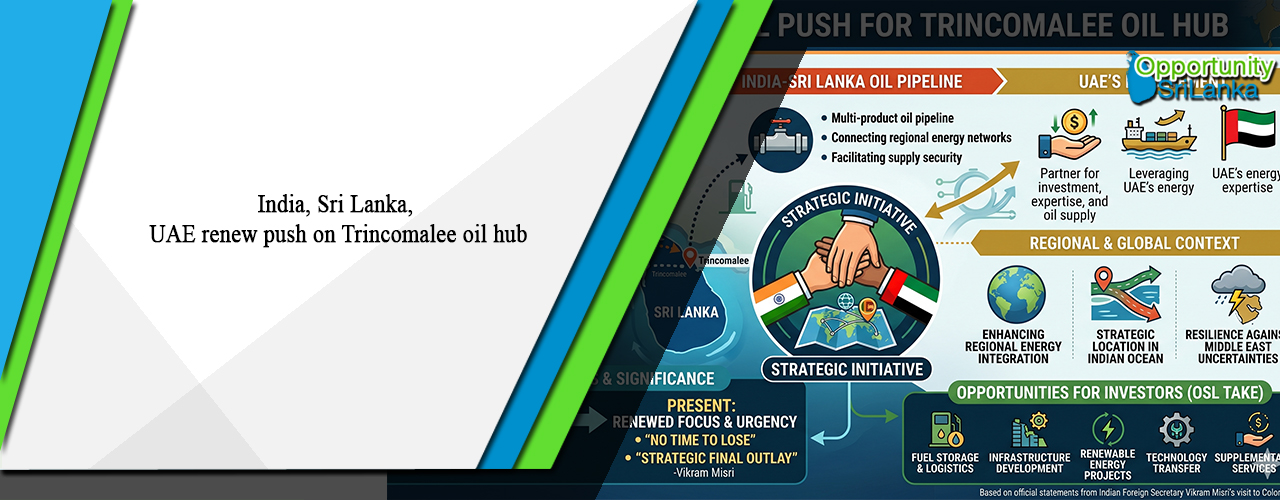
Newswire: Indian Foreign Secretary Vikram Misri says the Trincomalee oil farm project and the India–Sri Lanka oil pipeline were discussed during Indian Vice President C.P. Radhakrishnan’s visit to Sri Lanka.
Addressing the media in Colombo on Sunday (19), Misri said the planned oil hub in the northeastern port of Trincomalee was taken up in a meeting with Sri Lankan President Anura Kumara Dissanayake (AKD).
He noted that the project, which also involves the United Arab Emirates, has been under discussion since 2023. While there is no timeline yet, he described it as a strategic initiative with a significant final outlay.
“There is no further time to lose in making progress on strategic projects such as these,” Misri said, adding that both sides agreed on the need to get the project off the ground quickly.
He remarked that had the energy hub been completed, it could have been particularly useful “at a time like this,” referring to the impact of the Middle East conflict.
Sri Lanka, India, and the UAE signed an agreement a year ago, following two years of talks, to establish a multi‑product oil pipeline connecting the two South Asian neighbours and to set up the Trincomalee oil storage complex.
OSL take:
Sri Lanka’s energy sector is continuing to gain momentum as the country advances plans to position itself as a hub in South Asia supported by the country’s strategic positioning in the Indian Ocean and strong trade ties with many foreign countries. Key initiatives such as the proposed Trincomalee oil storage complex and the India-Sri Lanka oil pipeline highlight a shift toward large-scale infrastructure development and regional energy integration. With partnerships involving India and the United Arab Emirates, Sri Lanka is strengthening its role in energy storage, distribution, and connectivity across the region. The development of Trincomalee as an energy hub also offers significant potential due to its natural deep-water port and strategic location along major shipping routes. All these developments are creating attractive business/investment opportunities for foreign businesses/investors, which could also be expanded through local collaborations. The expansion of Sri Lanka’s energy infrastructure opens avenues in fuel storage, logistics, renewable energy, technology transfer, and supplementary services. As Sri Lanka continues to modernize its energy systems and attract international partnerships, the sector presents strong potential for long-term investment and regional market access.
| Article Code : | VBS/AT/20260422/Z_3 |