
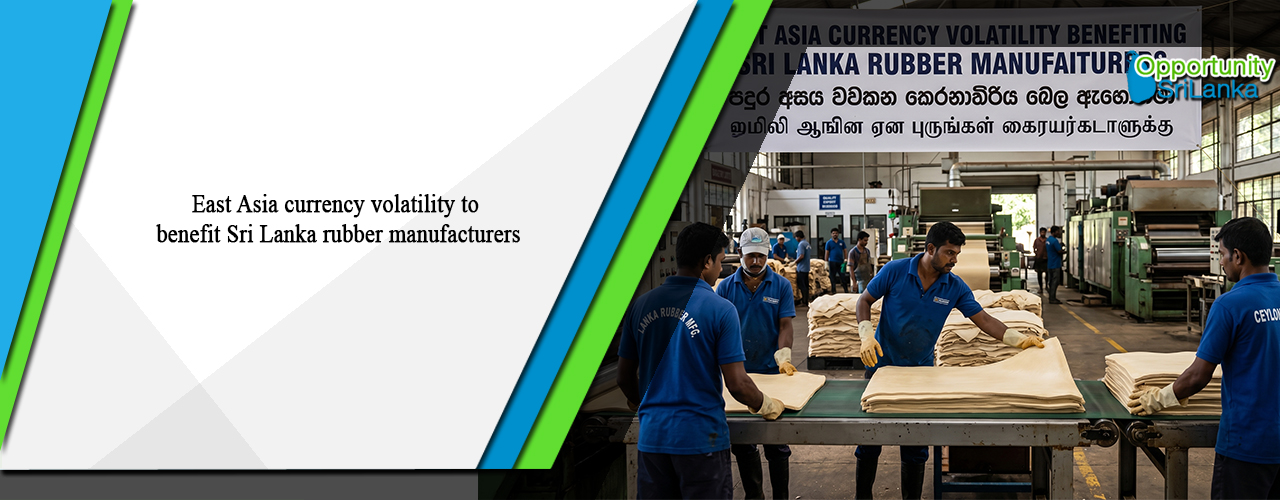
East Asia currency volatility to benefit Sri Lanka rubber manufacturers
The Morning: Global foreign exchange volatility in rubber products manufacturing countries such as Malaysia, Thailand, and China, offers Sri Lanka’s rubber glove manufacturers a competitive edge, First Capital’s recently published (4) rubber sector report said.
“FX movements in MYR, THB, and CNY provide tailwinds for Sri Lankan glove manufacturers,” the report titled Impact of Rising Rubber Prices on Listed Counters said.
With the depreciation of LKR seen since the end of February, the research unit noted that volatility that has driven Asian currencies upwards against the USD, may benefit Sri Lankan manufacturers.
“Appreciation of the MYR, THB, and CNY against the USD has enhanced the relative affordability of Sri Lankan gloves, with the MYR, THB, and CNY appreciating by 8.0%, 2.0%, and 6.1%, respectively, over 25-26 May, while the LKR depreciated by 6.7% over the same period.”
Commenting on the prevalent state of rubber futures, the unit added: “Rubber futures extended their rally, surpassing 216.3 SGD cents/kilogram, closer to a 10-year high.”
The surge in pricing was attributed to the ongoing volatility in higher oil prices. “The surge has been largely driven by firmer oil prices… Natural rubber prices tend to track crude oil, as higher oil costs increase the price of synthetic rubber.”
However, yesterday (6), Brent crude oil prices dove by over 10%, dropping below $ 100 a barrel over renewed hopes of a deal to end the war between the US and Iran.
It was further noted that local companies Kegalle Plantations PLC (KGAL), Agalawatte Plantations PLC (AGAL), Kotagala Plantations PLC (KOTA), and Horana Plantations PLC (HOPL) are to benefit from the tailwinds, as the segment makes up approximately 15% of revenues.
“KGAL, AGAL, KOTA, and HOPL are well positioned to benefit from rising rubber prices, given that the rubber segment accounts for c.15.0% or more of their revenue.”
OSL take:
Global foreign exchange volatility in key rubber-producing economies such as Malaysia, Thailand, and China is creating a notable opening for Sri Lanka’s rubber manufacturing sector, particularly in value-added segments like rubber gloves. As currencies such as the Malaysian ringgit (MYR), Thai baht (THB), and Chinese yuan (CNY) experience fluctuations, cost structures in competing manufacturing hubs have become less predictable, reducing their pricing stability in global export markets. Against this backdrop, Sri Lanka is emerging as a relatively competitive alternative. According to recent sector analysis, these forex movements are providing tailwinds for Sri Lankan glove manufacturers by improving their cost competitiveness and export attractiveness. Combined with steady access to natural rubber, an established industrial base, and growing compliance with international quality standards, the country is increasingly well-positioned to capture a larger share of global demand in medical and industrial gloves. For foreign businesses/investors, this shift presents a timely entry point into a niche but expanding manufacturing segment. Opportunities extend beyond production into capacity expansion, technology upgrades, and export-oriented joint ventures. As global supply chains continue to diversify away from over-concentrated hubs, Sri Lanka’s rubber sector offers a strategic foothold in a market driven by healthcare demand, industrial safety requirements, and supply chain resilience. If current macro and currency trends persist, Sri Lanka’s rubber manufacturing industry could transition from a secondary player to a more significant node in the global value chain, creating early-stage investment advantages for foreign businesses/investors willing to engage now.
| Article Code : | VBS/AT/20260511/Z_2 |