
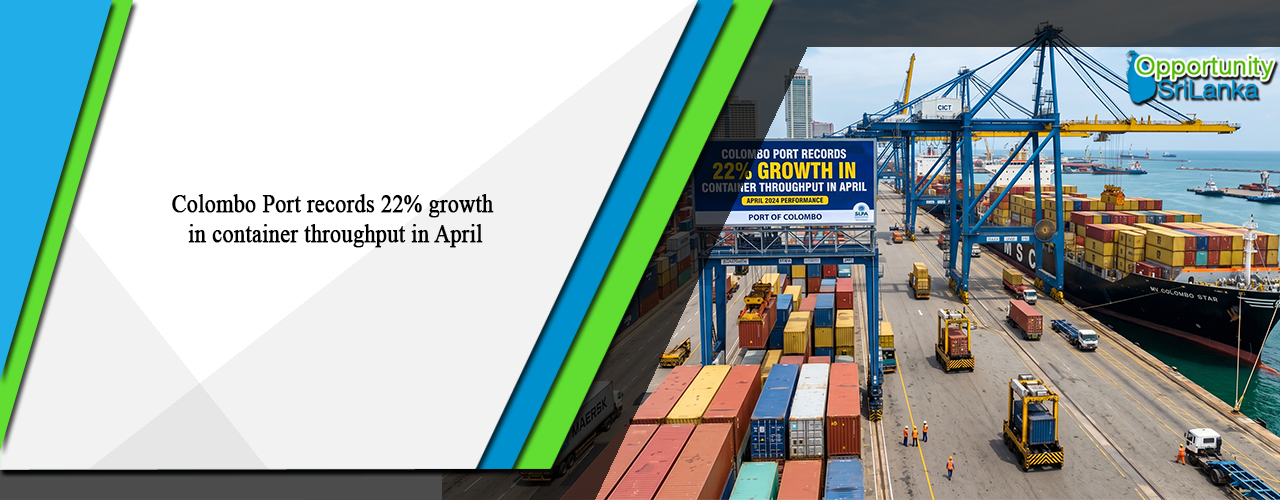
Colombo Port records 22% growth in container throughput in April
Daily FT: The Port of Colombo (POC) has recorded a significant increase in container handling volumes during the first four months of 2026.
It handled 761,096 Twenty-foot Equivalent Units (TEUs) in April 2026, compared to 623,719 TEUs recorded in April 2025, marking a growth of 22%.
The cumulative container throughput from January to April 2026 reached 2,915,004 TEUs, reflecting a 13.9% or 355,157 TEU increase, compared to the 2,559,847 TEUs handled during the corresponding period in 2025.
The POC continues to function primarily as a transhipment hub, with transhipment cargo accounting for over 80% of its total operations. A substantial volume of bulk cargo operations is also handled through the Port, particularly with imports originating from India.
In 2025, the POC handled approximately 8.2 million TEUs, maintaining its status among the busiest ports in the region.
Sources said the Sri Lanka Ports Authority (SLPA) is also preparing to call for Expressions of Interest (EOIs) before the end of 2026 for the construction of Phase II of the West Container Terminal (WCT) at the POC. The expansion is expected to add more than 3 million TEUs to the Port’s annual handling capacity, significantly enhancing Colombo’s role as a major regional logistics hub along the East-West maritime trade route.
Separately, the National Port Master Plan, funded by the Asian Development Bank (ADB), is expected to be completed within the next year. The comprehensive master plan is designed to guide the future development of all commercial ports in Sri Lanka and support long-term maritime sector expansion.
Sources said at the Colombo East Container Terminal (CECT), Phase I operations are already underway using four newly commissioned gantry cranes. Efforts are currently being accelerated to complete the remaining phases of the Terminal, with procurement processes ongoing for additional superstructure equipment required for efficient and seamless terminal operations.
The POC’s long-term operational security and expansion capacity were significantly strengthened through the construction of the Colombo South Port breakwater project, developed at an investment of approximately $ 400 million. The breakwater remains one of the largest maritime infrastructure projects undertaken in Sri Lanka and has enabled the accommodation of ultra-large container vessels at the Port.
OSL take:
The strong growth in container volumes at the Port of Colombo highlights Sri Lanka’s strengthening position as a key maritime and transshipment hub in the Indian Ocean. With throughput rising significantly in early 2026 and transshipment accounting for over 80% of operations, the port continues to consolidate its role as a strategic node linking major East-West shipping routes. This expansion is creating substantial business/investment opportunities for foreign businesses/investors across the maritime, ports, shipping, and logistics sectors. Increased cargo flows are driving demand for modern container terminals, port automation systems, warehousing facilities, cold-chain logistics, and digital supply chain solutions. International port operators, infrastructure developers, and logistics firms can explore partnerships in terminal expansion projects, inland freight networks, and integrated logistics parks. Sri Lanka’s proximity to major trade routes and its growing role in regional trade, particularly with high cargo movement linked to India, further enhances its attractiveness as a distribution and re-export center. Businesses/investors in maritime services such as bunkering, ship repair, vessel servicing, and maritime technology also stand to benefit from rising traffic through the port. As the Port of Colombo continues to scale its operations and modernise its infrastructure, it is positioning Sri Lanka as a competitive maritime gateway in South Asia, offering long-term, high-value opportunities for global investors in the blue economy and logistics ecosystem.
| Article Code : | VBS/AT/20260512/Z_4 |