
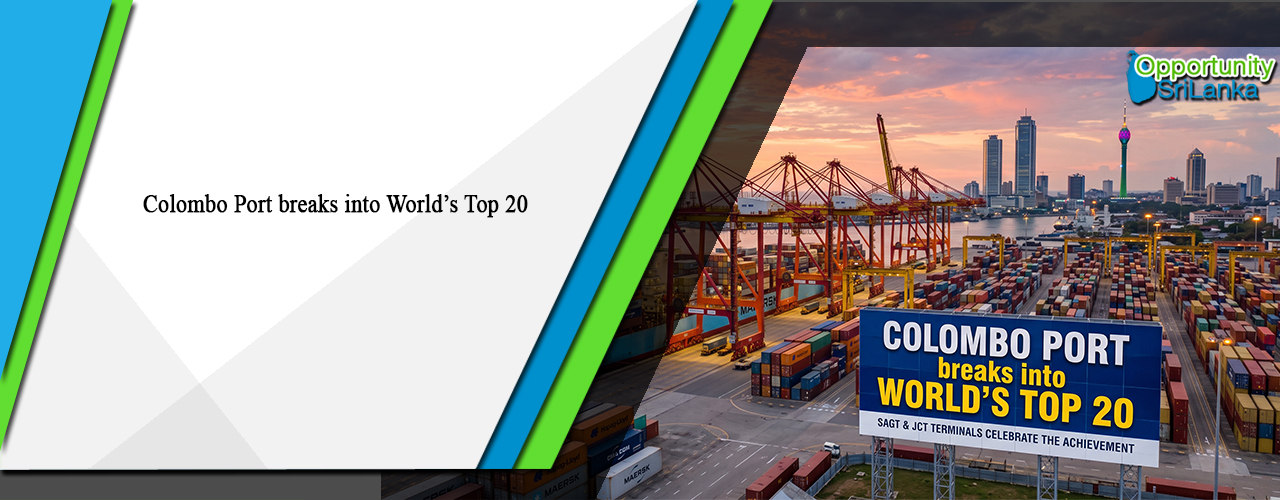
Colombo Port breaks into World’s Top 20
The Morning: The Port of Colombo has ranked in the Top 20 among the world’s major container ports, rising from the 26 position, to boost Sri Lanka’s maritime ambitions, according to the recent figures by Research Tool Alphaliner, cited by the Sri Lanka Ports Authority (SLPA).The port topped, handling 4.44 million TEUs (twenty-foot equivalent units) during the first half of 2026, container volumes increased by 11.9%, compared with the same period in 2025, which was around 3.97 million TEUs, according to SLPA figures.According to SLPA, the improvement in the global ranking is viewed as an important milestone for Sri Lanka’s efforts to strengthen its position in international shipping sector, where as a result, further investments in container handling, logistics and port capacity are expected to support the port’s future growth and improve its ability to serve as a gateway for regional and global trade.The latest figures underline Colombo’s growing importance as a key transshipment hub in the Indian Ocean, connecting major shipping routes between Asia, the Middle East, Africa and Europe, SLPA said as it seeks to expand capacity and attract a larger share of regional and global maritime trade.
OSL take:
Sri Lanka’s growing maritime sector is creating a widening range of business/investment opportunities for foreign companies and investors, as the country seeks to establish itself as a leading maritime hub in South Asia. The Port of Colombo’s rise into the world’s Top 20 container ports, following an 11.9% increase in container volumes to 4.44 million TEUs in the first half of 2026, highlights the growing potential of the country’s port and logistics industry. The investment opportunity extends well beyond container handling. Port infrastructure, terminal development, warehousing, freight forwarding, multimodal logistics, ship repair and maintenance, bunkering, marine services, cold-chain facilities and maritime technology are among the areas that could benefit from rising trade and transshipment activity. Sri Lanka’s strategic location along major East-West shipping routes gives it a natural advantage, while planned expansion and modernisation of port infrastructure could create opportunities for international operators, infrastructure investors and logistics companies. The development of Colombo, Hambantota and Trincomalee as complementary maritime and industrial centres could further broaden the investment landscape. With greater private-sector participation and foreign capital, Sri Lanka has the potential to develop an integrated maritime ecosystem connecting ports with logistics, manufacturing, energy and regional trade. For foreign businesses/investors, Sri Lanka’s maritime ambitions therefore present an opportunity not merely to invest in ports, but to participate in the development of a broader South Asian maritime and logistics hub.
| Article Code : | VBS/AT/20260903Z_2 |