
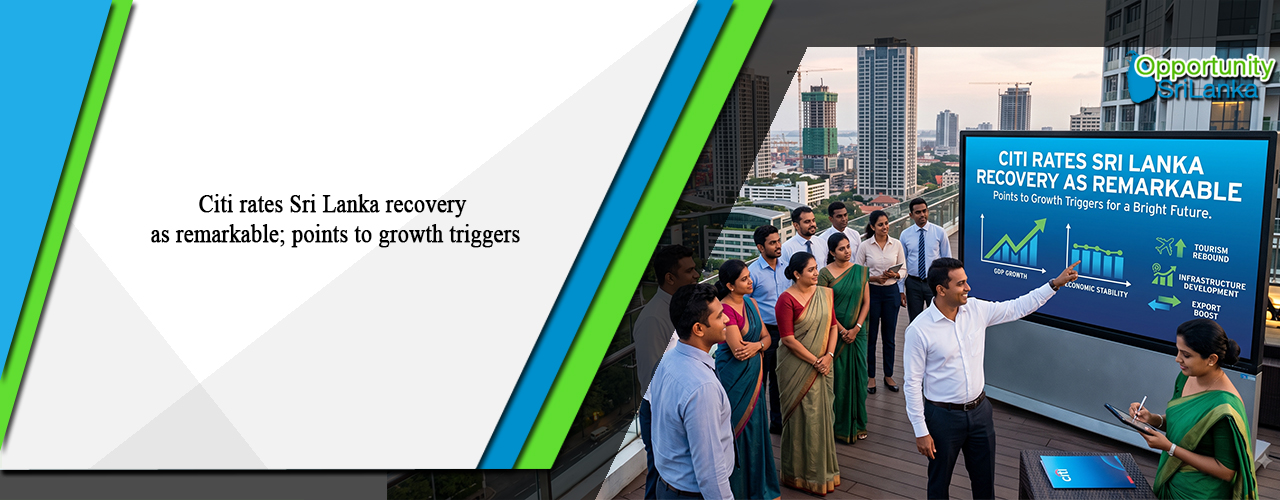
Citi rates Sri Lanka recovery as remarkable; points to growth triggers
Daily FT: Citigroup Director and Economist for India and Sri Lanka Baqar Zaidi recently described Sri Lanka’s economic recovery as “remarkable” and “consistent,” beating everyone’s expectations.
“It has been a remarkable recovery. I don’t remember the last time a country has beaten market expectations so consistently. The striking feature has been not just the fact that we have had upside to our expectations, it is the breadth of surprises; macros have been above expectation consistently,” Zaidi told the Daily FT in an exclusive interview in Colombo.
He pointed to Sri Lanka achieving positive growth in successive quarters as noteworthy.
“You can pick any major macro parameter, and Sri Lanka has done consistently well,” emphasised Zaidi. He noted that to consistently achieve 5% growth was commendable.
“Despite the fiscal tightening, to get the kind of growth achieved by Sri Lanka tells you that the inherent domestic demand of the private sector has recovered well. If you keep doing it consistently, it tells you that there is a design, an inherent strength in the economy,” he added.
Zaidi also noted that on the fiscal side, the Government has done much better than what the market expected. With regard to the current account, he said Sri Lanka’s performance has been much better than what the market would have expected.
He also noted that even on general policy and political stability, Sri Lanka has fared well as against initial reservations from some foreign investors and analysts.
Expanding further on Sri Lanka’s resilience, he said that 5% growth came amidst external shocks including the high US tariff impact, the conflict in the Middle East leading to supply side shocks, and internal challenges such as Cyclone Ditwah.
“Sri Lanka’s domestic economy continues to do well. Investment continues to do well. This tells you two things. One, that the economy has learned, and this is true for the global economy as well, to adapt to shocks, both domestic and external. Secondly, it tells you that consistent reforms, policy stability, macro stability, are finally giving dividends.”
Though giving a high rating to Sri Lanka’s recovery, the Citigroup Director and Economist for India and Sri Lanka acknowledged that challenges remain for the country. He pointed out that whilst 5% growth is good, if one breaks it down, there are sectors of the economy which are still below its 2018 levels.
“For example, the construction and mining sectors are two sectors which are growing in double digits. But despite double digit growth over the last two years in absolute level terms, their economic activity is still 25% to 30% below the 2018 level,” he explained.
“Whilst there has been recovery, because of the severe extent of the shock between 2019 to 2020, the overall growth has not been enough to completely bring the economy back to just 2018 levels. At aggregate level, it is fine, but there are segments of the economy which are still below pre-crisis levels,” Zaidi added.
He also noted that the challenge for Sri Lanka is sustaining recovery and stimulating growth in a much difficult global macro backdrop. “This makes achieving some of the targets of the International Monetary Fund (IMF) program difficult,” he opined, and pointed to the impact of possibly higher oil prices and the current account going into deficit.
Zaidi also welcomed the fact that Sri Lanka’s public debt sustainability is improving,
“In the absolute sense, debt is still high, so there’s a lot of work left to be done to meet those debt sustainability targets that the IMF set a couple of years ago,” he added.
He expressed confidence that Sri Lanka can meet its debt obligations from 2028 onwards.
In each of the critical parameters of debt sustainability, debt servicing, and debt financing, Sri Lanka is doing much better than what the IMF had forecast in March 2023. This, and the buffers created thus far, tells you that there should not be a big worry in terms of finance, in terms of servicing the debt. The only thing that needs to be watched out for are the repeated global supply shocks, which can put pressure on the current account and foreign exchange reserves.
“So we can be comfortable in saying that, at least as of now, there is limited risk visible where Sri Lanka is not able to service external debt,” added the Citigroup Director and Economist for India and Sri Lanka.
He was of the view that Sri Lanka needs to continue the good work of implementing the IMF reform targets. “Those targets are paying dividends,” he added.
Zaidi also said that Sri Lanka needs to put the improved macroeconomic stability to good use.
“If the overall macro stability is maintained, especially in the next couple of years, as Sri Lanka’s debt servicing picks up, the real economy will do its job. Of course, whether it is tourism, manufacturing, or construction, growth must continue. Unfortunately, in each of those aspects, Sri Lanka faces a much more difficult geopolitical environment than in the past,” he explained.
The importance of Sri Lanka maximising the India opportunity was also stressed.
OSL take:
Sri Lanka’s stronger-than-expected economic recovery is creating a more favourable environment for foreign businesses/investors, as the country seeks to position itself as an emerging business hub in South Asia. Citigroup Director and Economist for India and Sri Lanka Zaidi’s description of the recovery as “remarkable” and “consistent” reflects the improving performance of key economic indicators, including successive quarters of growth and a recovery in domestic private-sector demand. This improving macroeconomic environment, together with Sri Lanka’s strategic location along major international shipping routes, skilled workforce and proximity to major South Asian markets, is creating business/investment opportunities across logistics, ports, tourism, manufacturing, technology, renewable energy, financial services and export-oriented industries. For foreign businesses/investors, Sri Lanka’s potential lies increasingly in its ability to serve not only its domestic market but also as a regional base connecting South Asia with global markets. As economic stability strengthens and reforms continue, the country has an opportunity to attract new capital, technology and expertise and develop into a more competitive regional business hub.
Sri Lanka’s BIA Terminal II contract to be awarded by year-end
The Morning: The Bandaranaike International Airport (BIA) Terminal II project is expected to be awarded to the chosen contractor only by November–December this year, the Deputy Minister of Ports and Civil Aviation reveals.
Speaking to The Sunday Morning Business, Deputy Minister of Ports and Civil Aviation Janitha Ruwan Kodithuwakku revealed that according to the timeline provided by the High-Level Procurement Committee appointed to evaluate the two bids received to serve as contractor for the BIA Terminal II project, the awarding of the project would be likely done by year-end.
He further pointed out that once the contract was awarded, the contractor would need a reasonable amount of time to mobilise before commencing the project.
“We are hopeful that we might be able to award the project by November-December. Mobilisation will require around another month,” he stated.
Kodithuwakku stated that he was unable to comment on the exact stage of the bid evaluation process, noting that he was not privy to such matters despite being the Deputy Minister.
He added that the High-Level Procurement Committee evaluating the bids did not have the practice of divulging such details to external parties.
However, the Deputy Minister said that both bids had been from Japanese contractors and that no local contractors had been involved. According to him, this is because, in terms of the conditions of the Japan International Cooperation Agency (JICA) loan agreement, the contractor is mandatorily required to be Japanese.
The contract for the construction of the BIA Terminal II project, which involves the construction of a multi-level terminal, was valued at $ 564 million and was initially awarded to Taisei Corporation in 2020. However, following the stoppage of construction work in 2022 due to the funding freeze imposed by JICA following Sri Lanka’s default, Taisei Corporation terminated its contract with Sri Lanka.
The construction of this multi-level terminal is part of Package A of the BIA expansion project, which was initially estimated to cost Rs. 133 billion and was to be largely funded by the Special Terms for Economic Partnership (STEP) concessionary Official Development Assistance (ODA) loan granted by JICA, amounting to Rs. 131.5 billion (¥ 74.4 billion) at a 0.1% interest rate per annum. The remaining Rs. 21.5 billion was to be funded by Airport and Aviation Services (Sri Lanka) Ltd. (AASL).
With regard to Package A, AASL entered into two agreements with JICA. The first agreement was entered into in March 2012 for ¥ 29 billion, and the second in March 2016 for ¥ 45.4 billion.
OSL take:
The planned expansion of BIA through the Terminal II project highlights not only the growing demand for air connectivity but also the wider business/investment opportunities emerging across Sri Lanka’s development landscape. The project, expected to be awarded to the selected contractor by November-December this year, reflects the country’s efforts to strengthen aviation infrastructure in line with the expansion of tourism and international travel. For foreign businesses/investors, such infrastructure development creates opportunities well beyond airport construction. Growing demand for air travel can support investment in aviation services, logistics, tourism, hospitality, transport, retail and related infrastructure. More broadly, BIA Terminal II is an indication of Sri Lanka’s continuing development programme and the need for private and foreign capital to support major infrastructure projects. As the economy stabilises and investment expands, business/investment opportunities are likely to emerge across transport, ports, energy, urban development, tourism and other strategic sectors. Sri Lanka’s ongoing infrastructure expansion therefore offers foreign businesses/investors an opportunity to participate not only in individual projects, but also in the country’s broader transformation into a more connected and investment-oriented economy.
| Article Code : | VBS/AT/20260810Z_2 |