
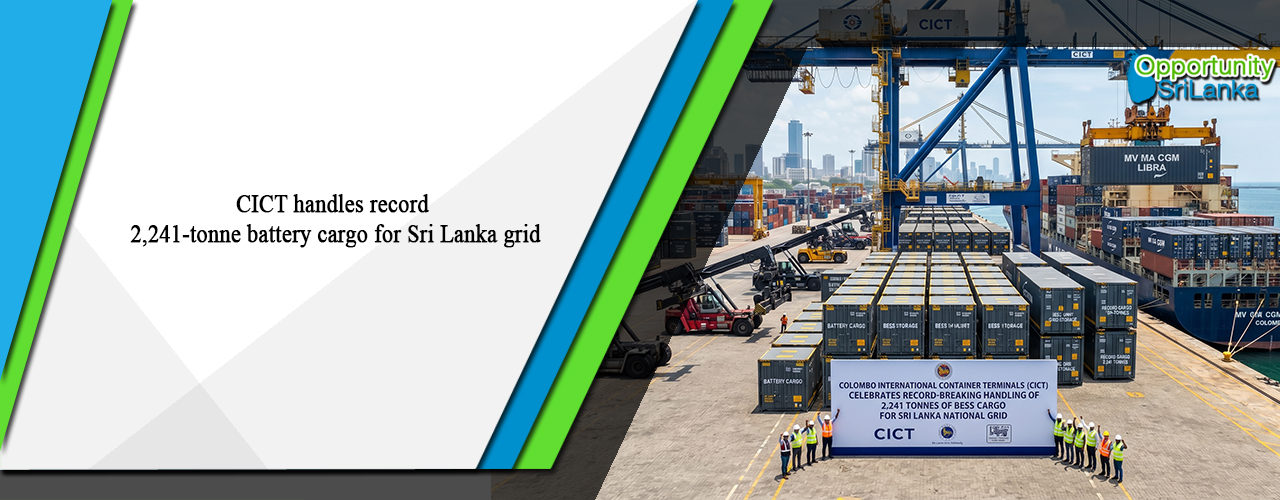
CICT handles record 2,241-tonne battery cargo for Sri Lanka grid
EconomyNext: Sri Lanka’s Colombo International Container Terminals (CICT) said it successfully handled a 2,241 tonne Battery Energy Storage System (BESS), in a specialised midnight operation.
The system comprised 54 battery units meant for the largest energy storage program in Sri Lankan history. The project aims to strengthen the country’s grid stability, and further renewable energy integration, the terminal said in a press release.
The BESS units are deployed across 16 substations and are expected to play a part in achieving 70 percent renewable energy output by 2030.
The units arrived onboard Da Xiang, a heavy lift vessel operated by COSCO Shipping. The battery units weigh 41.5 tonnes each and are the size of a 20-foot container.
The discharge operation was carried out in a specially planned midnight shift, with 2 quay cranes, sixteen prime movers and two reach stackers utilised for the transfer of the battery units from vessel to stack.
Two Rubber Tyred Gantries (RTGs) were also on standby, although the BESS units exceeded its load handling capacity, and were therefore not utilised.
“The successful handling of this 2,241-tonne battery energy storage shipment demonstrates CICT’s capability to manage highly specialised project cargoes that require meticulous planning, technical expertise and uncompromising safety standards.
“As Sri Lanka accelerates investments in renewable energy and grid modernisation, ports will play a critical role in enabling the timely delivery of strategic infrastructure.” Jan Zhang, Chief Executive Officer, CICT, said in the press release.
“We are proud to contribute to a project that supports the country’s energy security, sustainability goals and long-term economic development.”
OSL take:
CICT’s recent handling of a 2,241-tonne BESS in a complex midnight operation underscores the growing sophistication and capacity of Sri Lanka’s maritime and port infrastructure. As the country advances its ambition to position itself as a leading maritime hub in South Asia, its ports and shipping ecosystem are steadily evolving into a strategic platform for regional and global trade flows. This growth trajectory presents a wide range of business/investment opportunities for foreign businesses/investors across the maritime value chain. The expansion of transshipment services, container handling, and integrated logistics solutions is creating demand for advanced port technologies, automation systems, and digital supply chain management. At the same time, supporting services such as bunkering, vessel repair, ship chandelling, and maritime insurance are gaining renewed importance as shipping volumes and complexity increase. Importantly, Sri Lanka’s ports are increasingly interconnected with broader economic priorities, including energy transition and industrial development. The successful handling of large-scale energy infrastructure such as BESS units highlights the role ports will play in supporting renewable energy deployment and industrial imports. This opens niche business/investment areas in heavy-lift logistics, project cargo handling, and specialised storage solutions. As global shipping routes continue to shift and regional trade deepens, Sri Lanka’s maritime sector offers foreign businesses/investors a compelling opportunity to participate in an emerging hub that connects South Asia, the Middle East, and beyond.
| Article Code : | VBS/AT/20260616Z_2 |