
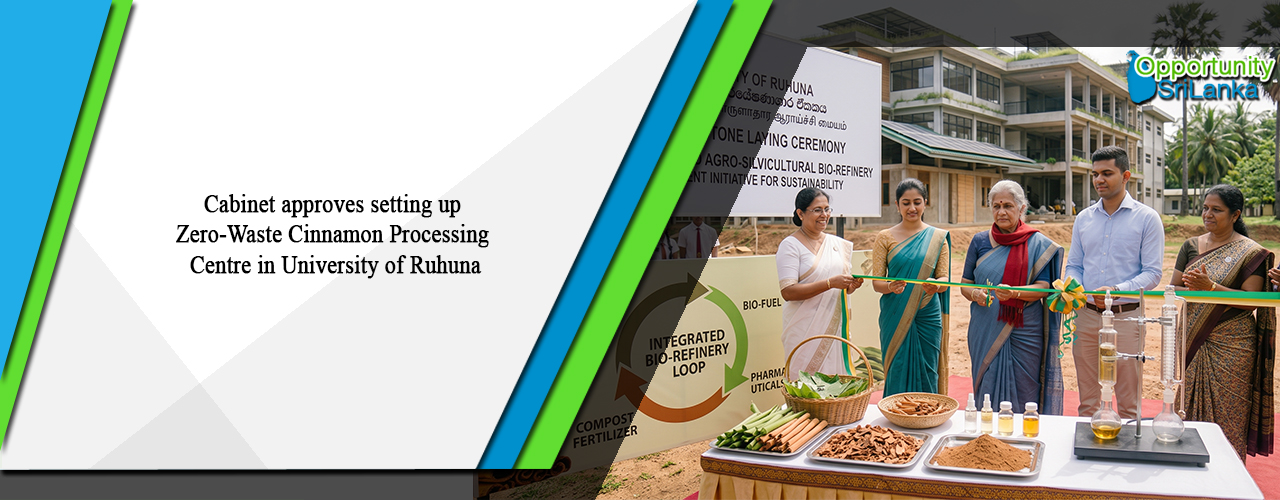
Cabinet approves setting up Zero-Waste Cinnamon Processing Centre in University of Ruhuna
Daily FT: The Cabinet of Ministers has approved the establishment of a Centralised Zero-Waste Biomass Cinnamon Processing Centre at the Mapalana Faculty of Agriculture of the University of Ruhuna to support the industry, particularly small-scale cultivators in the Matara and Galle districts.
The initiative, to be implemented jointly by the Science and Technology Ministry, the Industrial Technology Institute (ITI), and the University of Ruhuna, aims to address longstanding challenges faced by cinnamon producers, including high processing costs, compliance with sanitary standards, and the underutilisation of biomass waste.
“The project will be carried out in four phases over a period of 27 months and is expected to promote more sustainable and efficient cinnamon processing through the adoption of zero-waste biomass technologies,” Cabinet Spokesman, Minister Nalinda Jayatissa said at the weekly post-Cabinet meeting media briefing recently.
The proposal to this effect was submitted by Science and Technology Minister Prof. Chrishantha Abeysena.
OSL take:
The Cabinet’s approval of a Centralised Zero-Waste Biomass Cinnamon Processing Centre highlights Sri Lanka’s growing emphasis on research, innovation and sustainable industrial development. As the country advances its economic transformation and positions itself as a regional hub in South Asia, new business/investment opportunities are emerging for foreign businesses/investors to collaborate in research and development, technology transfer and sustainable innovation across key sectors. Business/investment potential extends beyond agriculture to renewable energy, advanced manufacturing, food processing, biotechnology, waste-to-value technologies and environmentally sustainable production systems. Through partnerships with universities, research institutions and industry, overseas investors can contribute to the commercialisation of innovative technologies that present lucrative business ventures in the country while supporting Sri Lanka’s transition towards a more knowledge-based, export-oriented and sustainable economy.
| Article Code : | VBS/AT/20260717Z_4 |