
UAE expresses interest in Sri Lanka’s Technical and Vocational Education and Training sector
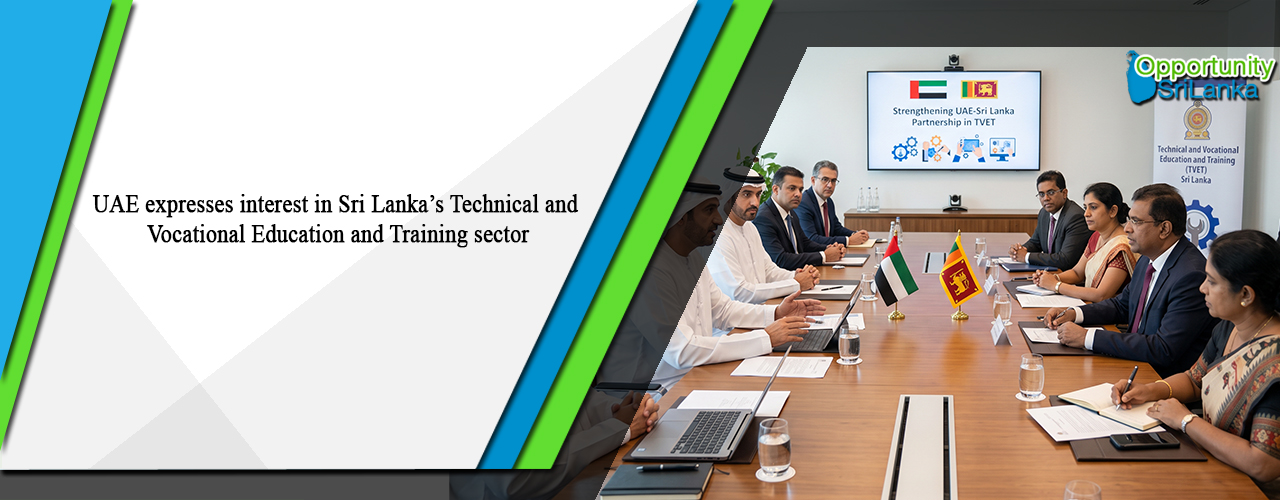
The Morning: Prime Minister Dr Harini Amarasuriya met with a high-level delegation from the UAE at Parliament to discuss the possibility of collaboration to strengthen the Technical and Vocational Education and Training (TVET) sector of Sri Lanka with a view to gradually increase the number of skilled workers demanded by various traditional and emerging industries.
During the meeting held recently, the Prime Minister outlined the government’s ongoing education reforms, including the introduction of vocational education pathways, and emphasised the Government’s commitment to investing in and upgrading vocational and technical education to equip youth with skills that enable them to pursue employment opportunities both locally and globally.
The Prime Minister also highlighted the importance of developing new and demand-driven programmes to meet the evolving requirements of the global labour market, according to the Prime Minister’s Media Division.
The UAE delegation commended the government’s efforts and expressed a positive interest in supporting and investing in the development of the sector, the statement said, adding that the Prime Minister invited the UAE delegation to explore investment opportunities in sectors of mutual interest for future cooperation.
The discussions focused on strengthening collaboration in skills development, expanding opportunities for skilled employment, and exploring avenues for investment and partnership between Sri Lanka and the UAE.
OSL take:
Sri Lanka’s higher education sector is emerging as a potentially significant area for foreign investment, particularly as the country seeks to strengthen its human capital and align education and training more closely with domestic and global labour-market demand. The UAE’s interest in supporting Sri Lanka’s TVET sector, highlighted during Prime Minister Amarasuriya’s recent meeting with a UAE delegation, points to a broader opportunity for international investors in education and skills development. Beyond traditional universities, business/investment opportunities could emerge in private higher education institutions, vocational and technical colleges, professional training centres, digital and blended learning platforms, industry-linked degree programmes and specialised institutes in areas such as IT, engineering, healthcare, logistics, tourism, maritime services and emerging technologies. Foreign universities and education companies could also explore partnerships with Sri Lankan institutions to offer joint degrees, franchise programmes, international certifications and industry-focused training, allowing Sri Lankan students to access globally recognised qualifications without leaving the country. The growing demand for skilled workers, combined with the Sri Lankan Government’s focus on expanding vocational pathways and upgrading technical education, could create opportunities for investors that can bring capital, technology, international curricula and links to overseas employment markets. For Sri Lanka, such investment would not only expand education capacity but could also help develop a workforce equipped for both the domestic economy and the growing international demand for skilled labour. For foreign investors, the sector offers an opportunity to participate in a market where education, workforce development and overseas employment are increasingly becoming closely connected.
| Article Code : | VBS/AT/20261006Z_1 |