
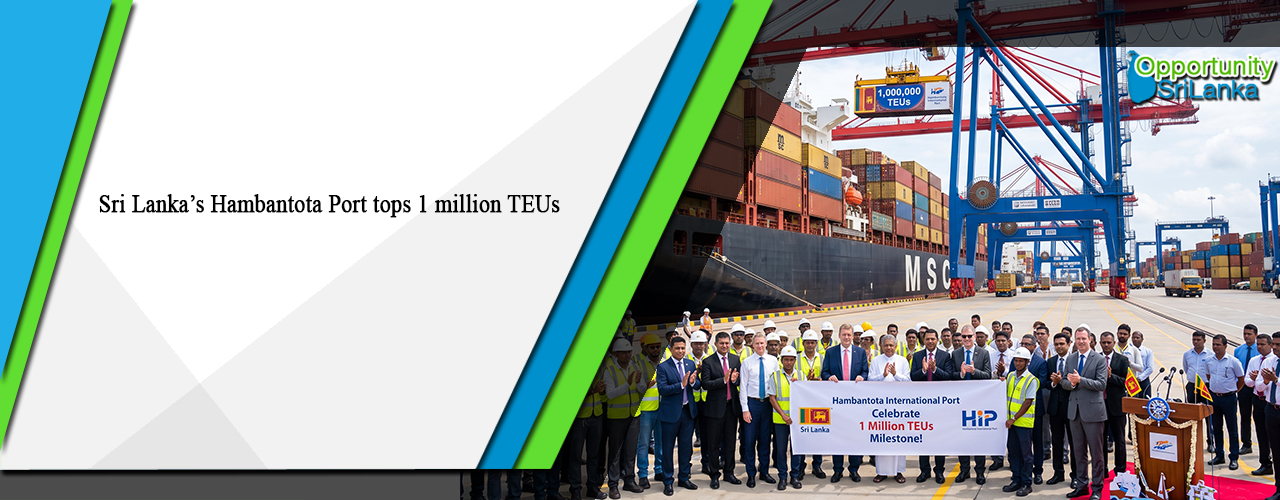
Sri Lanka’s Hambantota Port tops 1 million TEUs
EconomyNext: The Chinese built Hambantota International Port (HIP) has surpassed one million 20-foot equivalent units (TEUs) in cumulative container throughput since the commissioning of new quay cranes in 2025, as the Sri Lankan port accelerates investments to expand annual handling capacity to two million TEUs.
The port handled 428,036 TEUs in 2025 and a further 574,196 TEUs so far in 2026, bringing total throughput over the two-year period to 1,002,232 TEUs, HIP said.
The milestone reflected growing confidence among shipping lines and cargo owners in the port’s operations, HIPG Chief Executive Officer Wilson Qu said.
“Crossing one million TEUs is an important achievement for HIP and a strong indication of the confidence our customers are placing in the port,” Qu said.
“Our container growth has been built through close engagement with shipping lines, operational reliability and the ability to respond quickly to changing customer requirements.”
The port’s main container customer, Mediterranean Shipping Company (MSC), has played a key role in driving volumes, helping HIP achieve a series of operational records this year.
In April, the MSC Marie Leslie set a new single-vessel handling record at Hambantota, registering 7,968 container moves, equivalent to 13,260 TEUs during its port call. The achievement surpassed records set by MSC Ilenia and MSC Ruby in March.
HIP also recorded its highest monthly container throughput in June, handling 80,325 TEUs as disruptions and uncertainty affected major global trade routes.
To accommodate rising demand, the port is implementing a major expansion programme covering berth capacity, yard space, reefer facilities and container-handling equipment.
A central component of the expansion is a 108-million-US-dollar investment in six new quay cranes and 16 rubber-tyred gantry cranes, which are expected to be commissioned by February 2027.
The additional equipment will increase ship-to-shore and yard-handling capacity, improve vessel turnaround times and enable the use of a further 1,300 metres of berth space. The expansion will raise HIP’s total container quay length to nearly two kilometres and increase container yard capacity by 30 percent.
HIP Chief Operations Officer Tommy Yang said the investments were designed to support future growth while maintaining operational efficiency.
“The one-million-TEU milestone shows that HIP’s container business is moving into a new stage of growth,” Yang said.
“Our investment strategy is focused on developing capacity ahead of demand while maintaining operational efficiency and financial sustainability.”
The port said the upgrades would create the scale needed to reach its long-term target of handling two million TEUs annually, strengthening Hambantota’s position as an emerging regional container gateway.
OSL take:
Sri Lanka’s steady expansion of its maritime sector is creating growing business/investment opportunities for foreign businesses and investors as the country seeks to strengthen its position as a regional maritime and logistics hub in the Indian Ocean. The growth of container handling at ports such as Hambantota, alongside ongoing investments in Colombo and other maritime infrastructure, is generating business/investment opportunities across port operations, shipping, transshipment, logistics, warehousing, freight forwarding and maritime services. The expansion also creates potential for investment in supporting sectors, including ship repair and maintenance, marine engineering, bunkering, cold-chain logistics, container depots, digital port technologies and maritime equipment and services. Sri Lanka’s location along major East-West shipping routes gives businesses opportunities to use the country as a base for regional cargo distribution and supply-chain operations. Increasing port capacity and improving logistics infrastructure could further support regional distribution centres, bonded warehouses and value-added logistics services. The maritime opportunity also extends beyond ports. Boatbuilding, shipbuilding, marine tourism, offshore services and fisheries-related industries offer avenues for foreign companies with technology, capital and specialised expertise to partner with local businesses. As Sri Lanka continues to develop its ports and logistics network, the expanding maritime ecosystem could attract investment not only into large infrastructure projects but also into the wide range of services and industries that support international shipping and regional trade.
| Article Code : | VBS/AT/20261012Z_4 |