
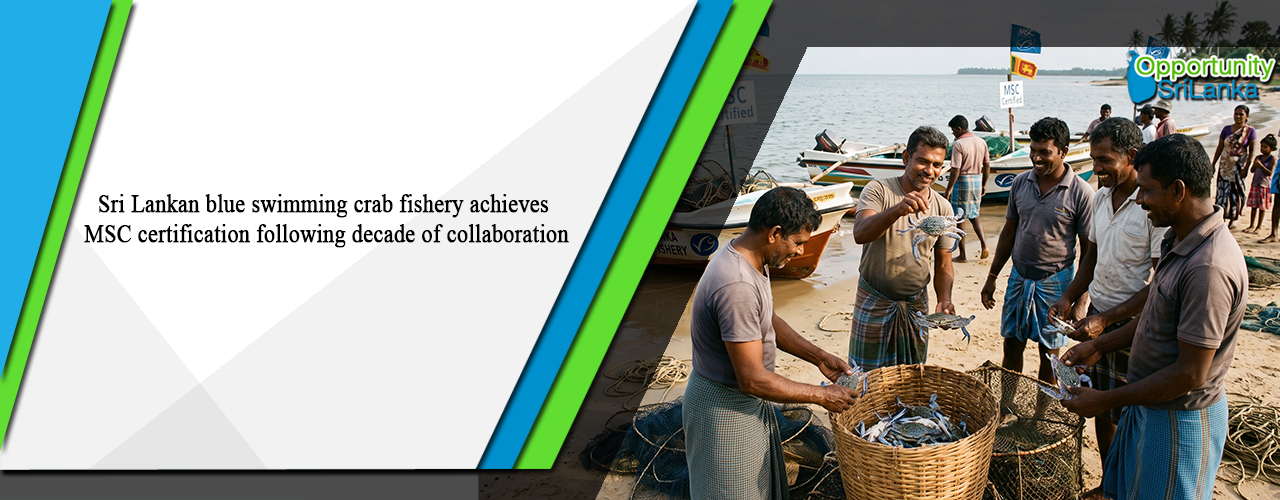
Sri Lankan blue swimming crab fishery achieves MSC certification following decade of collaboration
Daily FT: The North-Western Sri Lanka blue swimming crab fishery has become the country’s first to achieve Marine Stewardship Council (MSC) certification, meeting the internationally recognised MSC Fisheries Standard for environmental sustainability in fishing.
The milestone follows more than a decade of collaboration between fishing communities, seafood exporters, Government authorities and other stakeholders to strengthen fisheries management and support the long-term sustainability of the country’s blue swimming crab stocks.
The certification covers blue swimming crab (Portunus pelagicus) fishing in two areas off Sri Lanka’s north-western coast: Palk Bay and the Gulf of Mannar. Small-scale fishers use bottom-set gillnets from traditional boats and small motorised vessels, supplying international seafood markets across North America and Europe.
The journey towards certification began in 2013, when the Seafood Exporters’ Association of Sri Lanka, with support from the National Fisheries Institute Crab Council, brought together stakeholders to improve scientific understanding of crab stocks, assess fishing impacts on marine habitats and strengthen fisheries management.
Over the past decade, improved data collection has enhanced scientific stock assessments and informed the development of harvest strategies and fishery management plans. The fishery has also introduced measures to minimise impacts on non-target species and vulnerable marine life, and to protect juvenile crabs through a minimum legal purchasing size of 100 grams (≈ 117 mm).
Sri Lanka Blue Swimming Crab Fishery Improvement Project (FIP) Coordinator and Pelagikos Ltd., Executive Director Dr. Steve Creech said: “The success of the fishery improvement project in achieving MSC certification is built on a three-way partnership that promotes responsible harvesting by fishers, responsible purchasing by the seafood supply chain and collaborative fisheries management by the Department of Fisheries.
“Central to this approach has been the continuous collection and analysis of data on crab stocks and ecological impacts, and fisheries management. The scientific evidence gathered by pelagikos in collaboration with FIP members has been instrumental in enabling the two units of assessment (UoAs) to meet the MSC’s Standard.”
MSC certification is an important milestone for the coastal communities that depend on the fishery for their livelihoods. The sector supports thousands of small-scale fishers and a wider supply chain of collection centres and labour-intensive processing facilities, which employ thousands of women in preparing crab meat for export.
Representing the client group Taprobane Seafoods Ltd., Co-Founder and Managing Director Timothy O’Reilly said: “It’s remarkable to reflect that we began this journey shortly after the end of Sri Lanka’s 30-year civil conflict. Years of dedication and collaboration have brought us to this important milestone for the fishing communities we work with and Sri Lanka’s blue swimming crab industry.”
“With leading global retailers committed to sourcing seafood from fisheries certified to the MSC Fisheries Standard, we now have an exciting opportunity to share our story, build new partnerships and supply regional and global markets with responsibly sourced Sri Lankan blue swimming crab carrying the MSC ecolabel.”
CM Blue Crab Ltd., and co-client on the MSC certificate Director John D. Paterson said: “When we established our processing facility in Mannar in 2016, we invested in the long-term future of the fishery and its communities. MSC certification reflects years of dedicated collaboration to protect crab stocks while creating lasting livelihood opportunities for families in Mannar and Jaffna, and connecting local seafood production to international markets.”
Sri Lanka’s Department of Fisheries and Aquatic Resources Director General Susantha Kahawatte said: “The MSC certification of Sri Lanka’s blue swimming crab stocks mark an important milestone in our commitment to sustainable fisheries management through science-based decision-making, responsible fishing practices and collaboration between Government, industry and coastal communities.
“This achievement supports the conservation of marine resources, safeguards fishing livelihoods and strengthens Sri Lanka’s position in international seafood markets. MSC certification demonstrates our commitment to the long-term sustainability and competitiveness of the fisheries sector.”
OSL take:
Sri Lanka’s fisheries and seafood export industries are gaining new business/investment opportunities to attract foreign investment following the country’s first MSC certification for its North-Western blue swimming crab fishery, strengthening its position in premium international seafood markets. The certification recognises the fishery’s compliance with internationally recognised environmental sustainability standards. It is expected to improve access to environmentally conscious buyers across North America and Europe, where demand for responsibly sourced seafood creates opportunities for higher-value exports. For foreign businesses/investors, the development presents opportunities to establish partnerships with local seafood exporters, invest in modern processing facilities and develop value-added products for international markets. Frozen, packaged and ready-to-cook seafood products, particularly crab, tuna, prawns and other commercially valuable marine species, offer potential for export-oriented ventures. Investment opportunities also extend to cold-chain infrastructure, refrigerated transportation, seafood storage, quality testing, traceability systems and modern packaging technology. These facilities are essential for maintaining product quality and meeting increasingly stringent international food safety and sustainability requirements. Aquaculture, sustainable fishing technology, hatcheries and fisheries research also offer scope for foreign expertise and capital, particularly in improving production capacity and ensuring the long-term sustainability of marine resources. The MSC certification follows more than a decade of collaboration between fishing communities, seafood exporters and Sri Lankan Government authorities to improve fisheries management, scientific monitoring and responsible harvesting. Combined with the Sri Lankan Government’s target of increasing annual fish export earnings from US$315 million to US$600 million by 2030, the achievement strengthens the investment case for Sri Lanka’s seafood industry, offering foreign businesses/investors opportunities across an expanding export value chain.
| Article Code : | VBS/AT/20261109Z_3 |