
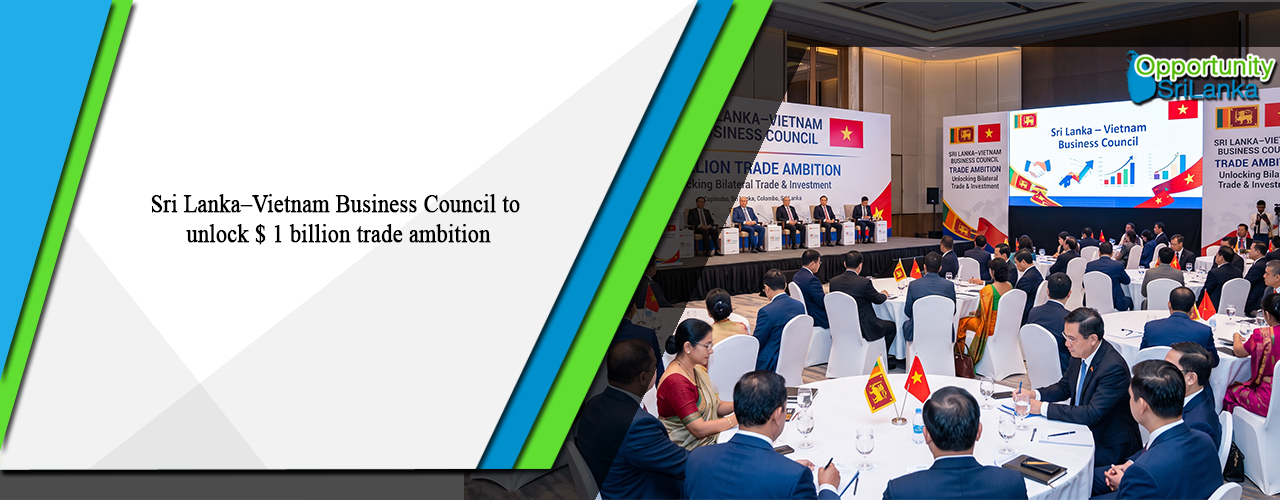
Sri Lanka–Vietnam Business Council to unlock $ 1 billion trade ambition
Daily FT: The Ceylon Chamber of Commerce recently launched the Sri Lanka–Vietnam Business Council, seeking to give fresh institutional momentum to bilateral trade, investment and tourism ties at a time when political and diplomatic relations between the two countries are gaining strength, though the commercial exchanges remain below their potential.
The new council, the 22nd bilateral business council established under the Ceylon Chamber, has attracted 30 inaugural members, signalling growing private-sector interest in Vietnam and the opportunities emerging from closer economic relations.
The launch follows commitments made during Vietnamese Party General Secretary and State President Tô Lâm’s State visit to Sri Lanka in May, when a Sri Lanka–Vietnam Trade, Investment and Tourism Forum brought together government and business representatives from both countries.
Ceylon Chamber Chairperson Krishan Balendra said the new council was intended to move those discussions from dialogue to sustained commercial engagement.
“This is an important milestone in the growing economic partnership between our two countries,” he said, describing the council as a platform to facilitate business partnerships, promote bilateral trade and investment, encourage knowledge sharing and strengthen private sector engagement.
“As we launch the business council today, I am confident that it will serve as a catalyst of stronger partnerships, increased trade and investments, and deeper collaboration between the private sectors of Sri Lanka and Vietnam,” he added.
The urgency of strengthening the commercial relationship was underscored by Vietnamese Ambassador to Sri Lanka Trinh Tam, who noted that bilateral trade has yet to cross the $ 500 million mark in any recent year.
This is despite the two countries having maintained diplomatic relations for more than 55 years and having recently elevated their relationship to a Comprehensive Partnership.
“Our economic, trade and investment cooperation is still under expectation,” she said, noting that the two countries’ leaders have nevertheless set an ambitious $ 1 billion bilateral trade target by 2030.
She said stronger Government-to-Government (G2G) relations alone would not be sufficient to achieve that ambition. “For this partnership to grow further, we need not only close G2G relations, but also stronger connections between our businesses and our people.”
The Ambassador said the new Business Council could provide the practical mechanism for companies to meet, exchange market information, identify opportunities and develop partnerships.
Balendra highlighted Vietnam’s rapid economic transformation and its emergence as a major manufacturing, logistics and investment hub in Asia as key reasons for Sri Lankan companies to engage more actively with the market.
He identified manufacturing, agriculture, logistics, tourism, ICT, renewable energy and professional services as areas with potential for greater cooperation.
“Sri Lanka’s strategic location in the Indian Ocean, strong services sector and growing tourism potential offer Vietnamese companies with opportunities for partnerships and regional access,” he outlined.
He said the Chamber’s earlier ‘Doing Business in Vietnam’ event in October 2025 had already generated considerable interest among Sri Lankan businesses. “It showed a strong appetite for exploring opportunities in one of Asia’s fastest-growing economies,” Balendra said.
The council, he added, would provide a structured platform to identify new opportunities and address common challenges rather than functioning simply as another business association.
“We warmly invite interested companies and stakeholders to become part of this initiative and join us in shaping the next chapter of Sri Lanka-Vietnam economic relations,” Balendra said.
Improved connectivity is emerging as one of the most immediate enablers of the relationship.
Balendra also highlighted that the expansion of services by Vietnam Airlines and Vietjet had significantly improved connectivity between the two countries, making travel easier for businesses, investors and tourists.
The Ambassador pointed out that the direct flights had already begun producing tangible business interest. She said since Vietnam Airlines and Vietjet Air commenced direct services between Ho Chi Minh City and Colombo around two months ago, the Vietnamese Embassy has facilitated about 10 groups of Vietnamese businessmen visiting Sri Lanka to explore the market and promote their products.
She also urged the new Council to ensure that the relationship does not become concentrated solely among large corporations.
The Ambassador called for greater participation by small and medium-sized enterprises (SMEs), young entrepreneurs and businesses operating in emerging areas, arguing that the council should help move discussions beyond potential opportunities towards actual projects.
“Most importantly, turn ideas into real projects,” she stressed, outlining the Council’s role in connecting companies, sharing information and facilitating partnerships.
The Ambassador also outlined trade, investment, tourism, logistics, agriculture, food products and services as areas offering particularly strong potential.
OSL take:
The establishment of the Sri Lanka–Vietnam Business Council is expected to strengthen commercial ties between the two countries, opening opportunities for investment, trade and joint ventures across several sectors. For Vietnamese businesses/investors, Sri Lanka offers a strategic location along major Indian Ocean shipping routes, creating opportunities in logistics, warehousing, port-related services and export-oriented manufacturing. The country’s ports and access to regional markets could provide a platform for Vietnamese businesses seeking to expand their regional presence. Renewable energy, information technology, infrastructure and tourism are other potential investment areas. Vietnamese companies could explore partnerships in solar power, digital services and technology-driven industries as Sri Lanka seeks to attract foreign investment and diversify its economy. Agriculture and food processing also offer scope for collaboration. Vietnam’s expertise in agricultural technology, seafood processing and value-added manufacturing could complement Sri Lanka’s strengths in tea, spices, coconut products and rubber-based industries. Joint ventures could help improve processing capacity, introduce new technologies and expand access to international markets. Sri Lankan exporters, meanwhile, could use Vietnam’s growing economy and manufacturing networks to expand their presence in Southeast Asia. Potential exports include Ceylon tea, spices, coconut-based products, rubber products and selected food items. Sri Lankan businesses could also explore partnerships in professional services, information technology and tourism. Tourism presents opportunities for two-way growth through destination promotion, travel packages and stronger links between tourism operators. Greater business connectivity could encourage Vietnamese visitors to Sri Lanka while opening Vietnam’s attractions to Sri Lankan travellers. The new council could facilitate business-to-business engagement, identify investment projects and help companies navigate market-entry challenges. With bilateral trade yet to cross US$500 million in a recent year, stronger commercial cooperation could help both countries diversify export markets, attract investment and build a more substantial economic partnership.
| Article Code : | VBS/AT/20261019Z_1 |