
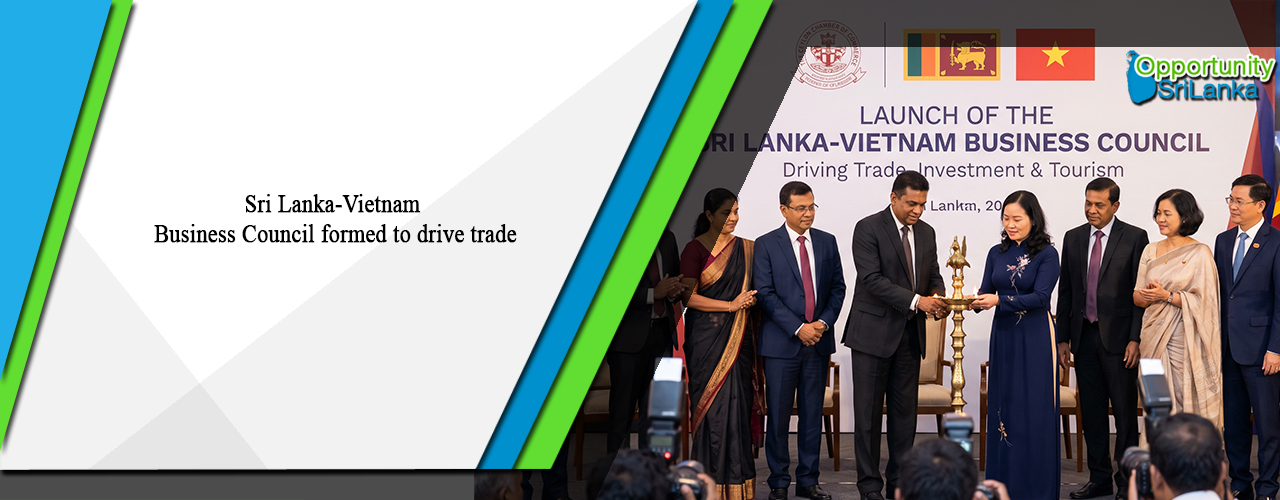
Sri Lanka-Vietnam Business Council formed to drive trade
EconomyNext: Sri Lanka’s private sector trade body has set up a Sri Lanka-Viet Nam Business Council (SLVBC), to expand trade, attract investment and build commercial partnerships between businesses of the two countries.
“The Sri Lanka–Viet Nam Business Council will work to connect businesses, identify market opportunities and support partnerships that can translate into increased trade and investment,” the Ceylon Chamber of Commerce said.
30 companies joined as inaugural members.
“The Council reflects growing private sector interest in strengthening commercial ties and pursuing new opportunities across both markets,” the chamber said.
The launch was attended by the Viet Nam ambassador Trinh Thi Tam, Chamber Chairperson Krishan Balendra and Secretary General Shiran Fernando, and representatives of the business community and government institutions.
Balendra identified opportunities across manufacturing, agriculture, logistics, tourism, ICT, renewable energy and professional services, noting that closer business engagement could translate into greater trade and investment flows between the two countries.
Ambassador Trinh Thi Tam noted that with both countries working towards a bilateral trade target of US$ 1 billion by 2030, it is important to ensure strengthening business-to-business connections, and encouraged the Council to create opportunities for companies of all sizes.
The launch was attended by the Viet Nam ambassador Trinh Thi Tam, Chamber Chairperson Krishan Balendra and Secretary General Shiran Fernando, and representatives of the business community and government institutions.
Mahen Kariyawasan, Managing Director of Andrew the Travel Company, was appointed inaugural President of the Council.
Suranjaya Rajaguru, Director of Millennium Transportation (Pvt) Ltd, was appointed Senior Vice President, while Kamal Wimalaratne, Chief Executive Officer of Hayleys Engineering, was appointed Vice President, with Malith Thilakarathne of Nations Trust Bank PLC appointed Treasurer.
The Executive Committee will also include representatives from AgStar PLC, Aitken Spence Cargo, Hirdaramani International Exports (Pvt) Ltd, Linea Aqua (Pvt) Ltd and Maliban Biscuits (Pvt) Ltd.
Kariyawasan called for a more active commercial relationship that converts longstanding ties between the two countries into tangible business outcomes.
He highlighted tourism, aviation, agriculture, manufacturing, technology and logistics as areas with scope for greater cooperation, while emphasising the need to facilitate business partnerships, trade delegations and investment opportunities for both large companies and small and medium-sized enterprises.
Through the Ceylon Chamber of Commerce, the Council will also provide Sri Lankan and Vietnamese enterprises with a structured channel to engage with each other and pursue new commercial ventures, strengthening the private sector’s contribution to bilateral economic relations.
OSL take:
The establishment of the Sri Lanka-Viet Nam Business Council is expected to create fresh business/investment opportunities for businesses and investors in both countries, strengthening trade, investment and commercial partnerships across a range of sectors. Launched by the CCC with 30 companies as inaugural members, the Council aims to connect businesses, identify market opportunities and facilitate partnerships that can translate into increased trade and investment flows. For Vietnamese businesses, Sri Lanka offers opportunities in manufacturing, agriculture, logistics, tourism, information and communications technology, renewable energy and professional services. Investors could explore joint ventures with local companies, establish production and processing facilities, and use Sri Lanka’s port infrastructure and strategic location to support regional distribution. Sri Lankan businesses, meanwhile, could use stronger commercial links to access Viet Nam’s expanding consumer market and manufacturing base. Opportunities include exporting tea, spices, processed food, rubber products and other value-added goods, while exploring partnerships in technology, industrial production, tourism and logistics. The relationship also offers potential for third-country investors. International businesses could establish regional offices, sourcing operations, manufacturing facilities or distribution hubs in Sri Lanka to develop commercial links with Viet Nam and other Asian markets. Similarly, Sri Lankan companies could work with Vietnamese partners to access wider regional supply chains and overseas markets. With a dedicated private-sector platform now in place, the two countries have an opportunity to move beyond conventional trade towards long-term investment partnerships, technology exchange and cross-border business expansion.
| Article Code : | VBS/AT/20261102Z_3 |