
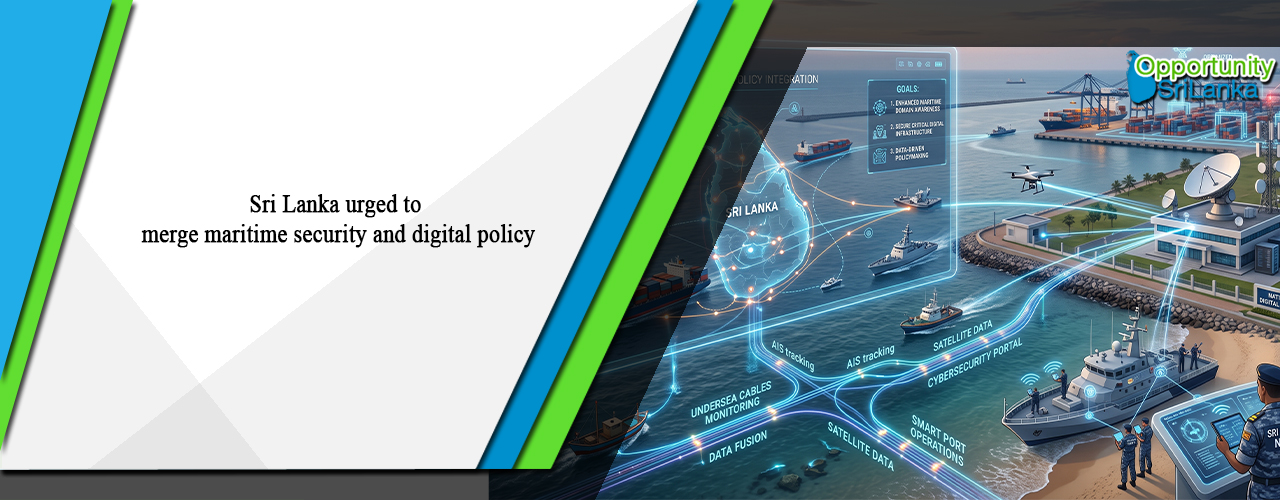
Sri Lanka urged to merge maritime security and digital policy
EconomyNext: Sri Lanka should not treat maritime security and digital economy as separate policy areas, but interconnected components of national stability, economic resilience and technological sovereignty, officials have said.For island and coastal states the physical environment is overwhelmingly maritime, Secretary of the Ministry of Digital Economy Waruna Sri Dhanapala said, highlighting several areas where Sri Lanka’s maritime and technological interests intersect.He was speaking at a cross-sectoral discussion on maritime security and technological capabilities at the Regional Centre for Strategic Studies (RCSS).A recent RCSS Policy Study, “Non-Traditional Security in the Bay of Bengal: Maritime Threats, Corrective Measures, and Technological Innovations’, highlighted emerging non-traditional maritime security challenges and the role of emerging technologies.“These included seabed resources, offshore energy, shipbuilding and repair, and submarine communications infrastructure,” Dhanapala said.He stressed the importance of developing domestic technological capabilities while engaging international partners in ways that protect national interests and environmental safeguards.As Chairman of the Telecommunications Regulatory Commission of Sri Lanka (TRCSL), he also emphasized the importance of submarine fibre-optic cables to Sri Lanka’s digital economy and called for their protection and monitoring to be incorporated into the country’s maritime security framework.Technology was also crucial in addressing environmental security challenges, including maritime pollution and oil spills, he said.Active collaboration of coastal and island states in the wake of the unprecedented climate scenarios was also important, he added, pointing to Sri Lanka’s adoption of the UN Convention on the Law of the Sea (UNCLOS) and the Agreement on Marine Biological Diversity of Areas beyond National Jurisdiction (BBNJ Agreement).The event brought together serving and retired senior public officials, diplomats, members of the security forces, academics, researchers, technology and maritime practitioners, civil society representatives and other stakeholders to examine the changing technological dimensions of maritime security and their implications for Sri Lanka.Country Representative of The Asia Foundation, Johann Rebert, reaffirmed TAF’s support for RCSS’s work on maritime security and technology.Shayan Peris examined how emerging technologies are strengthening maritime security capabilities while creating new vulnerabilities and dependencies.He highlighted the evolution of Maritime Domain Awareness (MDA) from conventional vessel tracking towards the integration of AIS, radar, satellite imagery and artificial intelligence to identify anomalous activity and support more targeted responses.He also examined the growing convergence between maritime and digital security, including risks to ports and other critical infrastructure arising from cyber vulnerabilities, the resilience of submarine cable networks, and the expanding use of unmanned and autonomous systems for surveillance, fisheries monitoring, pollution response and search and rescue.Peris emphasized that for resource-constrained states such as Sri Lanka, the central challenge is not simply acquiring more advanced technologies, but developing the institutional capacity to integrate information, retain expertise and act upon it.Technological resilience therefore depends on operational cyber security, resilient connectivity, effective information-sharing and appropriate governance frameworks for artificial intelligence and autonomous systems, he said.An open discussion followed which considered the practical challenges of translating technological systems into effective maritime security capabilities.
OSL take:
Sri Lanka’s growing focus on maritime security and the digitisation of its maritime economy could open a new range of business/investment opportunities for foreign businesses/investors, extending beyond traditional port, shipping and logistics investments into technology-driven services. With submarine fibre-optic cables, offshore energy, seabed resources, shipbuilding and repair, and maritime environmental protection increasingly viewed as interconnected components of national security and economic resilience, demand is likely to grow for specialised technologies and services supporting these sectors. The emphasis on protecting and monitoring submarine communications infrastructure is particularly significant for technology investors, creating potential opportunities in cable monitoring, maritime surveillance, cybersecurity, data analytics and artificial intelligence-based threat detection. Sri Lanka’s ports and maritime logistics sector also offer scope for investment in smart-port technologies, automated cargo handling, digital tracking systems, maritime data platforms and integrated supply-chain solutions as the country seeks to improve efficiency and competitiveness. Environmental technology represents another emerging area, with digital systems capable of monitoring marine pollution, detecting oil spills and supporting rapid response likely to become increasingly important. For foreign companies, the convergence of maritime infrastructure and the digital economy therefore creates opportunities to participate not only as infrastructure investors but also as technology providers, joint-venture partners and service operators. The policy direction highlighted by officials also points to a potential role for international investors in transferring technology and developing domestic capabilities, provided investments are aligned with Sri Lanka’s national security, environmental and regulatory requirements. As Sri Lanka seeks to strengthen its position as a regional maritime and logistics hub, the digitisation of the sector could consequently create a second layer of business/investment opportunities — linking the country’s traditional maritime assets with its emerging digital economy.
| Article Code : | VBS/AT/20260921Z_2 |