
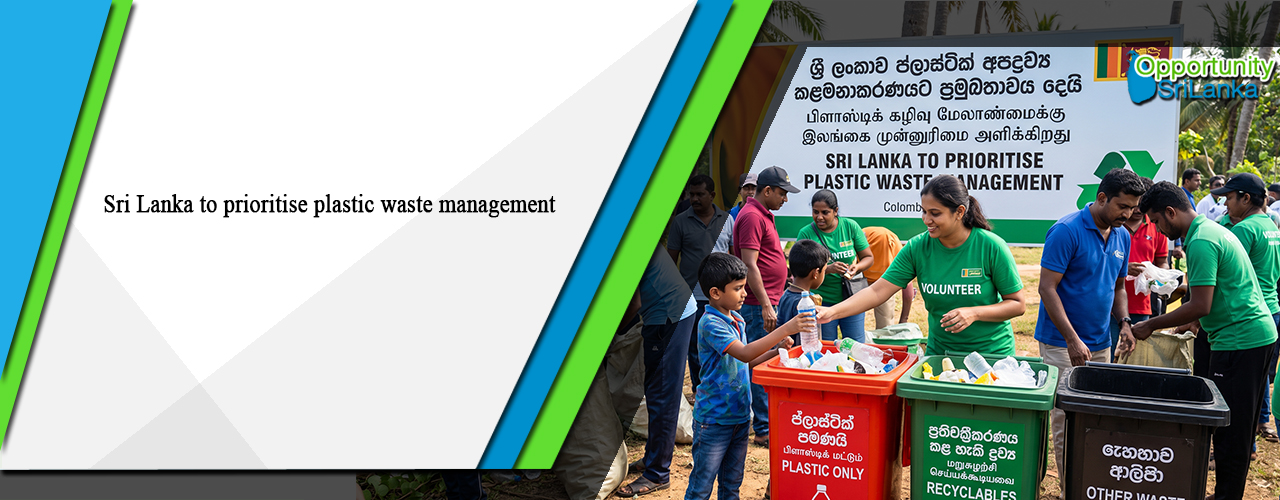
Sri Lanka to prioritise plastic waste management
The Morning: Sri Lanka is set to make waste management, plastic reduction, and recycling a top priority in the 2027 Budget as the country steps up efforts to address plastic pollution and protect its environment and natural resources, Prime Minister, Harini Amarasuriya said.
Speaking at the 3rd International Conference on Plastics, Innovation and Environmental Sustainability (ICPIES) 2026 held on 30 September Amarasuriya said: “To build a thriving nation, we have to understand that no economic progress or development is meaningful if it comes at the expense of our environment and natural resources. We are focusing on waste management, reduction and recycling as a top priority in our budget for 2027. Plastic use has become a significant contributor to the climate crisis as well. Precisely, to address environmental changes, the Government has planned Rs 5 billion for 52 projects.”
“Also, as a part of efforts to prevent waste from reaching the sea, a World Bank-supported project has been launched worth around $ 150,000 to install floating barriers in 22 canals in Colombo,” she said.
Amarasuriya said: “Around 400 million tonnes of plastic are generated globally each year. Today, plastic pollution and the identification of microplastics for circular economy and resource recovery, environmental policy, sustainable innovations, use of Artificial Intelligence (AI), and smart monitoring systems, climate change adaptation as well as community participation and environmental education have all become interconnected and essential areas of concern.”
According to the United Nations Development Programme (UNDP), Sri Lanka generates roughly 250,000 metric tonnes of municipal plastic waste annually, of which only about 11% is recycled. Sri Lanka has also introduced a range of measures under the National Environmental Act to address plastic pollution.
Meanwhile, Open University of Sri Lanka Vice Chancellor Prof P M C Thilakerathne said “Plastics have made a significant contribution to medicine, food security, transport and affordability. The challenge is not to reject this material, but to transform the way we design, produce, use and recover it. This is why innovation lies in the heart of this theme. It requires materials innovation, bio-based and biodegradable polymers. Polymers are designed for recycling and substitutes drawn from renewable resources.”
“Sri Lanka’s natural resources including natural rubber, coconut, fiber and agricultural residues offer genuine opportunities, provided that new materials are rigorously assessed so that we do not replace one problem with another. It requires processed and recycling innovation, advances in mechanical recycling, automated sorting and waste-to-resource technologies that turn waste from liability into a raw material,” Prof Thilakerathne said.
He said: “Therefore it requires design innovation because much of the waste problem is decided at the drawing board. Eco-design, standardised materials, reusable packaging and products designed for disassembly can prevent waste before it is created.”
Prof. Thilakerathne added: “It requires social, digital and business innovation, data systems that track materials across supply chains and business models built on reuse, refill and repair that can reduce dependence on single-use plastics, while creating new enterprises and green jobs, policy and the circular economy.”
He further said: “However, technology alone will not deliver without enabling policy. The transition from a linear model of take, make, and dispose to a circular economy calls for coherent instruments including extended producer responsibility, clear standards and labelling, incentives, recycled content, targeted restrictions, and problematic single-use items, and sustained investment in collection and recovery infrastructure.”
“Sri Lanka has taken many meaningful measures in this direction including restrictions on thin polythene, lunch sheets and a range of single-use plastic items. At international level following the 2022 United Nations Environment Assembly resolution, nations have been negotiating a legally binding global instrument to end plastic pollution,” Prof Thilakerathne noted.
OSL take:
Sri Lanka’s growing focus on environmental sustainability is creating investment opportunities for foreign businesses/investors in waste management, recycling, green manufacturing and circular economy technologies, as the country seeks to expand its economy and establish itself as a regional hub. Prime Minister Amarasuriya has identified waste management, plastic reduction and recycling as priorities in the 2027 Budget. The Government has also allocated Rs. 5 billion for 52 environmental projects, signalling potential demand for innovative technologies, infrastructure and private sector partnerships. Sri Lanka generates approximately 250,000 metric tonnes of municipal plastic waste annually, with only around 11% recycled, according to the UNDP. This creates business/investment opportunities for international companies specialising in recycling plants, automated waste sorting, plastic recovery and waste-to-resource technologies. Foreign businesses/investors could also explore manufacturing biodegradable packaging, reusable products and sustainable materials. Sri Lanka’s natural rubber, coconut fibre and agricultural residues offer potential for developing environmentally friendly alternatives for domestic consumption and export markets. Further opportunities exist in wastewater treatment, renewable energy, smart waste collection, environmental monitoring and artificial intelligence-based resource management. Technology transfer and public-private partnerships (PPPs) could accelerate the development of these emerging industries. Sri Lanka’s strategic location along major Indian Ocean shipping routes could support ambitions to become a regional centre for green manufacturing, sustainable materials and environmental technology services, serving South Asian and international markets. Realising this potential will require predictable regulations, reliable waste collection systems, adequate infrastructure and commercially viable recycling operations. For foreign businesses/investors, Sri Lanka’s green transition offers opportunities to introduce advanced technologies, establish export-oriented businesses and develop local supply chains. With appropriate policy support, these investments could diversify the economy, generate employment and strengthen Sri Lanka’s position in the expanding regional green economy.
| Article Code : | VBS/AT/20261013Z_3 |