
Sri Lanka targets FDI with new agency and 200-pct tax write-off
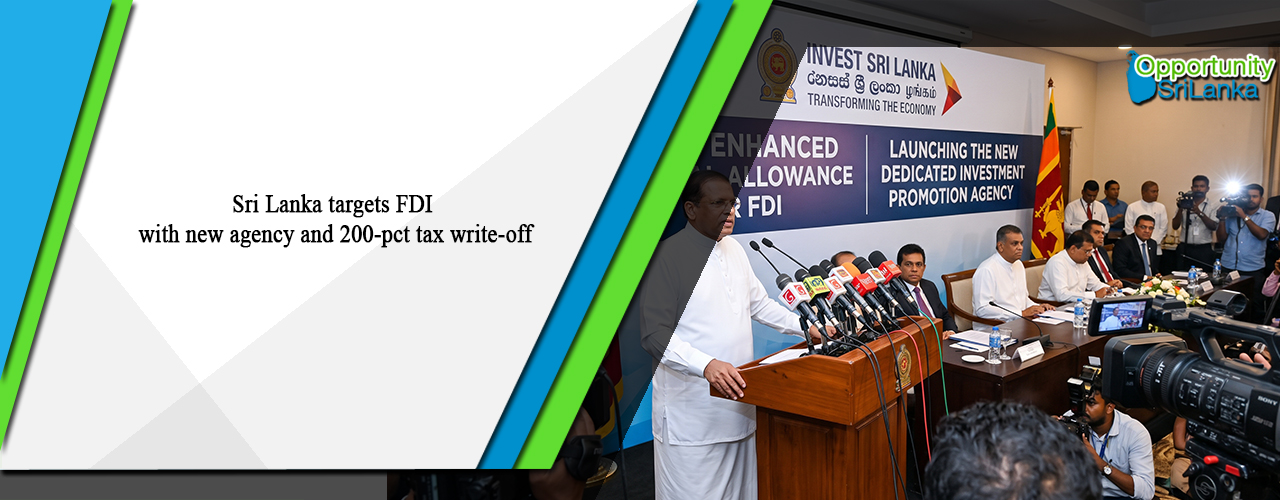
EconomyNext: Sri Lanka will set up a new state-owned investment promotion agency run by the private sector and international professionals, enact two key investment laws, and overhaul capital allowances and capital gains taxes to attract private capital, President Anura Kumara Dissanayake said.
Presenting the 2027 budget to parliament, Dissanayake said the proposed investment agency will be a 100-percent Treasury-owned company offering market-aligned salaries and allowances, following the model used to establish GovTech.
A cabinet committee will speed up state land allocation and recommend concessions based on national importance, job creation, and regional location.
“Some of our laws are over 100 years old, and the roles of some institutions have ended. They have become shackles preventing economic transformation,” Dissanayake said.
New Investment and Residency Laws
To replace outdated rules, the government is advancing two investment laws. The Investment Protection Bill has been referred to the Attorney General for clearance to safeguard investor assets, guarantee fair and equal treatment, and provide clear rules for compensation and dispute resolution.
Meanwhile, a gazetted Public-Private Partnership bill will be tabled in parliament in early 2027 to develop and manage joint projects.
Authorities have also initiated laws to grant permanent residency to qualifying investors, alongside upcoming customs and labour law reforms.
“Every investment made by the government and every tax concession granted will be evaluated on the economic and social benefits they generate,” Dissanayake said.
200-Percent Enhanced Capital Allowance
From April 1, 2027, Board of Investment-approved enterprises investing at least 3 million dollars in export-oriented manufacturing or tourism development will have the option to claim a 200 percent enhanced capital allowance on qualifying capital expenditure.
To qualify, investments must be completed within three years for manufacturing and non-hotel tourism projects, and within five years for hotels.
Enterprises opting for this incentive will not be permitted to claim existing capital allowances under the Fourth Schedule or enhanced capital allowances under the Second Schedule of the Inland Revenue Act.
Unlike existing Second Schedule concessions, which are tied to depreciable assets and the geographic location of the investment, the proposed allowance will apply strictly to qualifying capital expenditure within the stipulated time frame, without any location-based distinction.
Capital Gains Tax Expanded to Crypto, Licences, and Gems
The government will also broaden the tax base effective April 1, 2027, by amending Section 195 of the Inland Revenue Act to expand the definition of a “capital asset” and bring new asset classes under the scope of Capital Gains Tax (CGT).
Under the proposal, CGT will apply to:
· Digital and virtual assets, including cryptocurrencies.
· Commercially valuable licences and rights, including telecommunications and broadcasting licences.
· Gems, jewellery, precious metals, and other valuable movable assets exceeding a prescribed monetary threshold.
VAT Amendments, Data Centres, and Capital Markets
To ease cash flow for new exporters, the definition of an “eligible exporter” will be amended to recognise newly value-added tax-registered persons whose exports exceed 80 percent of turnover in the preceding six months, removing the current one-year waiting period.
For foreign-currency supplies, businesses will be required to apply the central bank’s indicative exchange rate for VAT conversion, as specified by the Commissioner General of Inland Revenue.
The government will also offer power tariff concessions for data centres and clarify tax rules to protect legitimate refunds and input tax credits.
To deepen capital markets, the Treasury allocated 500 million rupees alongside 250 million rupees from the Colombo Stock Exchange to support small business listings and grant selected 18-year-old students 10,000-rupee share portfolios.
OSL take:
Sri Lanka is stepping up efforts to attract foreign investment, with a package of institutional, legal and tax reforms aimed at creating a more competitive business environment and unlocking opportunities across the economy. Presenting the 2027 Budget, President Dissanayake announced plans to establish a new state-owned investment promotion agency managed by private-sector and international professionals, alongside two new investment laws and reforms to capital allowances and capital gains taxation. The proposed agency, fully owned by the Treasury but operating with market-aligned salaries, is expected to strengthen investment facilitation and improve the country’s ability to attract international capital. The Sri Lankan Government also plans to accelerate the allocation of state land for investment projects, with concessions determined by factors including national importance, employment generation and regional development. These reforms could open business/investment opportunities for foreign businesses/investors across manufacturing, renewable energy, tourism, logistics, ports, infrastructure, information technology, financial services and export-oriented industries. Sri Lanka’s strategic location in the Indian Ocean, access to regional markets, skilled workforce and established trade links offer additional advantages for international businesses seeking regional expansion. The proposed changes signal a broader effort to move beyond traditional investment promotion towards a more investor-oriented economic framework.