
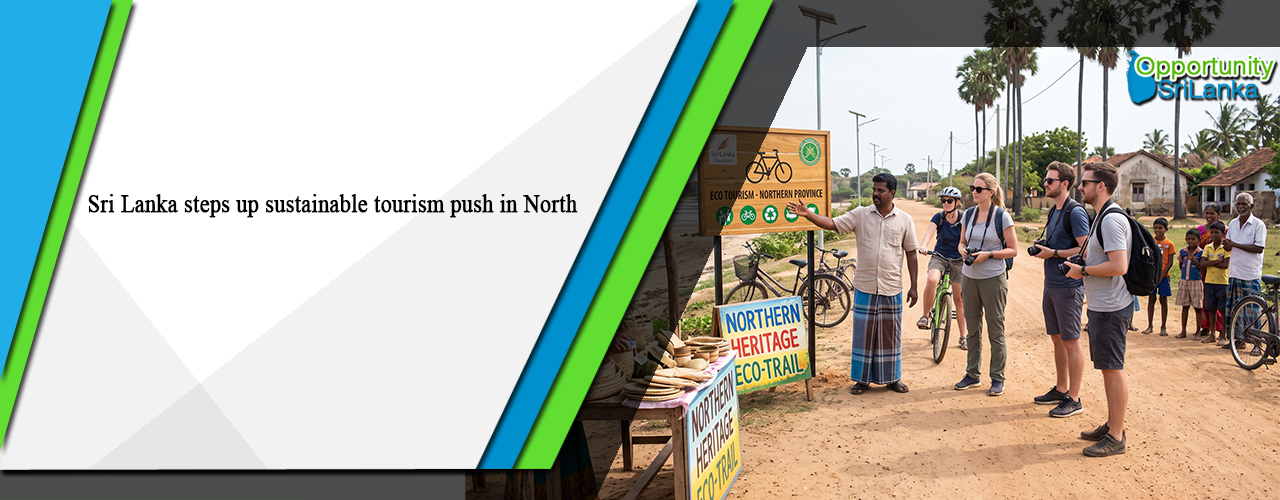
Sri Lanka steps up sustainable tourism push in North
The Morning: Sri Lanka is stepping up sustainable tourism development in the Northern Province, with Kokilai Puliyamunai village considered as a sustainable tourism village, to promote authentic tourism experiences, Deputy Minister of Tourism Ruwan Ranasinghe said in Parliament on 8 October.
Ranasinghe said: “The Sri Lanka Tourism Development Authority (SLTDA) has considered the Kokkilai Palamunai village in the Northern Province as a vibrant sustainable tourism village, providing support for community-based organisations, small-scale infrastructure development, livelihoods and skills-building programmes, local heritage tourism products and authentic tourism experiences.”
“The Northern Province’s tourism plan focuses on the tourism potential, infrastructure requirements, development opportunities and safeguarding local culture and ecosystems within the district, ensuring the participation of local communities and protecting their aspirations,” Ranasinghe said.
Meanwhile, Batticaloa District Member of Parliament Shanakiyan Rasamanickam highlighted the importance of respecting the linguistic and cultural identity of the Northern and Eastern Provinces.
“Star-class hotels in these regions had traditionally welcomed visitors with the Tamil greeting ‘Vanakkam’, but that this practice had increasingly been replaced by the Sinhala greeting ‘Ayubowan’,” Rasamanickam said.
He stressed that respecting the distinctive languages and cultural traditions of different regions was an important part of responsible tourism development.
“Therefore, this plan provides the strategic guidance necessary to prioritise and implement tourism development projects across the Northern Province,” Ranasinghe said.
The Government has also allocated funds for tourism development, including improving access to local ecotourism sites.
Ranasinghe said: “The Ministry incurred an expenditure of Rs 424 million on 46 projects in 2025 and has allocated Rs 930 million for 2026 for the development of the tourism sector, including improvement of access to local eco-tourism sites.”
“Accordingly, the development projects aimed at improving access to ecotourism sites in the Northern Province were implemented in 2025 and scheduled for implementation in 2026 through district secretariats and the local government institutions,” he said.
Rasamanickam also stressed that tourism development should provide meaningful opportunities for ordinary residents and small and medium-sized enterprises rather than concentrating benefits among major investors.
Rasamanickam further emphasised that tourism development must generate employment, support local suppliers and encourage community-based enterprises and that such projects must be properly planned and designed to generate direct economic benefits for local residents.
Ranasinghe further added: “The SLTDA collaborates with industry stakeholders and state agencies to raise awareness among tourism service providers regarding the standards and quality requirements necessary for establishing, registering and operating tourism enterprises, while also offering them technical guidance and support.”
“Accordingly, SLTDA has agreed to establish five such centres and is seeking a suitable location in the Vavuniya District, representing the Northern Province,” Ranasinghe noted.
OSL take:
Sri Lanka’s expanding tourism industry is creating new business/investment opportunities beyond traditional destinations, with the Sri Lankan Government promoting regional tourism hubs that showcase the country’s cultural diversity, natural attractions and community-based experiences. The Northern Province is emerging as a potential growth area, with the SLTDA considering Kokkilai Palamunai village for sustainable tourism development. The initiative aims to support community-based organisations, small-scale infrastructure, local livelihoods, skills development and heritage tourism products. The Sri Lankan Government’s investment is also supporting regional tourism infrastructure. The Tourism Ministry spent Rs. 424 million on 46 projects in 2025 and allocated Rs. 930 million for 2026, including improvements to access and infrastructure serving local ecotourism sites. For foreign businesses/investors, expansion beyond established destinations such as Colombo, Galle and the southern coast presents business/investment opportunities in boutique hotels, eco-lodges, wellness retreats, cultural tourism, adventure travel and community-based accommodation. The Northern and Eastern provinces offer potential for tourism products built around coastal landscapes, wildlife, heritage sites and distinctive local traditions. Investment opportunities also extend to transport services, destination management, digital booking platforms, hospitality training and sustainable tourism infrastructure. Partnerships with local entrepreneurs and communities could help international operators develop authentic experiences while generating employment and supporting regional economies. Sri Lanka seeks to diversify its tourism offering and distribute economic benefits across the country, while developing emerging regional destinations.
| Article Code : | VBS/AT/20261014Z_3 |