
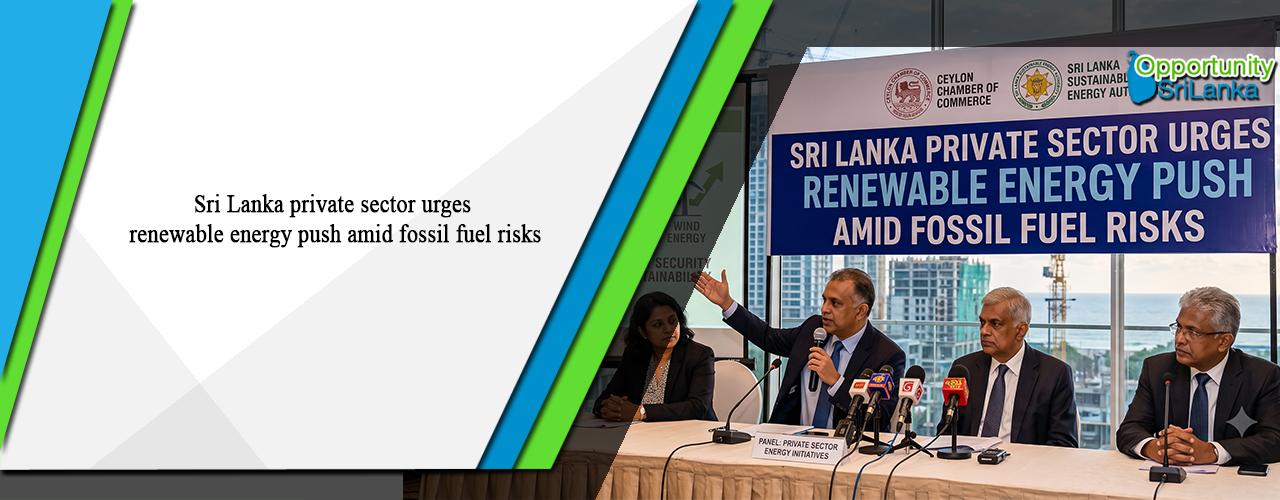
Sri Lanka private sector urges renewable energy push amid fossil fuel risks
EconomyNext: Sri Lanka’s private sector has pointed out the growing need for renewable energy in meeting rising electricity demand while reducing dependence on imported fossil fuels, even as tensions around the strait of Hormuz ratcheted up.
The Ceylon Chamber of Commerce recently convened “Energy Transition in Sri Lanka: Strategic Insights from Global Markets,” bringing together stakeholders from government, industry, academia, and the energy sector to discuss the policies, investments, and reforms needed to accelerate Sri Lanka’s transition towards a more secure, affordable, and sustainable energy system.
“The discussion focused on the growing role of renewable energy in meeting Sri Lanka’s rising electricity demand while reducing dependence on imported fossil fuels,” the chamber said.
Solar energy was identified as a priority area for expansion, with participants highlighting the importance of purchase tariffs, procurement mechanisms, and distributed renewable energy development to encourage private investment, strengthen grid stability, and reduce transmission losses.
Participants also examined the barriers that continue to slow renewable energy deployment, including policy inconsistency, lengthy approval processes, land acquisition challenges, grid constraints, and delays in project implementation.
The need for a stable and predictable policy environment, streamlined regulatory processes, and stronger institutional coordination was identified as essential to improve investor confidence and accelerate project delivery.
The dialogue explored the role of procurement frameworks, financing mechanisms, and electricity sector reforms in supporting future investment.
Net metering and feed-in arrangements were recognised as important tools to encourage commercial and industrial users to adopt solar power by enabling them to sell surplus electricity back to the grid.
Participants also stressed the importance of improving access to financing, developing more bankable project structures, and addressing financial sustainability issues, including timely payments to renewable energy developers.
Energy storage systems emerged as a key area of discussion, with participants highlighting their importance in supporting greater renewable energy integration, improving grid stability, and enhancing system flexibility.
Global experiences in deploying solar-plus-storage solutions were examined, alongside the need for clear technical standards, safety frameworks, financing mechanisms, and market structures to support the adoption of energy storage technologies in Sri Lanka.
The discussion also considered the wider economic implications of the energy transition.
With electricity demand expected to increase alongside digitalisation, artificial intelligence, electric vehicles, and data centres, participants emphasised the need to modernise the country’s energy infrastructure through intelligent grids and emerging technologies to support long-term economic competitiveness.
Human capital development was another important theme, with participants calling for closer collaboration between industry and academia, expanded technical training opportunities, and stronger local expertise in renewable energy and energy storage technologies to support the sector’s continued growth.
The dialogue concluded by emphasising that achieving Sri Lanka’s renewable energy ambitions will require coordinated action across policy, regulation, financing, and infrastructure development.
OSL take:
Sri Lanka’s accelerating transition towards renewable energy is creating one of the country’s most attractive business/investment opportunities, with growing demand for clean power driving expansion across the sector. Backed by the Sri Lankan government’s targets to increase the share of renewable energy in the national electricity mix, the industry is witnessing rising investments in utility-scale solar and wind projects, rooftop solar, battery energy storage, transmission infrastructure, and emerging clean energy technologies. As electricity demand continues to grow and the country seeks to reduce its dependence on imported fossil fuels, renewable energy has become a strategic priority for both policymakers and the private sector. Businesses already operating in Sri Lanka’s renewable energy industry have continued to expand their portfolios, supported by improving market conditions and increasing demand for sustainable energy solutions. This momentum presents significant business/investment opportunities for foreign businesses/investors, project developers, equipment manufacturers, technology providers, engineering firms, and infrastructure financiers looking to participate in the country’s long-term energy transition. With ongoing economic reforms, a stronger investment climate, and increasing collaboration between the government and private sector, Sri Lanka is positioning itself as an attractive destination for international capital seeking sustainable, long-term returns in South Asia’s growing clean energy market.
| Article Code : | VBS/AT/20260804Z_3 |