
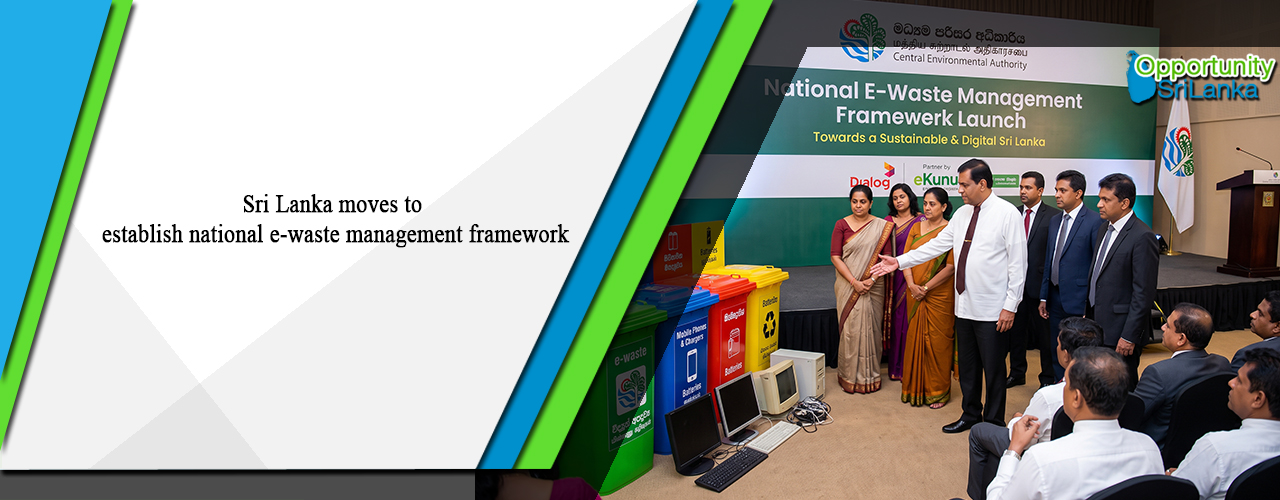
Sri Lanka moves to establish national e-waste management framework
The Morning: Sri Lanka is moving to establish a formal national mechanism for electronic waste (e-waste) management, bringing together government institutions, regulators and private-sector stakeholders to strengthen e-waste collection and recycling. The initiative was discussed at a meeting chaired by Deputy Minister of Environment Anton Jayakody at the Ministry’s premises on Monday (12) according to the Department of Government Information (DGI).
According to the DGI, the discussion emphasised the need to establish a formal mechanism integrating all public, private, and regulatory institutions for electrical and electronic waste (e-waste) management, ahead of International E-Waste Day on 14 October.
To manage e-waste effectively, the Ministry of Environment has taken steps to implement provisions on Extended Producer Responsibility (EPR), which are to be introduced into the National Environmental Act, further strengthening the policy and legal framework, according to the DGI.
These efforts are being initiated alongside the proposed National Policy on Electrical and Electronic Waste Management, which is awaiting approval, the DGI stated.
The DGI stated that the initiative is expected to involve importers, manufacturers, distributors, telecommunications companies, repairers, and registered recycling institutions through innovation, research, and scientific recycling methods, contributing to a green economy and a digital Sri Lanka.
The DGI further stated that an islandwide e-waste collection programme implemented by the Central Environmental Authority (CEA) in collaboration with Dialog Axiata commenced in August, enabling consumers and organisations to dispose of unwanted electronic equipment through telecommunications service centres and designated collection centres.
The Ministry also noted that achieving the ‘Net Zero Carbon’ target by 2050 is a primary goal of the Government. Although the increased use of digital devices poses an environmental challenge, responsible collection, reuse, and scientific recycling offer opportunities to create sustainable economic value while protecting the environment.
OSL take:
Sri Lanka’s efforts to establish a national e-waste management framework are creating potential business and investment opportunities for foreign companies/investors in recycling, environmental technology and the wider circular economy. The Ministry of Environment is working towards a formal mechanism bringing together government institutions, regulators and private-sector stakeholders to improve the collection and recycling of discarded electrical and electronic equipment. Proposed provisions on Extended Producer Responsibility (EPR) under the National Environmental Act could further strengthen the regulatory framework by increasing manufacturers’ and importers’ responsibility for managing waste generated by their products. These developments could open business/investment opportunities for foreign businesses specialising in advanced recycling technologies, electronic waste processing, resource recovery and environmentally sound disposal. Companies could also collaborate with local recyclers, telecommunications operators, electronics importers and manufacturers to establish collection networks and modern recycling facilities. E-waste contains recoverable materials, including copper, aluminium and valuable metals, creating opportunities for resource recovery and reuse. Businesses could also develop electronic equipment repair, refurbishment and resale services, extending product lifespans while reducing waste. Sri Lanka’s expanding digital economy and increasing use of electronic devices could support demand for responsible disposal and recycling services. An islandwide collection programme implemented by the CEA with Dialog Axiata illustrates the potential of public-private cooperation in developing the sector. Beyond e-waste, foreign investors could explore renewable energy, sustainable packaging, industrial recycling and waste-to-resource technologies. For foreign investors, partnerships with local businesses offer a route into this emerging market while supporting Sri Lanka’s transition towards a circular economy, sustainable resource management and environmentally responsible economic growth.
| Article Code : | VBS/AT/20261021Z_4 |