
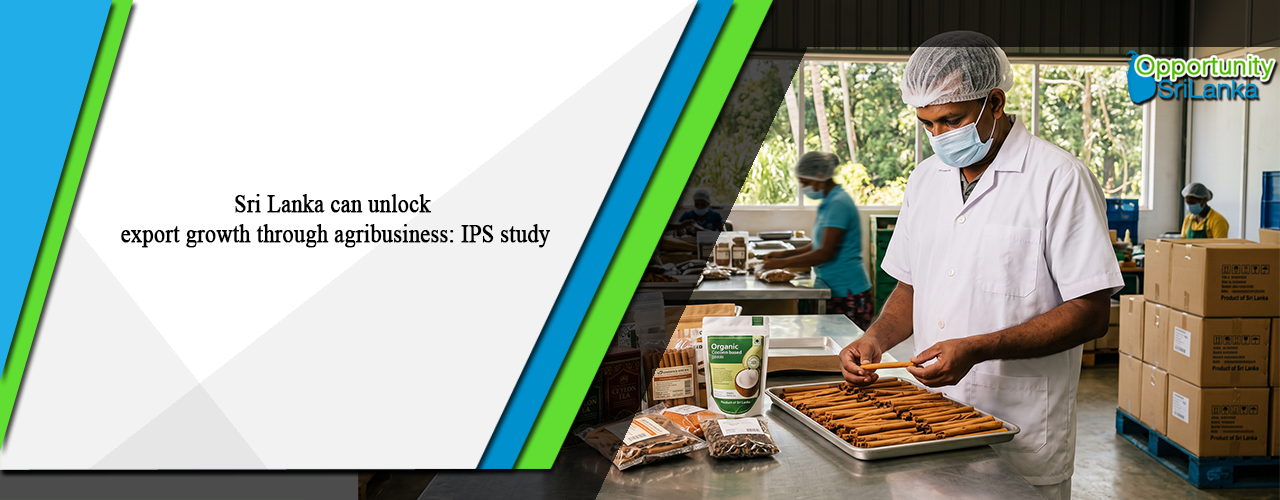
Sri Lanka can unlock export growth through agribusiness: IPS study
EconomyNext: A study by the Institute of Policy Studies of Sri Lanka (IPS) identifies opportunities to drive export growth through high-value agriculture and agro-processing.
The study finds that while primary agriculture accounts for 8.3% of Gross Domestic Product (GDP), the broader agrifood sector contributes 24.5% of GDP and 42.0% of total employment, underscoring its importance for economic growth and job creation.
Conducted as part of the Country Growth and Jobs Report of the World Bank, the study finds that the sector’s growth potential is constrained by complex tariff structures, policy uncertainty, low investment in agricultural research and development, and inadequate support for value-added production.
It recommends strengthening high-value, export-oriented agribusiness to enhance Sri Lanka’s export competitiveness, create higher-productivity employment, and support long-term economic development.
The study authored by IPS Research Fellow Asanka Wijesinghe shows that food and beverage manufacturing offers considerable potential for economic transformation.
“Developing food processing based on agricultural commodities offers a direct pathway from agriculture to industry. Agriculture supplies 38% of food processing inputs, while food processing sources 19% of its inputs from domestic agriculture. Strengthening agricultural productivity and expanding processing are therefore critical to sustaining growth,” Wijesinghe said.
An input-output analysis reveals that every USD 1 of final demand for food and beverage manufacturing generates USD 1.85 in total economic output, compared to USD 1.20 for primary agriculture.
The research also identifies six export clusters with strong growth potential; namely, cinnamon, other spices such as pepper and vanilla, coconut-based products, fruit and vegetable processing, seafood, and tea.
Coconut-related exports exceeded USD 1 billion in 2025, while fruit and vegetable processing exports grew by 302% over the past decade. Seafood exports have also recorded strong growth, supported by preferential market access under the Generalised Scheme of Preferences Plus (GSP+).
Download the publication via the IPS website: https://www.ips.lk/high-value-and-export-oriented-agribusiness-unlocking-agri-food-sector-potential-in-sri-lanka/
OSL take:
Sri Lanka’s large agrifood sector presents significant business/investment opportunities for foreign businesses and investors seeking exposure to agriculture, food manufacturing and export-oriented industries. While primary agriculture contributes 8.3% of GDP, the broader agrifood sector accounts for 24.5% of GDP and 42% of total employment, highlighting its importance to the economy. The latest IPS study identifies high-value agriculture and agro-processing as areas with strong potential for export-led growth. Business/investment opportunities extend beyond primary production to food processing, packaging, cold-chain logistics, agricultural technology, storage, quality certification and the development of value-added food products for international markets. Food and beverage manufacturing is particularly relevant, as stronger links between domestic agriculture and processing could help Sri Lanka shift from exporting relatively low-value commodities towards higher-value products. This creates potential for foreign companies to establish processing facilities, enter joint ventures with local producers, introduce technology and develop export supply chains. Business/investment opportunities could also emerge in precision agriculture, climate-resilient farming, research and development, irrigation and post-harvest technologies, helping improve productivity while meeting increasingly demanding international sustainability and quality standards. For international investors, Sri Lanka’s established agricultural base, diverse production and proximity to major South Asian and Indian Ocean markets provide a platform for developing export-oriented agribusiness and food manufacturing.
| Article Code : | VBS/AT/20261007Z_1 |