
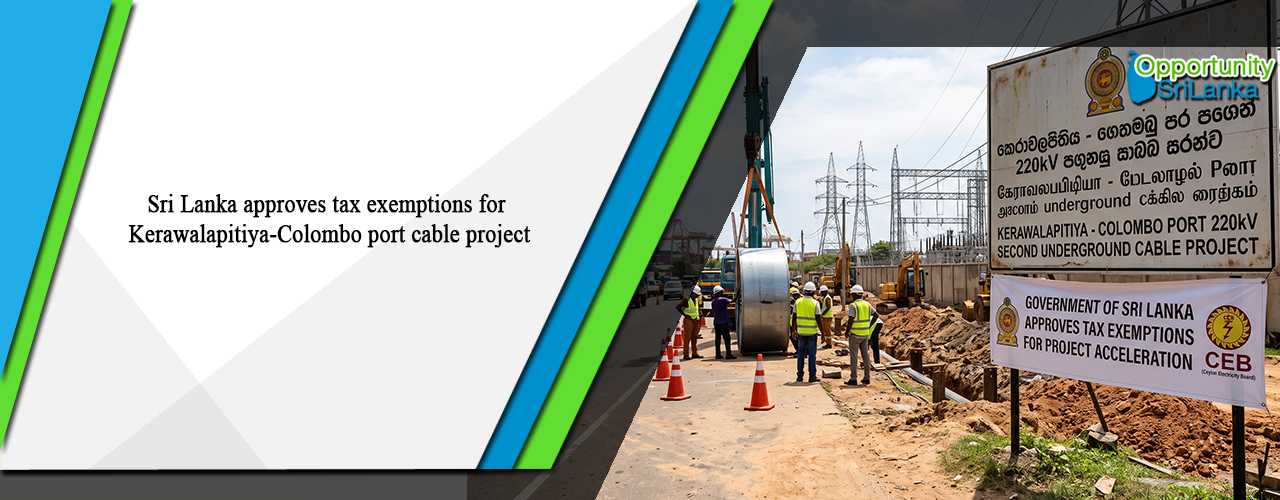
Sri Lanka approves tax exemptions for Kerawalapitiya-Colombo port cable project
EconomyNext: Sri Lanka’s cabinet has approved a proposal to declare the second 220kV Kerawalapitiya–Colombo Port underground cable project as a ‘Special Project’ under the Value Added Tax Act, granting it relief from major taxes and import duties.
Under the provisions of the Value Added Tax Act No. 14 of 2002, the new status exempts the project from value added tax (VAT), customs import duties, and other related statutory charges and levies.
“Designating the transmission link as a Special Project is necessary to secure vital exemptions from Value Added Tax, customs duties, and other levies for this strategically important project,” minister Nalinda Jayatissa said.
The underground power connection was initially approved by a cabinet on September 13, 2021.
Funding for the high-voltage transmission venture is provided by the Asian Infrastructure Investment Bank (AIIB).
The contract was originally awarded by the then Ceylon Electricity Board (CEB) to a joint consortium formed by China’s M/s Jiangsu ETERN Co. Ltd. and South Korea’s LS Cable & System Limited.
The venture has since been handed over to the National Transmission Network Service Provider (Private) Limited, a successor company established out of the Ceylon Electricity Board.
The tax waivers will allow the state-owned successor company and its international contractors to carry out the transmission work without added duty and levy costs.
OSL take:
Sri Lanka’s infrastructure development programme is creating business/investment opportunities for foreign businesses/investors in the energy sector, particularly in electricity transmission, renewable energy, grid modernisation and energy storage. The Cabinet’s approval to designate the second 220kV Kerawalapitiya–Colombo Port underground cable project as a ‘Special Project’ highlights the tax incentives available for strategically important infrastructure. The designation provides exemptions from VAT, customs import duties and other related statutory charges and levies, reducing the tax burden associated with implementation. For international businesses, such projects offer potential entry points through engineering, procurement and construction contracts, equipment supply, technology partnerships and project financing. Business/investment opportunities are also emerging in solar and wind power, battery energy storage systems, smart-grid technologies and energy efficiency as Sri Lanka seeks to strengthen electricity supply and integrate more renewable energy into its national grid. Tax concessions for designated projects can improve investment economics, while development-finance institutions offer potential funding channels for eligible infrastructure ventures. Foreign investors can also explore partnerships with local companies and participation in government-led development initiatives. As Sri Lanka modernises its electricity infrastructure, foreign companies offering capital, advanced technology and technical expertise have opportunities to participate in the country’s long-term energy development.
| Article Code : | VBS/AT/20261014Z_2 |