
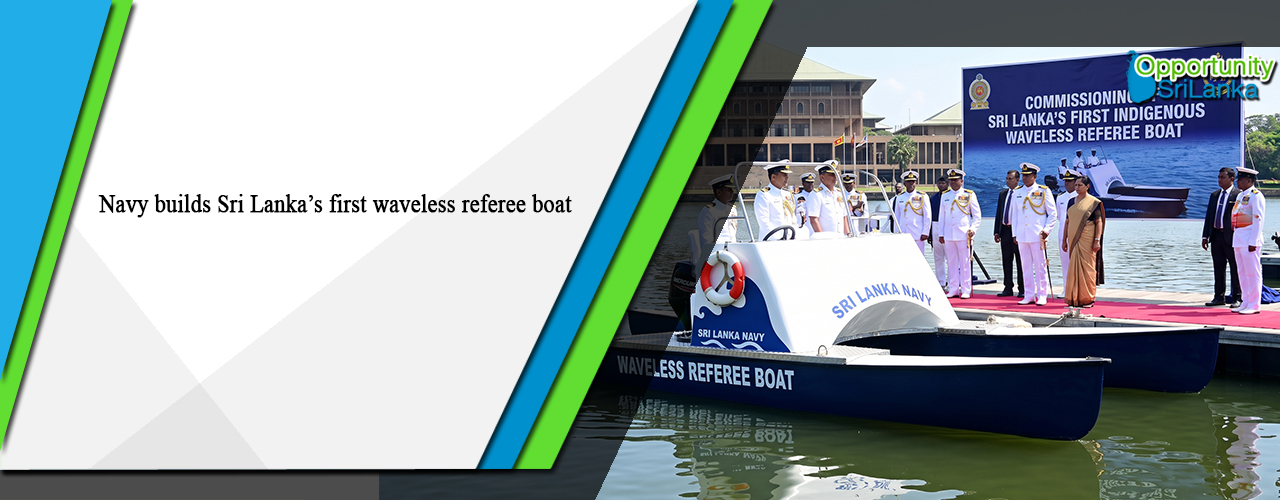
Navy builds Sri Lanka’s first waveless referee boat
Daily Mirror: The Sri Lanka Navy has designed and built the country’s first waveless referee boat for rowing and canoeing competitions at the Navy Water Sports Centre in Diyawanna, Battaramulla.
The Naval Boat Building Yard (NBBY) constructed the boat and delivered it to the centre in April 2026. The locally built catamaran is now in operational use during water sports events.
The project is part of the Navy’s Strategic Plan 2030, known as NAVSTRAT-2030, which focuses on self-reliance, technological development and strengthening local engineering capabilities.
Designed and approved by the Directorate of Naval Design in accordance with naval engineering standards, the vessel successfully completed performance trials before being deployed.
The high-stability catamaran has been specifically designed to minimise wake generation while operating alongside competitors. This is important in rowing events, where surface waves can affect athletes’ safety, timing and the fairness of races.
The vessel, bearing hull number NC/WL/001, is 5.53 metres long and 2.30 metres wide, with a draft of 0.16 metres and a total weight of 0.45 tonnes. It is powered by a 25-horsepower petrol outboard engine and can accommodate up to two people.
OSL take:
Sri Lanka’s ambition to position itself as a regional maritime hub is creating business/investment opportunities for foreign investors and businesses in boat building, marine engineering, vessel maintenance and other specialised maritime services. The country’s strategic location along major Indian Ocean shipping routes, combined with an established boat-building industry and a skilled workforce, provides a foundation for expanding both domestic production and exports. Sri Lanka Navy’s recent development of the country’s first locally built waveless referee boat for rowing and canoeing competitions highlights the growing technical capabilities within the local maritime sector. Built by the Navy’s Naval Boat Building Yard, the catamaran was designed to minimise wake generation while maintaining stability alongside competing boats. Beyond conventional boat manufacturing, investment opportunities are emerging in specialised vessel design, marine propulsion, navigation systems, composite materials, ship repair and maintenance, and the production of commercial, leisure, fishing and offshore vessels. The Sri Lankan Government has also identified shipbuilding and ship repair as potential activities within a proposed shipping-related industrial zone at Hambantota Port, reflecting its broader strategy to develop maritime-linked industries. For foreign companies, partnerships with Sri Lankan boat builders could provide opportunities for technology transfer, joint ventures and access to regional markets. Increased investment could also help local manufacturers move into higher-value vessel production and strengthen Sri Lanka’s position as a maritime services and manufacturing centre in the Indian Ocean.
| Article Code : | VBS/AT/20261005Z_1 |