
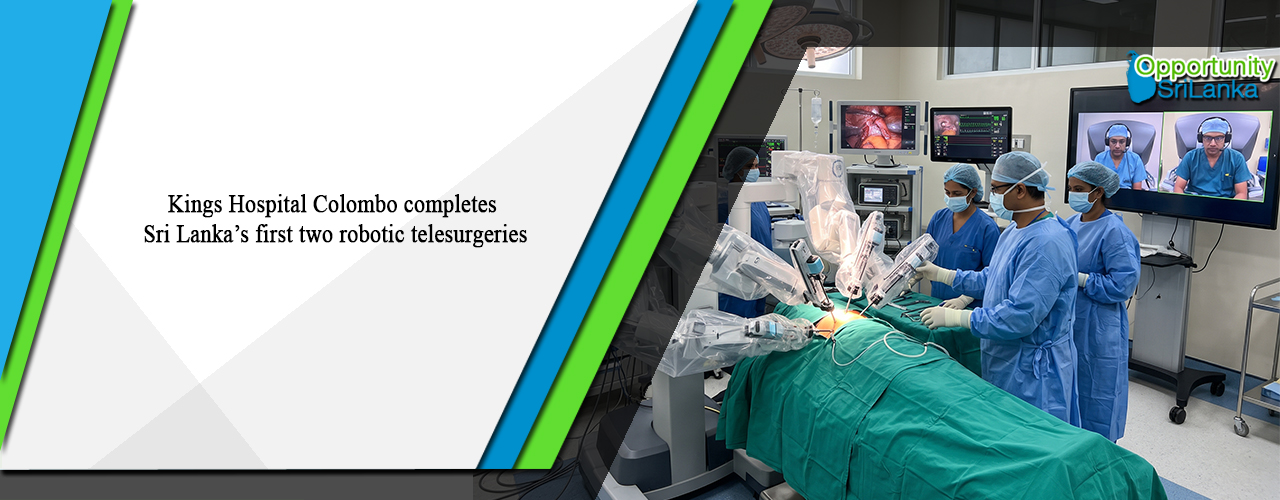
Kings Hospital Colombo completes Sri Lanka’s first two robotic telesurgeries
The Morning: Two patients at Kings Hospital Colombo underwent surgery today while their surgeons operated remotely from New Delhi more than 3000 km away marking Sri Lanka’s first two robotic telesurgeries.
Prof. Srinath Chandrasekera and Prof. Bawantha Gamage performed the procedures using a robotic surgical system linked across borders through high-speed communication networks. The achievement places Sri Lanka among a select group of nations that have demonstrated cross-border robotic telesurgery. Specialist surgeons were present alongside the patients in Colombo throughout both operations, ready to intervene immediately if any clinical or technical difficulty arose.
Both procedures were completed remotely without requiring intervention by the on-site surgeons, underscoring the importance of combining advanced technology with on-site surgical support.
Beyond the technological milestone, the development points to a potentially significant change in how patients in Sri Lanka could access specialist care in the future. A patient in any province who currently needs to travel to major cities for surgery could, one day in the future, receive treatment at a suitably equipped regional hospital while a specialist operates from a centre of excellence.
Similarly, expertise from overseas could become accessible without patients having to leave Sri Lanka. Robotic telesurgery allows a surgeon’s movements at a remote console to control surgical instruments beside the patient. Enhanced visualisation and precise instrument control enable surgeons to perform intricate surgical tasks across considerable distances.
The latest procedures build on Kings Hospital Colombo’s earlier completion of Sri Lanka’s first robotic cardiac surgery.
The technology also offers opportunities for surgical training and international collaboration, allowing local teams to observe and learn from specialists performing procedures remotely. Wider adoption will require reliable communication networks, appropriately equipped hospitals, trained teams and clear regulatory and safety protocols. While these first two procedures demonstrate what is possible, their broader promise lies in bringing specialist surgical expertise closer to patients wherever they live.
This is not simply a milestone for Kings Hospital Colombo. It is a milestone for Sri Lanka as proof of feasibility of future advanced surgery where distance does not have to be a barrier to specialised surgical care, and where every Sri Lankan has the opportunity to benefit from medical expertise, wherever they live.
OSL take:
Sri Lanka’s rapidly evolving healthcare sector is creating expanding business and investment opportunities for foreign companies/investors, as the country seeks to modernise medical infrastructure, introduce advanced healthcare technologies and position itself as an emerging destination for medical and wellness tourism. The recent completion of the country’s first two robotic telesurgeries at Kings Hospital Colombo highlights the growing potential for technology-driven healthcare investments. It also demonstrates business/investment opportunities for international partnerships in robotic surgery, telemedicine, digital healthcare and specialised medical services. The Sri Lankan Government’s focus on strengthening healthcare infrastructure and encouraging private-sector participation is opening opportunities across several segments, including hospital construction and management, diagnostic centres, medical equipment, pharmaceutical production and healthcare technology. Pharmaceutical manufacturing is particularly attractive to foreign businesses/investors. Sri Lanka’s pharmaceutical market was valued at approximately US$750 million in 2025, with around 85% of its requirements met through imports, creating considerable scope for local manufacturing, research and development, and technology partnerships. Meanwhile, medical and wellness tourism is emerging as another potential growth area. Sri Lanka’s established private healthcare facilities, skilled medical professionals and traditional Ayurvedic treatments provide a foundation for attracting patients from regional and international markets. Foreign businesses/investors could explore opportunities in specialised treatment centres, rehabilitation facilities, wellness resorts and international hospital partnerships. As Sri Lanka seeks to expand its healthcare sector beyond domestic service delivery, the combination of medical technology, pharmaceutical manufacturing and health tourism offers foreign businesses/investors opportunities to participate in a developing market while supporting the country’s ambition to become a regional healthcare destination.
| Article Code : | VBS/AT/20261104Z_2 |